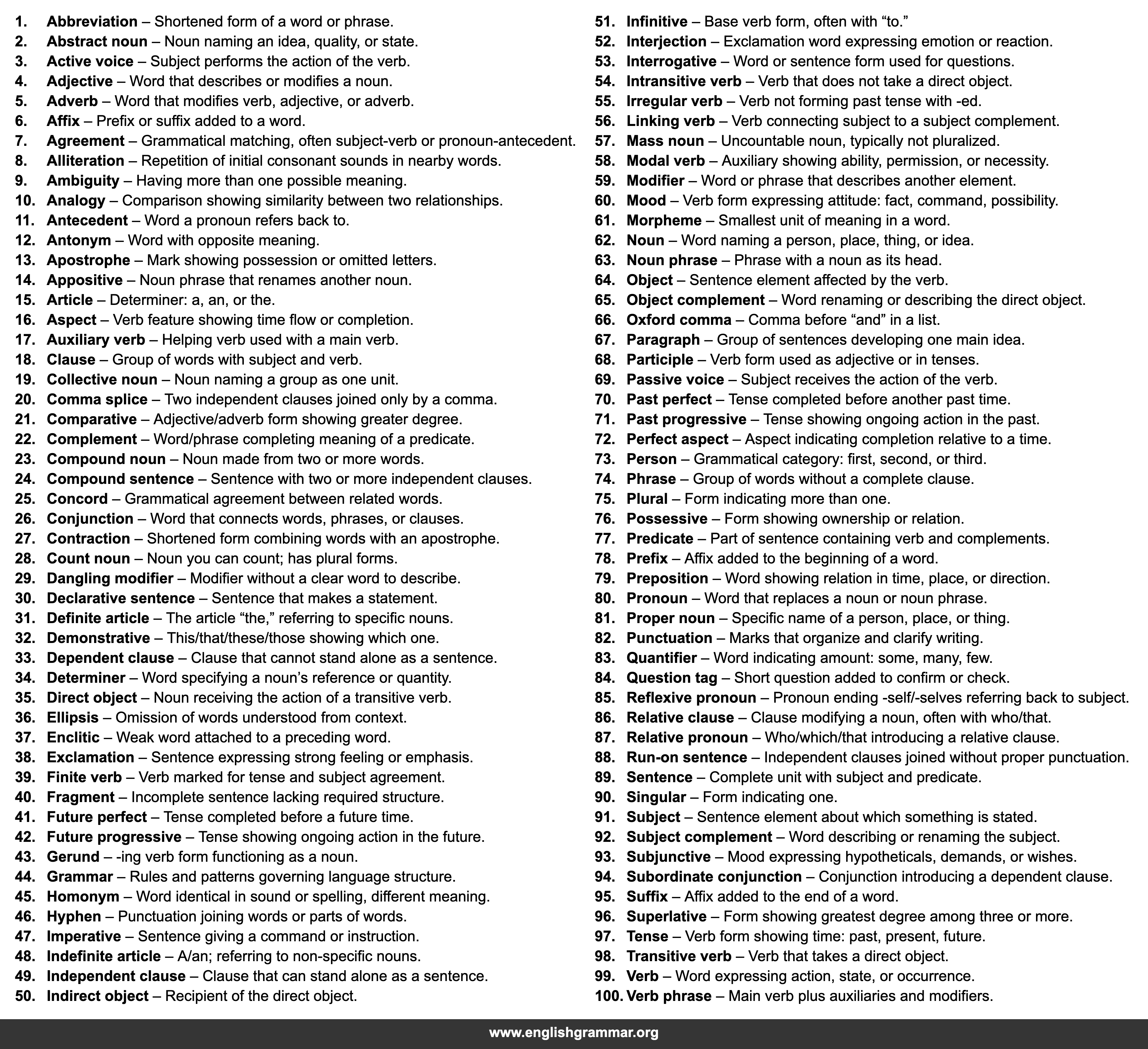
| No. | Term | Definition |
|---|---|---|
| 1. | Abbreviation | Shortened form of a word or phrase. |
| 2. | Abstract noun | Noun naming an idea, quality, or state. |
| 3. | Active voice | Subject performs the action of the verb. |
| 4. | Adjective | Word that describes or modifies a noun. |
| 5. | Adverb | Word that modifies verb, adjective, or adverb. |
| 6. | Affix | Prefix or suffix added to a word. |
| 7. | Agreement | Grammatical matching, often subject-verb or pronoun-antecedent. |
| 8. | Alliteration | Repetition of initial consonant sounds in nearby words. |
| 9. | Ambiguity | Having more than one possible meaning. |
| 10. | Analogy | Comparison showing similarity between two relationships. |
| 11. | Antecedent | Word a pronoun refers back to. |
| 12. | Antonym | Word with opposite meaning. |
| 13. | Apostrophe | Mark showing possession or omitted letters. |
| 14. | Appositive | Noun phrase that renames another noun. |
| 15. | Article | Determiner: a, an, or the. |
| 16. | Aspect | Verb feature showing time flow or completion. |
| 17. | Auxiliary verb | Helping verb used with a main verb. |
| 18. | Clause | Group of words with subject and verb. |
| 19. | Collective noun | Noun naming a group as one unit. |
| 20. | Comma splice | Two independent clauses joined only by a comma. |
| 21. | Comparative | Adjective/adverb form showing greater degree. |
| 22. | Complement | Word/phrase completing meaning of a predicate. |
| 23. | Compound noun | Noun made from two or more words. |
| 24. | Compound sentence | Sentence with two or more independent clauses. |
| 25. | Concord | Grammatical agreement between related words. |
| 26. | Conjunction | Word that connects words, phrases, or clauses. |
| 27. | Contraction | Shortened form combining words with an apostrophe. |
| 28. | Count noun | Noun you can count; has plural forms. |
| 29. | Dangling modifier | Modifier without a clear word to describe. |
| 30. | Declarative sentence | Sentence that makes a statement. |
| 31. | Definite article | The article “the,” referring to specific nouns. |
| 32. | Demonstrative | This/that/these/those showing which one. |
| 33. | Dependent clause | Clause that cannot stand alone as a sentence. |
| 34. | Determiner | Word specifying a noun’s reference or quantity. |
| 35. | Direct object | Noun receiving the action of a transitive verb. |
| 36. | Ellipsis | Omission of words understood from context. |
| 37. | Enclitic | Weak word attached to a preceding word. |
| 38. | Exclamation | Sentence expressing strong feeling or emphasis. |
| 39. | Finite verb | Verb marked for tense and subject agreement. |
| 40. | Fragment | Incomplete sentence lacking required structure. |
| 41. | Future perfect | Tense completed before a future time. |
| 42. | Future progressive | Tense showing ongoing action in the future. |
| 43. | Gerund | -ing verb form functioning as a noun. |
| 44. | Grammar | Rules and patterns governing language structure. |
| 45. | Homonym | Word identical in sound or spelling, different meaning. |
| 46. | Hyphen | Punctuation joining words or parts of words. |
| 47. | Imperative | Sentence giving a command or instruction. |
| 48. | Indefinite article | A/an; referring to non-specific nouns. |
| 49. | Independent clause | Clause that can stand alone as a sentence. |
| 50. | Indirect object | Recipient of the direct object. |
| 51. | Infinitive | Base verb form, often with “to.” |
| 52. | Interjection | Exclamation word expressing emotion or reaction. |
| 53. | Interrogative | Word or sentence form used for questions. |
| 54. | Intransitive verb | Verb that does not take a direct object. |
| 55. | Irregular verb | Verb not forming past tense with -ed. |
| 56. | Linking verb | Verb connecting subject to a subject complement. |
| 57. | Mass noun | Uncountable noun, typically not pluralized. |
| 58. | Modal verb | Auxiliary showing ability, permission, or necessity. |
| 59. | Modifier | Word or phrase that describes another element. |
| 60. | Mood | Verb form expressing attitude: fact, command, possibility. |
| 61. | Morpheme | Smallest unit of meaning in a word. |
| 62. | Noun | Word naming a person, place, thing, or idea. |
| 63. | Noun phrase | Phrase with a noun as its head. |
| 64. | Object | Sentence element affected by the verb. |
| 65. | Object complement | Word renaming or describing the direct object. |
| 66. | Oxford comma | Comma before “and” in a list. |
| 67. | Paragraph | Group of sentences developing one main idea. |
| 68. | Participle | Verb form used as adjective or in tenses. |
| 69. | Passive voice | Subject receives the action of the verb. |
| 70. | Past perfect | Tense completed before another past time. |
| 71. | Past progressive | Tense showing ongoing action in the past. |
| 72. | Perfect aspect | Aspect indicating completion relative to a time. |
| 73. | Person | Grammatical category: first, second, or third. |
| 74. | Phrase | Group of words without a complete clause. |
| 75. | Plural | Form indicating more than one. |
| 76. | Possessive | Form showing ownership or relation. |
| 77. | Predicate | Part of sentence containing verb and complements. |
| 78. | Prefix | Affix added to the beginning of a word. |
| 79. | Preposition | Word showing relation in time, place, or direction. |
| 80. | Pronoun | Word that replaces a noun or noun phrase. |
| 81. | Proper noun | Specific name of a person, place, or thing. |
| 82. | Punctuation | Marks that organize and clarify writing. |
| 83. | Quantifier | Word indicating amount: some, many, few. |
| 84. | Question tag | Short question added to confirm or check. |
| 85. | Reflexive pronoun | Pronoun ending -self/-selves referring back to subject. |
| 86. | Relative clause | Clause modifying a noun, often with who/that. |
| 87. | Relative pronoun | Who/which/that introducing a relative clause. |
| 88. | Run-on sentence | Independent clauses joined without proper punctuation. |
| 89. | Sentence | Complete unit with subject and predicate. |
| 90. | Singular | Form indicating one. |
| 91. | Subject | Sentence element about which something is stated. |
| 92. | Subject complement | Word describing or renaming the subject. |
| 93. | Subjunctive | Mood expressing hypotheticals, demands, or wishes. |
| 94. | Subordinate conjunction | Conjunction introducing a dependent clause. |
| 95. | Suffix | Affix added to the end of a word. |
| 96. | Superlative | Form showing greatest degree among three or more. |
| 97. | Tense | Verb form showing time: past, present, future. |
| 98. | Transitive verb | Verb that takes a direct object. |
| 99. | Verb | Word expressing action, state, or occurrence. |
| 100. | Verb phrase | Main verb plus auxiliaries and modifiers. |
