| No. | Term | Definition |
|---|---|---|
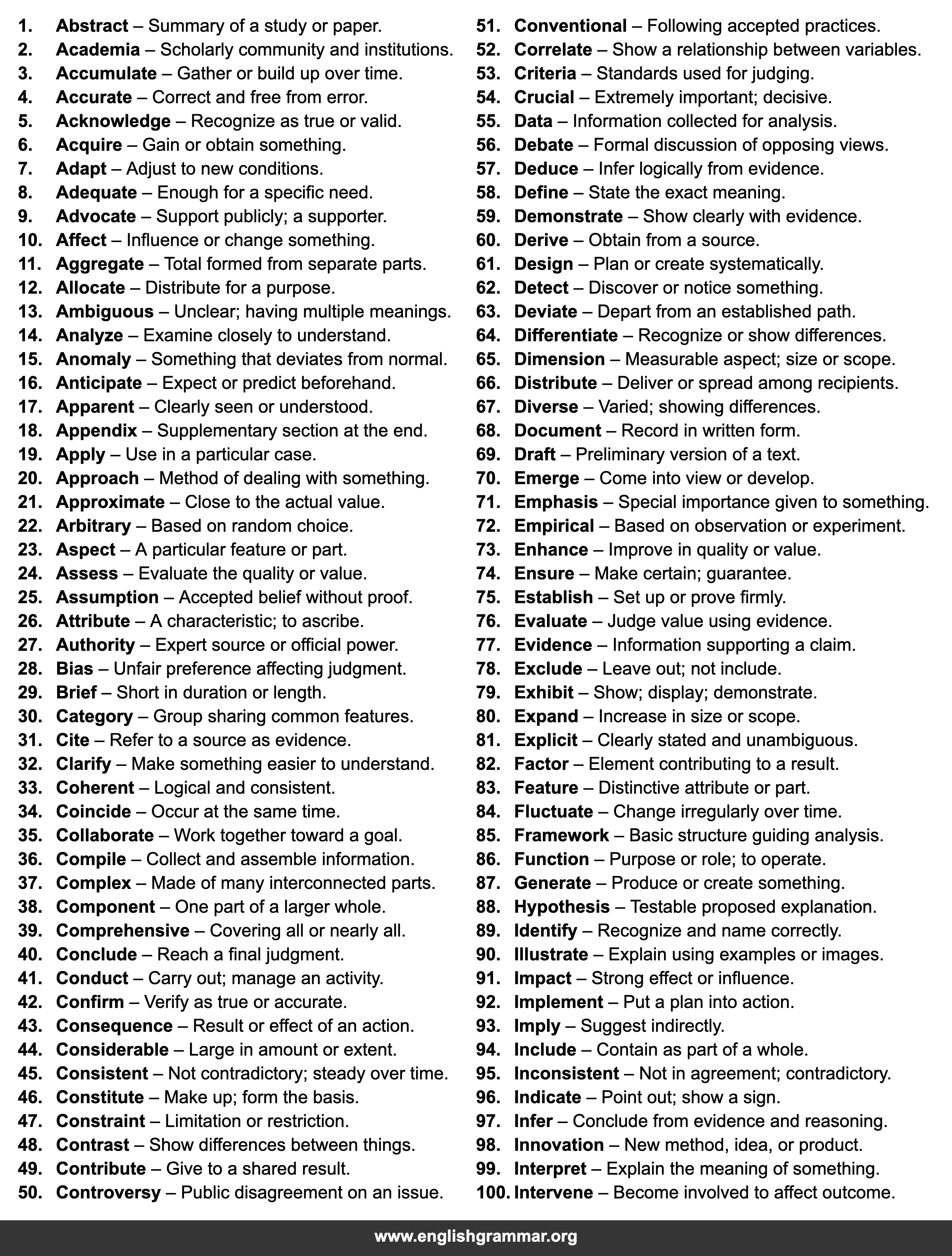
| 1. | Abstract | Summary of a study or paper. |
| 2. | Academia | Scholarly community and institutions. |
| 3. | Accumulate | Gather or build up over time. |
| 4. | Accurate | Correct and free from error. |
| 5. | Acknowledge | Recognize as true or valid. |
| 6. | Acquire | Gain or obtain something. |
| 7. | Adapt | Adjust to new conditions. |
| 8. | Adequate | Enough for a specific need. |
| 9. | Advocate | Support publicly; a supporter. |
| 10. | Affect | Influence or change something. |
| 11. | Aggregate | Total formed from separate parts. |
| 12. | Allocate | Distribute for a purpose. |
| 13. | Ambiguous | Unclear; having multiple meanings. |
| 14. | Analyze | Examine closely to understand. |
| 15. | Anomaly | Something that deviates from normal. |
| 16. | Anticipate | Expect or predict beforehand. |
| 17. | Apparent | Clearly seen or understood. |
| 18. | Appendix | Supplementary section at the end. |
| 19. | Apply | Use in a particular case. |
| 20. | Approach | Method of dealing with something. |
| 21. | Approximate | Close to the actual value. |
| 22. | Arbitrary | Based on random choice. |
| 23. | Aspect | A particular feature or part. |
| 24. | Assess | Evaluate the quality or value. |
| 25. | Assumption | Accepted belief without proof. |
| 26. | Attribute | A characteristic; to ascribe. |
| 27. | Authority | Expert source or official power. |
| 28. | Bias | Unfair preference affecting judgment. |
| 29. | Brief | Short in duration or length. |
| 30. | Category | Group sharing common features. |
| 31. | Cite | Refer to a source as evidence. |
| 32. | Clarify | Make something easier to understand. |
| 33. | Coherent | Logical and consistent. |
| 34. | Coincide | Occur at the same time. |
| 35. | Collaborate | Work together toward a goal. |
| 36. | Compile | Collect and assemble information. |
| 37. | Complex | Made of many interconnected parts. |
| 38. | Component | One part of a larger whole. |
| 39. | Comprehensive | Covering all or nearly all. |
| 40. | Conclude | Reach a final judgment. |
| 41. | Conduct | Carry out; manage an activity. |
| 42. | Confirm | Verify as true or accurate. |
| 43. | Consequence | Result or effect of an action. |
| 44. | Considerable | Large in amount or extent. |
| 45. | Consistent | Not contradictory; steady over time. |
| 46. | Constitute | Make up; form the basis. |
| 47. | Constraint | Limitation or restriction. |
| 48. | Contrast | Show differences between things. |
| 49. | Contribute | Give to a shared result. |
| 50. | Controversy | Public disagreement on an issue. |
| 51. | Conventional | Following accepted practices. |
| 52. | Correlate | Show a relationship between variables. |
| 53. | Criteria | Standards used for judging. |
| 54. | Crucial | Extremely important; decisive. |
| 55. | Data | Information collected for analysis. |
| 56. | Debate | Formal discussion of opposing views. |
| 57. | Deduce | Infer logically from evidence. |
| 58. | Define | State the exact meaning. |
| 59. | Demonstrate | Show clearly with evidence. |
| 60. | Derive | Obtain from a source. |
| 61. | Design | Plan or create systematically. |
| 62. | Detect | Discover or notice something. |
| 63. | Deviate | Depart from an established path. |
| 64. | Differentiate | Recognize or show differences. |
| 65. | Dimension | Measurable aspect; size or scope. |
| 66. | Distribute | Deliver or spread among recipients. |
| 67. | Diverse | Varied; showing differences. |
| 68. | Document | Record in written form. |
| 69. | Draft | Preliminary version of a text. |
| 70. | Emerge | Come into view or develop. |
| 71. | Emphasis | Special importance given to something. |
| 72. | Empirical | Based on observation or experiment. |
| 73. | Enhance | Improve in quality or value. |
| 74. | Ensure | Make certain; guarantee. |
| 75. | Establish | Set up or prove firmly. |
| 76. | Evaluate | Judge value using evidence. |
| 77. | Evidence | Information supporting a claim. |
| 78. | Exclude | Leave out; not include. |
| 79. | Exhibit | Show; display; demonstrate. |
| 80. | Expand | Increase in size or scope. |
| 81. | Explicit | Clearly stated and unambiguous. |
| 82. | Factor | Element contributing to a result. |
| 83. | Feature | Distinctive attribute or part. |
| 84. | Fluctuate | Change irregularly over time. |
| 85. | Framework | Basic structure guiding analysis. |
| 86. | Function | Purpose or role; to operate. |
| 87. | Generate | Produce or create something. |
| 88. | Hypothesis | Testable proposed explanation. |
| 89. | Identify | Recognize and name correctly. |
| 90. | Illustrate | Explain using examples or images. |
| 91. | Impact | Strong effect or influence. |
| 92. | Implement | Put a plan into action. |
| 93. | Imply | Suggest indirectly. |
| 94. | Include | Contain as part of a whole. |
| 95. | Inconsistent | Not in agreement; contradictory. |
| 96. | Indicate | Point out; show a sign. |
| 97. | Infer | Conclude from evidence and reasoning. |
| 98. | Innovation | New method, idea, or product. |
| 99. | Interpret | Explain the meaning of something. |
| 100. | Intervene | Become involved to affect outcome. |
