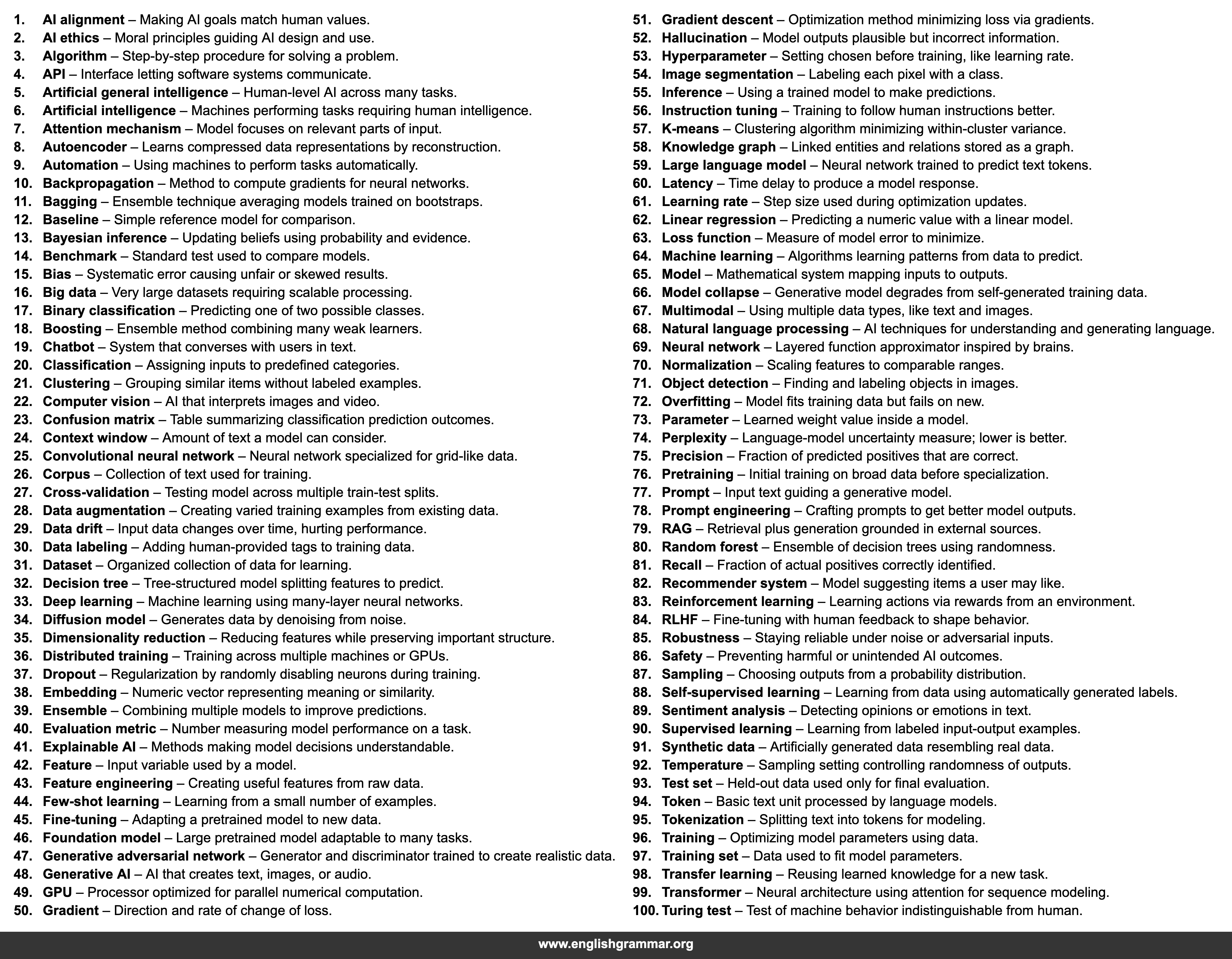
| No. | Term | Definition |
|---|---|---|
| 1. | AI alignment | Making AI goals match human values. |
| 2. | AI ethics | Moral principles guiding AI design and use. |
| 3. | Algorithm | Step-by-step procedure for solving a problem. |
| 4. | API | Interface letting software systems communicate. |
| 5. | Artificial general intelligence | Human-level AI across many tasks. |
| 6. | Artificial intelligence | Machines performing tasks requiring human intelligence. |
| 7. | Attention mechanism | Model focuses on relevant parts of input. |
| 8. | Autoencoder | Learns compressed data representations by reconstruction. |
| 9. | Automation | Using machines to perform tasks automatically. |
| 10. | Backpropagation | Method to compute gradients for neural networks. |
| 11. | Bagging | Ensemble technique averaging models trained on bootstraps. |
| 12. | Baseline | Simple reference model for comparison. |
| 13. | Bayesian inference | Updating beliefs using probability and evidence. |
| 14. | Benchmark | Standard test used to compare models. |
| 15. | Bias | Systematic error causing unfair or skewed results. |
| 16. | Big data | Very large datasets requiring scalable processing. |
| 17. | Binary classification | Predicting one of two possible classes. |
| 18. | Boosting | Ensemble method combining many weak learners. |
| 19. | Chatbot | System that converses with users in text. |
| 20. | Classification | Assigning inputs to predefined categories. |
| 21. | Clustering | Grouping similar items without labeled examples. |
| 22. | Computer vision | AI that interprets images and video. |
| 23. | Confusion matrix | Table summarizing classification prediction outcomes. |
| 24. | Context window | Amount of text a model can consider. |
| 25. | Convolutional neural network | Neural network specialized for grid-like data. |
| 26. | Corpus | Collection of text used for training. |
| 27. | Cross-validation | Testing model across multiple train-test splits. |
| 28. | Data augmentation | Creating varied training examples from existing data. |
| 29. | Data drift | Input data changes over time, hurting performance. |
| 30. | Data labeling | Adding human-provided tags to training data. |
| 31. | Dataset | Organized collection of data for learning. |
| 32. | Decision tree | Tree-structured model splitting features to predict. |
| 33. | Deep learning | Machine learning using many-layer neural networks. |
| 34. | Diffusion model | Generates data by denoising from noise. |
| 35. | Dimensionality reduction | Reducing features while preserving important structure. |
| 36. | Distributed training | Training across multiple machines or GPUs. |
| 37. | Dropout | Regularization by randomly disabling neurons during training. |
| 38. | Embedding | Numeric vector representing meaning or similarity. |
| 39. | Ensemble | Combining multiple models to improve predictions. |
| 40. | Evaluation metric | Number measuring model performance on a task. |
| 41. | Explainable AI | Methods making model decisions understandable. |
| 42. | Feature | Input variable used by a model. |
| 43. | Feature engineering | Creating useful features from raw data. |
| 44. | Few-shot learning | Learning from a small number of examples. |
| 45. | Fine-tuning | Adapting a pretrained model to new data. |
| 46. | Foundation model | Large pretrained model adaptable to many tasks. |
| 47. | Generative adversarial network | Generator and discriminator trained to create realistic data. |
| 48. | Generative AI | AI that creates text, images, or audio. |
| 49. | GPU | Processor optimized for parallel numerical computation. |
| 50. | Gradient | Direction and rate of change of loss. |
| 51. | Gradient descent | Optimization method minimizing loss via gradients. |
| 52. | Hallucination | Model outputs plausible but incorrect information. |
| 53. | Hyperparameter | Setting chosen before training, like learning rate. |
| 54. | Image segmentation | Labeling each pixel with a class. |
| 55. | Inference | Using a trained model to make predictions. |
| 56. | Instruction tuning | Training to follow human instructions better. |
| 57. | K-means | Clustering algorithm minimizing within-cluster variance. |
| 58. | Knowledge graph | Linked entities and relations stored as a graph. |
| 59. | Large language model | Neural network trained to predict text tokens. |
| 60. | Latency | Time delay to produce a model response. |
| 61. | Learning rate | Step size used during optimization updates. |
| 62. | Linear regression | Predicting a numeric value with a linear model. |
| 63. | Loss function | Measure of model error to minimize. |
| 64. | Machine learning | Algorithms learning patterns from data to predict. |
| 65. | Model | Mathematical system mapping inputs to outputs. |
| 66. | Model collapse | Generative model degrades from self-generated training data. |
| 67. | Multimodal | Using multiple data types, like text and images. |
| 68. | Natural language processing | AI techniques for understanding and generating language. |
| 69. | Neural network | Layered function approximator inspired by brains. |
| 70. | Normalization | Scaling features to comparable ranges. |
| 71. | Object detection | Finding and labeling objects in images. |
| 72. | Overfitting | Model fits training data but fails on new. |
| 73. | Parameter | Learned weight value inside a model. |
| 74. | Perplexity | Language-model uncertainty measure; lower is better. |
| 75. | Precision | Fraction of predicted positives that are correct. |
| 76. | Pretraining | Initial training on broad data before specialization. |
| 77. | Prompt | Input text guiding a generative model. |
| 78. | Prompt engineering | Crafting prompts to get better model outputs. |
| 79. | RAG | Retrieval plus generation grounded in external sources. |
| 80. | Random forest | Ensemble of decision trees using randomness. |
| 81. | Recall | Fraction of actual positives correctly identified. |
| 82. | Recommender system | Model suggesting items a user may like. |
| 83. | Reinforcement learning | Learning actions via rewards from an environment. |
| 84. | RLHF | Fine-tuning with human feedback to shape behavior. |
| 85. | Robustness | Staying reliable under noise or adversarial inputs. |
| 86. | Safety | Preventing harmful or unintended AI outcomes. |
| 87. | Sampling | Choosing outputs from a probability distribution. |
| 88. | Self-supervised learning | Learning from data using automatically generated labels. |
| 89. | Sentiment analysis | Detecting opinions or emotions in text. |
| 90. | Supervised learning | Learning from labeled input-output examples. |
| 91. | Synthetic data | Artificially generated data resembling real data. |
| 92. | Temperature | Sampling setting controlling randomness of outputs. |
| 93. | Test set | Held-out data used only for final evaluation. |
| 94. | Token | Basic text unit processed by language models. |
| 95. | Tokenization | Splitting text into tokens for modeling. |
| 96. | Training | Optimizing model parameters using data. |
| 97. | Training set | Data used to fit model parameters. |
| 98. | Transfer learning | Reusing learned knowledge for a new task. |
| 99. | Transformer | Neural architecture using attention for sequence modeling. |
| 100. | Turing test | Test of machine behavior indistinguishable from human. |
