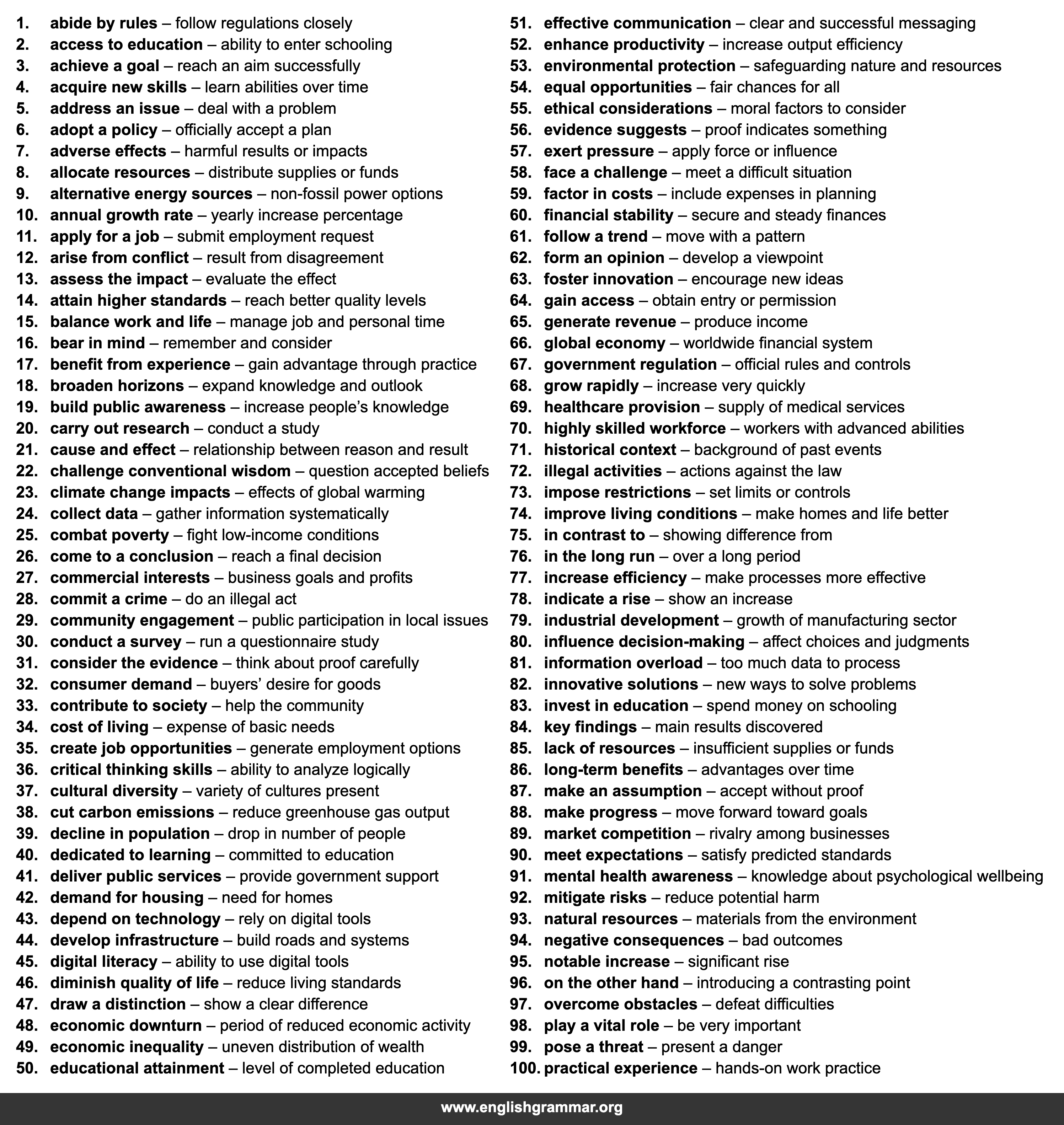
| No. | Term | Definition |
|---|---|---|
| 1. | abide by rules | follow regulations closely |
| 2. | access to education | ability to enter schooling |
| 3. | achieve a goal | reach an aim successfully |
| 4. | acquire new skills | learn abilities over time |
| 5. | address an issue | deal with a problem |
| 6. | adopt a policy | officially accept a plan |
| 7. | adverse effects | harmful results or impacts |
| 8. | allocate resources | distribute supplies or funds |
| 9. | alternative energy sources | non-fossil power options |
| 10. | annual growth rate | yearly increase percentage |
| 11. | apply for a job | submit employment request |
| 12. | arise from conflict | result from disagreement |
| 13. | assess the impact | evaluate the effect |
| 14. | attain higher standards | reach better quality levels |
| 15. | balance work and life | manage job and personal time |
| 16. | bear in mind | remember and consider |
| 17. | benefit from experience | gain advantage through practice |
| 18. | broaden horizons | expand knowledge and outlook |
| 19. | build public awareness | increase people’s knowledge |
| 20. | carry out research | conduct a study |
| 21. | cause and effect | relationship between reason and result |
| 22. | challenge conventional wisdom | question accepted beliefs |
| 23. | climate change impacts | effects of global warming |
| 24. | collect data | gather information systematically |
| 25. | combat poverty | fight low-income conditions |
| 26. | come to a conclusion | reach a final decision |
| 27. | commercial interests | business goals and profits |
| 28. | commit a crime | do an illegal act |
| 29. | community engagement | public participation in local issues |
| 30. | conduct a survey | run a questionnaire study |
| 31. | consider the evidence | think about proof carefully |
| 32. | consumer demand | buyers’ desire for goods |
| 33. | contribute to society | help the community |
| 34. | cost of living | expense of basic needs |
| 35. | create job opportunities | generate employment options |
| 36. | critical thinking skills | ability to analyze logically |
| 37. | cultural diversity | variety of cultures present |
| 38. | cut carbon emissions | reduce greenhouse gas output |
| 39. | decline in population | drop in number of people |
| 40. | dedicated to learning | committed to education |
| 41. | deliver public services | provide government support |
| 42. | demand for housing | need for homes |
| 43. | depend on technology | rely on digital tools |
| 44. | develop infrastructure | build roads and systems |
| 45. | digital literacy | ability to use digital tools |
| 46. | diminish quality of life | reduce living standards |
| 47. | draw a distinction | show a clear difference |
| 48. | economic downturn | period of reduced economic activity |
| 49. | economic inequality | uneven distribution of wealth |
| 50. | educational attainment | level of completed education |
| 51. | effective communication | clear and successful messaging |
| 52. | enhance productivity | increase output efficiency |
| 53. | environmental protection | safeguarding nature and resources |
| 54. | equal opportunities | fair chances for all |
| 55. | ethical considerations | moral factors to consider |
| 56. | evidence suggests | proof indicates something |
| 57. | exert pressure | apply force or influence |
| 58. | face a challenge | meet a difficult situation |
| 59. | factor in costs | include expenses in planning |
| 60. | financial stability | secure and steady finances |
| 61. | follow a trend | move with a pattern |
| 62. | form an opinion | develop a viewpoint |
| 63. | foster innovation | encourage new ideas |
| 64. | gain access | obtain entry or permission |
| 65. | generate revenue | produce income |
| 66. | global economy | worldwide financial system |
| 67. | government regulation | official rules and controls |
| 68. | grow rapidly | increase very quickly |
| 69. | healthcare provision | supply of medical services |
| 70. | highly skilled workforce | workers with advanced abilities |
| 71. | historical context | background of past events |
| 72. | illegal activities | actions against the law |
| 73. | impose restrictions | set limits or controls |
| 74. | improve living conditions | make homes and life better |
| 75. | in contrast to | showing difference from |
| 76. | in the long run | over a long period |
| 77. | increase efficiency | make processes more effective |
| 78. | indicate a rise | show an increase |
| 79. | industrial development | growth of manufacturing sector |
| 80. | influence decision-making | affect choices and judgments |
| 81. | information overload | too much data to process |
| 82. | innovative solutions | new ways to solve problems |
| 83. | invest in education | spend money on schooling |
| 84. | key findings | main results discovered |
| 85. | lack of resources | insufficient supplies or funds |
| 86. | long-term benefits | advantages over time |
| 87. | make an assumption | accept without proof |
| 88. | make progress | move forward toward goals |
| 89. | market competition | rivalry among businesses |
| 90. | meet expectations | satisfy predicted standards |
| 91. | mental health awareness | knowledge about psychological wellbeing |
| 92. | mitigate risks | reduce potential harm |
| 93. | natural resources | materials from the environment |
| 94. | negative consequences | bad outcomes |
| 95. | notable increase | significant rise |
| 96. | on the other hand | introducing a contrasting point |
| 97. | overcome obstacles | defeat difficulties |
| 98. | play a vital role | be very important |
| 99. | pose a threat | present a danger |
| 100. | practical experience | hands-on work practice |
