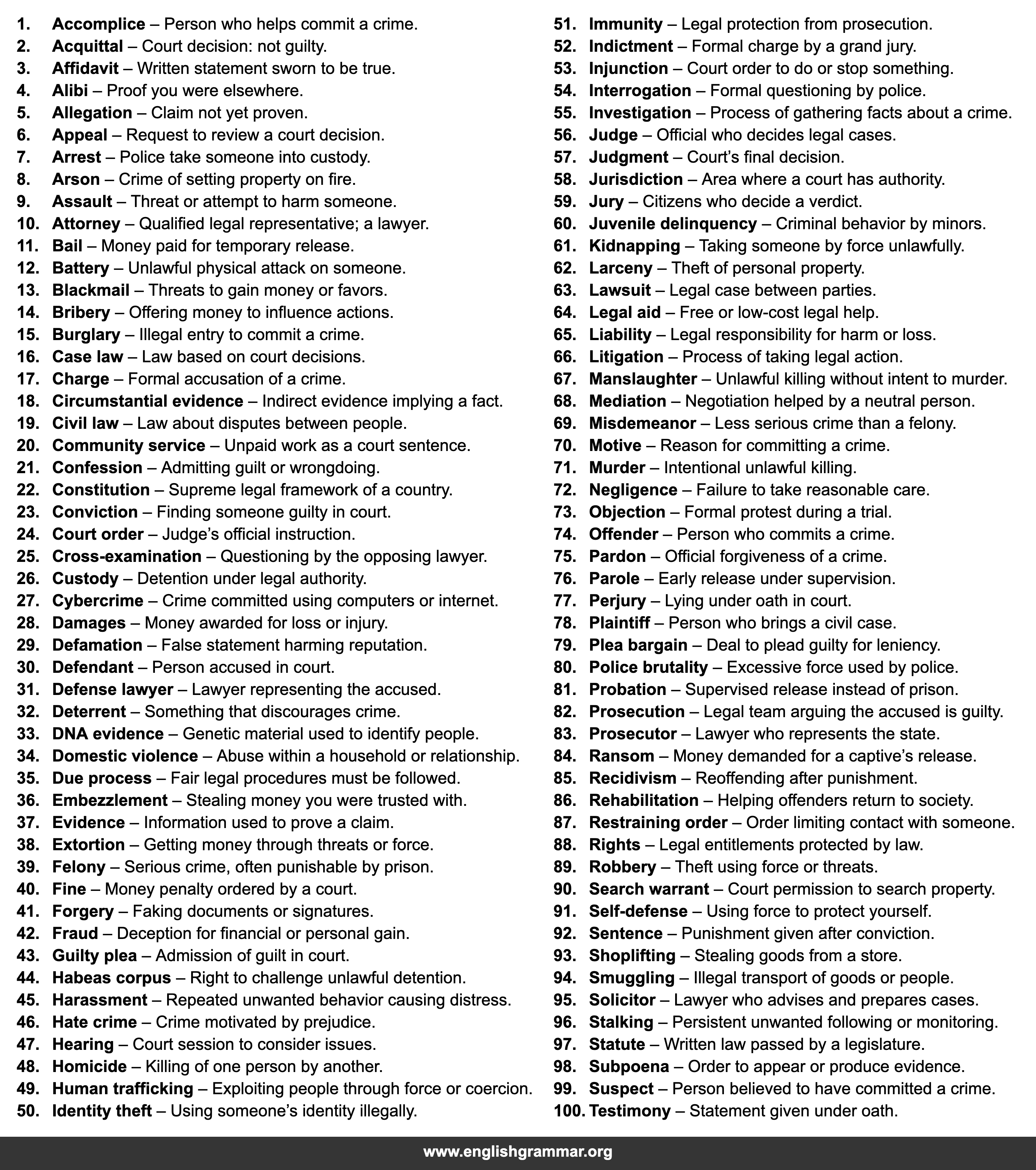
| No. | Term | Definition |
|---|---|---|
| 1. | Accomplice | Person who helps commit a crime. |
| 2. | Acquittal | Court decision: not guilty. |
| 3. | Affidavit | Written statement sworn to be true. |
| 4. | Alibi | Proof you were elsewhere. |
| 5. | Allegation | Claim not yet proven. |
| 6. | Appeal | Request to review a court decision. |
| 7. | Arrest | Police take someone into custody. |
| 8. | Arson | Crime of setting property on fire. |
| 9. | Assault | Threat or attempt to harm someone. |
| 10. | Attorney | Qualified legal representative; a lawyer. |
| 11. | Bail | Money paid for temporary release. |
| 12. | Battery | Unlawful physical attack on someone. |
| 13. | Blackmail | Threats to gain money or favors. |
| 14. | Bribery | Offering money to influence actions. |
| 15. | Burglary | Illegal entry to commit a crime. |
| 16. | Case law | Law based on court decisions. |
| 17. | Charge | Formal accusation of a crime. |
| 18. | Circumstantial evidence | Indirect evidence implying a fact. |
| 19. | Civil law | Law about disputes between people. |
| 20. | Community service | Unpaid work as a court sentence. |
| 21. | Confession | Admitting guilt or wrongdoing. |
| 22. | Constitution | Supreme legal framework of a country. |
| 23. | Conviction | Finding someone guilty in court. |
| 24. | Court order | Judge’s official instruction. |
| 25. | Cross-examination | Questioning by the opposing lawyer. |
| 26. | Custody | Detention under legal authority. |
| 27. | Cybercrime | Crime committed using computers or internet. |
| 28. | Damages | Money awarded for loss or injury. |
| 29. | Defamation | False statement harming reputation. |
| 30. | Defendant | Person accused in court. |
| 31. | Defense lawyer | Lawyer representing the accused. |
| 32. | Deterrent | Something that discourages crime. |
| 33. | DNA evidence | Genetic material used to identify people. |
| 34. | Domestic violence | Abuse within a household or relationship. |
| 35. | Due process | Fair legal procedures must be followed. |
| 36. | Embezzlement | Stealing money you were trusted with. |
| 37. | Evidence | Information used to prove a claim. |
| 38. | Extortion | Getting money through threats or force. |
| 39. | Felony | Serious crime, often punishable by prison. |
| 40. | Fine | Money penalty ordered by a court. |
| 41. | Forgery | Faking documents or signatures. |
| 42. | Fraud | Deception for financial or personal gain. |
| 43. | Guilty plea | Admission of guilt in court. |
| 44. | Habeas corpus | Right to challenge unlawful detention. |
| 45. | Harassment | Repeated unwanted behavior causing distress. |
| 46. | Hate crime | Crime motivated by prejudice. |
| 47. | Hearing | Court session to consider issues. |
| 48. | Homicide | Killing of one person by another. |
| 49. | Human trafficking | Exploiting people through force or coercion. |
| 50. | Identity theft | Using someone’s identity illegally. |
| 51. | Immunity | Legal protection from prosecution. |
| 52. | Indictment | Formal charge by a grand jury. |
| 53. | Injunction | Court order to do or stop something. |
| 54. | Interrogation | Formal questioning by police. |
| 55. | Investigation | Process of gathering facts about a crime. |
| 56. | Judge | Official who decides legal cases. |
| 57. | Judgment | Court’s final decision. |
| 58. | Jurisdiction | Area where a court has authority. |
| 59. | Jury | Citizens who decide a verdict. |
| 60. | Juvenile delinquency | Criminal behavior by minors. |
| 61. | Kidnapping | Taking someone by force unlawfully. |
| 62. | Larceny | Theft of personal property. |
| 63. | Lawsuit | Legal case between parties. |
| 64. | Legal aid | Free or low-cost legal help. |
| 65. | Liability | Legal responsibility for harm or loss. |
| 66. | Litigation | Process of taking legal action. |
| 67. | Manslaughter | Unlawful killing without intent to murder. |
| 68. | Mediation | Negotiation helped by a neutral person. |
| 69. | Misdemeanor | Less serious crime than a felony. |
| 70. | Motive | Reason for committing a crime. |
| 71. | Murder | Intentional unlawful killing. |
| 72. | Negligence | Failure to take reasonable care. |
| 73. | Objection | Formal protest during a trial. |
| 74. | Offender | Person who commits a crime. |
| 75. | Pardon | Official forgiveness of a crime. |
| 76. | Parole | Early release under supervision. |
| 77. | Perjury | Lying under oath in court. |
| 78. | Plaintiff | Person who brings a civil case. |
| 79. | Plea bargain | Deal to plead guilty for leniency. |
| 80. | Police brutality | Excessive force used by police. |
| 81. | Probation | Supervised release instead of prison. |
| 82. | Prosecution | Legal team arguing the accused is guilty. |
| 83. | Prosecutor | Lawyer who represents the state. |
| 84. | Ransom | Money demanded for a captive’s release. |
| 85. | Recidivism | Reoffending after punishment. |
| 86. | Rehabilitation | Helping offenders return to society. |
| 87. | Restraining order | Order limiting contact with someone. |
| 88. | Rights | Legal entitlements protected by law. |
| 89. | Robbery | Theft using force or threats. |
| 90. | Search warrant | Court permission to search property. |
| 91. | Self-defense | Using force to protect yourself. |
| 92. | Sentence | Punishment given after conviction. |
| 93. | Shoplifting | Stealing goods from a store. |
| 94. | Smuggling | Illegal transport of goods or people. |
| 95. | Solicitor | Lawyer who advises and prepares cases. |
| 96. | Stalking | Persistent unwanted following or monitoring. |
| 97. | Statute | Written law passed by a legislature. |
| 98. | Subpoena | Order to appear or produce evidence. |
| 99. | Suspect | Person believed to have committed a crime. |
| 100. | Testimony | Statement given under oath. |
