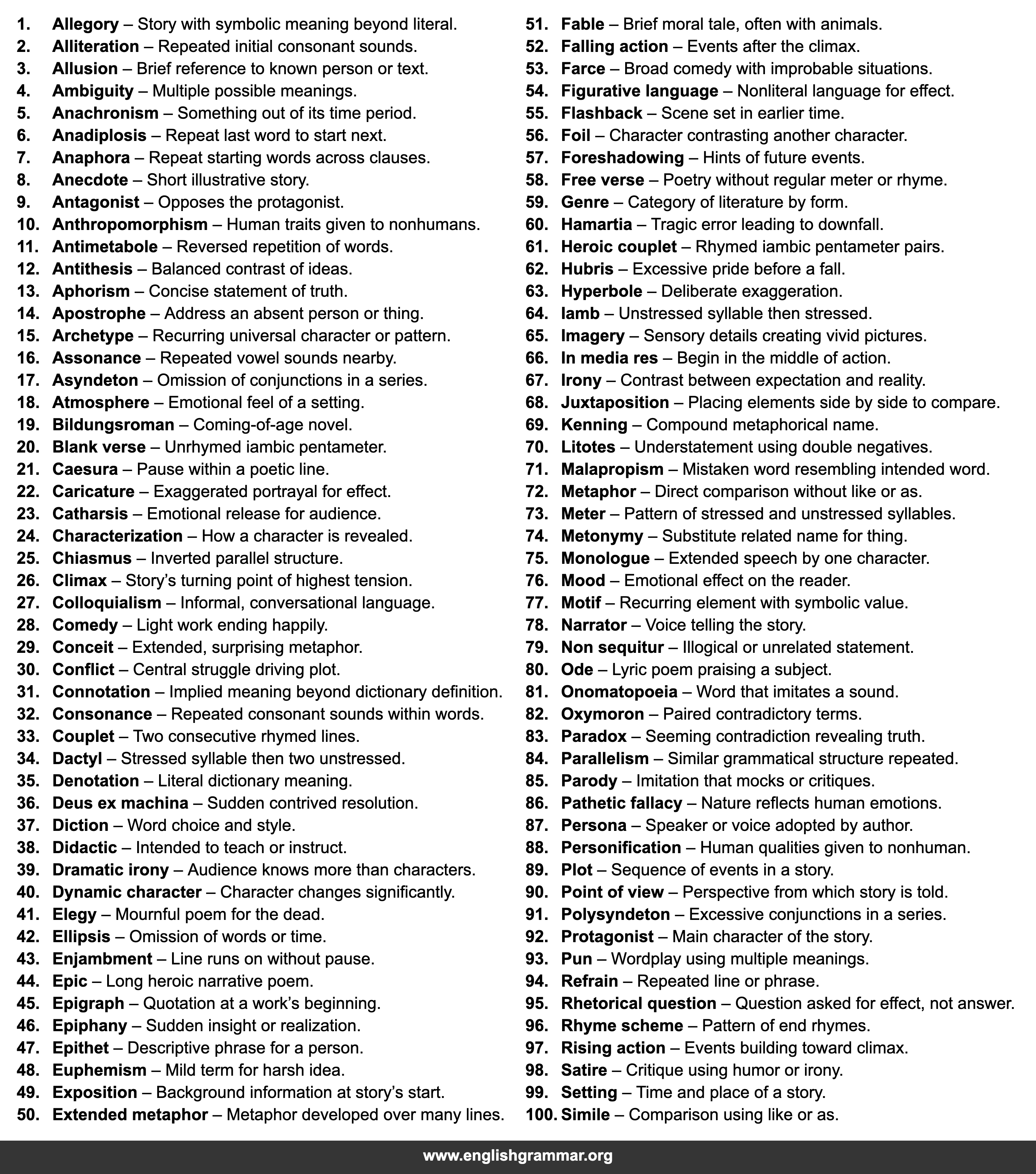
| No. | Term | Definition |
|---|---|---|
| 1. | Allegory | Story with symbolic meaning beyond literal. |
| 2. | Alliteration | Repeated initial consonant sounds. |
| 3. | Allusion | Brief reference to known person or text. |
| 4. | Ambiguity | Multiple possible meanings. |
| 5. | Anachronism | Something out of its time period. |
| 6. | Anadiplosis | Repeat last word to start next. |
| 7. | Anaphora | Repeat starting words across clauses. |
| 8. | Anecdote | Short illustrative story. |
| 9. | Antagonist | Opposes the protagonist. |
| 10. | Anthropomorphism | Human traits given to nonhumans. |
| 11. | Antimetabole | Reversed repetition of words. |
| 12. | Antithesis | Balanced contrast of ideas. |
| 13. | Aphorism | Concise statement of truth. |
| 14. | Apostrophe | Address an absent person or thing. |
| 15. | Archetype | Recurring universal character or pattern. |
| 16. | Assonance | Repeated vowel sounds nearby. |
| 17. | Asyndeton | Omission of conjunctions in a series. |
| 18. | Atmosphere | Emotional feel of a setting. |
| 19. | Bildungsroman | Coming-of-age novel. |
| 20. | Blank verse | Unrhymed iambic pentameter. |
| 21. | Caesura | Pause within a poetic line. |
| 22. | Caricature | Exaggerated portrayal for effect. |
| 23. | Catharsis | Emotional release for audience. |
| 24. | Characterization | How a character is revealed. |
| 25. | Chiasmus | Inverted parallel structure. |
| 26. | Climax | Story’s turning point of highest tension. |
| 27. | Colloquialism | Informal, conversational language. |
| 28. | Comedy | Light work ending happily. |
| 29. | Conceit | Extended, surprising metaphor. |
| 30. | Conflict | Central struggle driving plot. |
| 31. | Connotation | Implied meaning beyond dictionary definition. |
| 32. | Consonance | Repeated consonant sounds within words. |
| 33. | Couplet | Two consecutive rhymed lines. |
| 34. | Dactyl | Stressed syllable then two unstressed. |
| 35. | Denotation | Literal dictionary meaning. |
| 36. | Deus ex machina | Sudden contrived resolution. |
| 37. | Diction | Word choice and style. |
| 38. | Didactic | Intended to teach or instruct. |
| 39. | Dramatic irony | Audience knows more than characters. |
| 40. | Dynamic character | Character changes significantly. |
| 41. | Elegy | Mournful poem for the dead. |
| 42. | Ellipsis | Omission of words or time. |
| 43. | Enjambment | Line runs on without pause. |
| 44. | Epic | Long heroic narrative poem. |
| 45. | Epigraph | Quotation at a work’s beginning. |
| 46. | Epiphany | Sudden insight or realization. |
| 47. | Epithet | Descriptive phrase for a person. |
| 48. | Euphemism | Mild term for harsh idea. |
| 49. | Exposition | Background information at story’s start. |
| 50. | Extended metaphor | Metaphor developed over many lines. |
| 51. | Fable | Brief moral tale, often with animals. |
| 52. | Falling action | Events after the climax. |
| 53. | Farce | Broad comedy with improbable situations. |
| 54. | Figurative language | Nonliteral language for effect. |
| 55. | Flashback | Scene set in earlier time. |
| 56. | Foil | Character contrasting another character. |
| 57. | Foreshadowing | Hints of future events. |
| 58. | Free verse | Poetry without regular meter or rhyme. |
| 59. | Genre | Category of literature by form. |
| 60. | Hamartia | Tragic error leading to downfall. |
| 61. | Heroic couplet | Rhymed iambic pentameter pairs. |
| 62. | Hubris | Excessive pride before a fall. |
| 63. | Hyperbole | Deliberate exaggeration. |
| 64. | Iamb | Unstressed syllable then stressed. |
| 65. | Imagery | Sensory details creating vivid pictures. |
| 66. | In media res | Begin in the middle of action. |
| 67. | Irony | Contrast between expectation and reality. |
| 68. | Juxtaposition | Placing elements side by side to compare. |
| 69. | Kenning | Compound metaphorical name. |
| 70. | Litotes | Understatement using double negatives. |
| 71. | Malapropism | Mistaken word resembling intended word. |
| 72. | Metaphor | Direct comparison without like or as. |
| 73. | Meter | Pattern of stressed and unstressed syllables. |
| 74. | Metonymy | Substitute related name for thing. |
| 75. | Monologue | Extended speech by one character. |
| 76. | Mood | Emotional effect on the reader. |
| 77. | Motif | Recurring element with symbolic value. |
| 78. | Narrator | Voice telling the story. |
| 79. | Non sequitur | Illogical or unrelated statement. |
| 80. | Ode | Lyric poem praising a subject. |
| 81. | Onomatopoeia | Word that imitates a sound. |
| 82. | Oxymoron | Paired contradictory terms. |
| 83. | Paradox | Seeming contradiction revealing truth. |
| 84. | Parallelism | Similar grammatical structure repeated. |
| 85. | Parody | Imitation that mocks or critiques. |
| 86. | Pathetic fallacy | Nature reflects human emotions. |
| 87. | Persona | Speaker or voice adopted by author. |
| 88. | Personification | Human qualities given to nonhuman. |
| 89. | Plot | Sequence of events in a story. |
| 90. | Point of view | Perspective from which story is told. |
| 91. | Polysyndeton | Excessive conjunctions in a series. |
| 92. | Protagonist | Main character of the story. |
| 93. | Pun | Wordplay using multiple meanings. |
| 94. | Refrain | Repeated line or phrase. |
| 95. | Rhetorical question | Question asked for effect, not answer. |
| 96. | Rhyme scheme | Pattern of end rhymes. |
| 97. | Rising action | Events building toward climax. |
| 98. | Satire | Critique using humor or irony. |
| 99. | Setting | Time and place of a story. |
| 100. | Simile | Comparison using like or as. |
