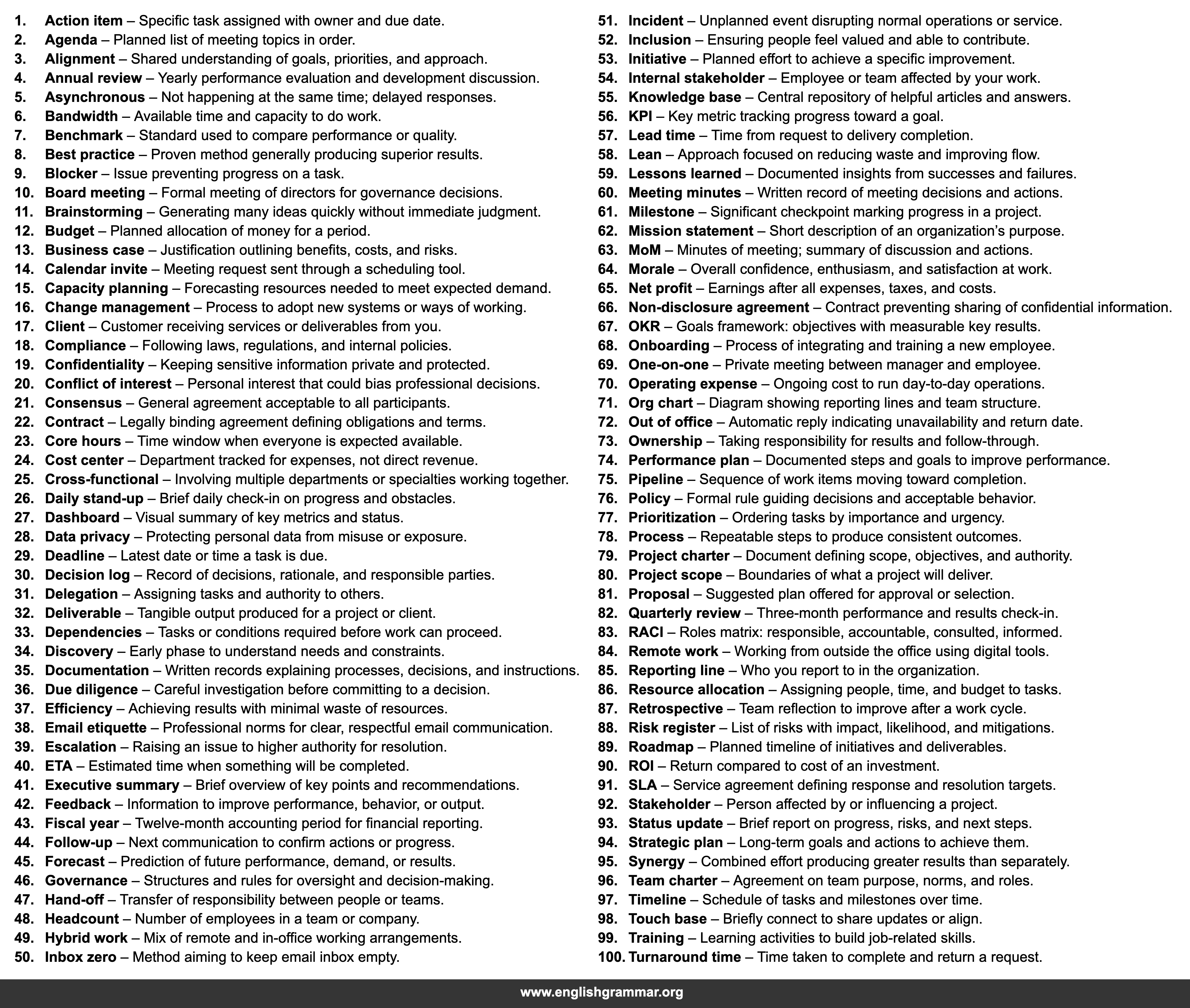
| No. | Term | Definition |
|---|---|---|
| 1. | Action item | Specific task assigned with owner and due date. |
| 2. | Agenda | Planned list of meeting topics in order. |
| 3. | Alignment | Shared understanding of goals, priorities, and approach. |
| 4. | Annual review | Yearly performance evaluation and development discussion. |
| 5. | Asynchronous | Not happening at the same time; delayed responses. |
| 6. | Bandwidth | Available time and capacity to do work. |
| 7. | Benchmark | Standard used to compare performance or quality. |
| 8. | Best practice | Proven method generally producing superior results. |
| 9. | Blocker | Issue preventing progress on a task. |
| 10. | Board meeting | Formal meeting of directors for governance decisions. |
| 11. | Brainstorming | Generating many ideas quickly without immediate judgment. |
| 12. | Budget | Planned allocation of money for a period. |
| 13. | Business case | Justification outlining benefits, costs, and risks. |
| 14. | Calendar invite | Meeting request sent through a scheduling tool. |
| 15. | Capacity planning | Forecasting resources needed to meet expected demand. |
| 16. | Change management | Process to adopt new systems or ways of working. |
| 17. | Client | Customer receiving services or deliverables from you. |
| 18. | Compliance | Following laws, regulations, and internal policies. |
| 19. | Confidentiality | Keeping sensitive information private and protected. |
| 20. | Conflict of interest | Personal interest that could bias professional decisions. |
| 21. | Consensus | General agreement acceptable to all participants. |
| 22. | Contract | Legally binding agreement defining obligations and terms. |
| 23. | Core hours | Time window when everyone is expected available. |
| 24. | Cost center | Department tracked for expenses, not direct revenue. |
| 25. | Cross-functional | Involving multiple departments or specialties working together. |
| 26. | Daily stand-up | Brief daily check-in on progress and obstacles. |
| 27. | Dashboard | Visual summary of key metrics and status. |
| 28. | Data privacy | Protecting personal data from misuse or exposure. |
| 29. | Deadline | Latest date or time a task is due. |
| 30. | Decision log | Record of decisions, rationale, and responsible parties. |
| 31. | Delegation | Assigning tasks and authority to others. |
| 32. | Deliverable | Tangible output produced for a project or client. |
| 33. | Dependencies | Tasks or conditions required before work can proceed. |
| 34. | Discovery | Early phase to understand needs and constraints. |
| 35. | Documentation | Written records explaining processes, decisions, and instructions. |
| 36. | Due diligence | Careful investigation before committing to a decision. |
| 37. | Efficiency | Achieving results with minimal waste of resources. |
| 38. | Email etiquette | Professional norms for clear, respectful email communication. |
| 39. | Escalation | Raising an issue to higher authority for resolution. |
| 40. | ETA | Estimated time when something will be completed. |
| 41. | Executive summary | Brief overview of key points and recommendations. |
| 42. | Feedback | Information to improve performance, behavior, or output. |
| 43. | Fiscal year | Twelve-month accounting period for financial reporting. |
| 44. | Follow-up | Next communication to confirm actions or progress. |
| 45. | Forecast | Prediction of future performance, demand, or results. |
| 46. | Governance | Structures and rules for oversight and decision-making. |
| 47. | Hand-off | Transfer of responsibility between people or teams. |
| 48. | Headcount | Number of employees in a team or company. |
| 49. | Hybrid work | Mix of remote and in-office working arrangements. |
| 50. | Inbox zero | Method aiming to keep email inbox empty. |
| 51. | Incident | Unplanned event disrupting normal operations or service. |
| 52. | Inclusion | Ensuring people feel valued and able to contribute. |
| 53. | Initiative | Planned effort to achieve a specific improvement. |
| 54. | Internal stakeholder | Employee or team affected by your work. |
| 55. | Knowledge base | Central repository of helpful articles and answers. |
| 56. | KPI | Key metric tracking progress toward a goal. |
| 57. | Lead time | Time from request to delivery completion. |
| 58. | Lean | Approach focused on reducing waste and improving flow. |
| 59. | Lessons learned | Documented insights from successes and failures. |
| 60. | Meeting minutes | Written record of meeting decisions and actions. |
| 61. | Milestone | Significant checkpoint marking progress in a project. |
| 62. | Mission statement | Short description of an organization’s purpose. |
| 63. | MoM | Minutes of meeting; summary of discussion and actions. |
| 64. | Morale | Overall confidence, enthusiasm, and satisfaction at work. |
| 65. | Net profit | Earnings after all expenses, taxes, and costs. |
| 66. | Non-disclosure agreement | Contract preventing sharing of confidential information. |
| 67. | OKR | Goals framework: objectives with measurable key results. |
| 68. | Onboarding | Process of integrating and training a new employee. |
| 69. | One-on-one | Private meeting between manager and employee. |
| 70. | Operating expense | Ongoing cost to run day-to-day operations. |
| 71. | Org chart | Diagram showing reporting lines and team structure. |
| 72. | Out of office | Automatic reply indicating unavailability and return date. |
| 73. | Ownership | Taking responsibility for results and follow-through. |
| 74. | Performance plan | Documented steps and goals to improve performance. |
| 75. | Pipeline | Sequence of work items moving toward completion. |
| 76. | Policy | Formal rule guiding decisions and acceptable behavior. |
| 77. | Prioritization | Ordering tasks by importance and urgency. |
| 78. | Process | Repeatable steps to produce consistent outcomes. |
| 79. | Project charter | Document defining scope, objectives, and authority. |
| 80. | Project scope | Boundaries of what a project will deliver. |
| 81. | Proposal | Suggested plan offered for approval or selection. |
| 82. | Quarterly review | Three-month performance and results check-in. |
| 83. | RACI | Roles matrix: responsible, accountable, consulted, informed. |
| 84. | Remote work | Working from outside the office using digital tools. |
| 85. | Reporting line | Who you report to in the organization. |
| 86. | Resource allocation | Assigning people, time, and budget to tasks. |
| 87. | Retrospective | Team reflection to improve after a work cycle. |
| 88. | Risk register | List of risks with impact, likelihood, and mitigations. |
| 89. | Roadmap | Planned timeline of initiatives and deliverables. |
| 90. | ROI | Return compared to cost of an investment. |
| 91. | SLA | Service agreement defining response and resolution targets. |
| 92. | Stakeholder | Person affected by or influencing a project. |
| 93. | Status update | Brief report on progress, risks, and next steps. |
| 94. | Strategic plan | Long-term goals and actions to achieve them. |
| 95. | Synergy | Combined effort producing greater results than separately. |
| 96. | Team charter | Agreement on team purpose, norms, and roles. |
| 97. | Timeline | Schedule of tasks and milestones over time. |
| 98. | Touch base | Briefly connect to share updates or align. |
| 99. | Training | Learning activities to build job-related skills. |
| 100. | Turnaround time | Time taken to complete and return a request. |
