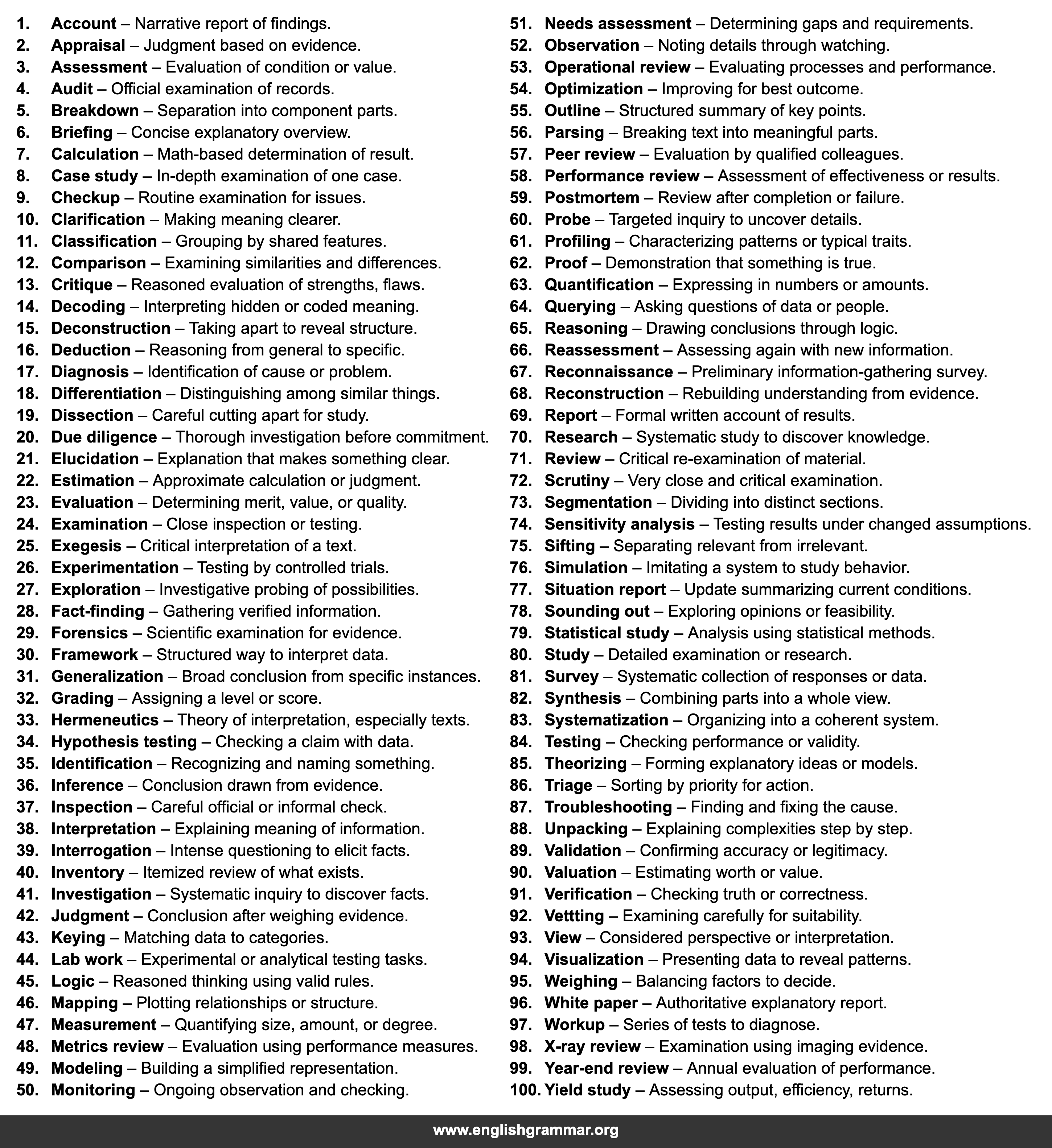
| No. | Term | Definition |
|---|---|---|
| 1. | Account | Narrative report of findings. |
| 2. | Appraisal | Judgment based on evidence. |
| 3. | Assessment | Evaluation of condition or value. |
| 4. | Audit | Official examination of records. |
| 5. | Breakdown | Separation into component parts. |
| 6. | Briefing | Concise explanatory overview. |
| 7. | Calculation | Math-based determination of result. |
| 8. | Case study | In-depth examination of one case. |
| 9. | Checkup | Routine examination for issues. |
| 10. | Clarification | Making meaning clearer. |
| 11. | Classification | Grouping by shared features. |
| 12. | Comparison | Examining similarities and differences. |
| 13. | Critique | Reasoned evaluation of strengths, flaws. |
| 14. | Decoding | Interpreting hidden or coded meaning. |
| 15. | Deconstruction | Taking apart to reveal structure. |
| 16. | Deduction | Reasoning from general to specific. |
| 17. | Diagnosis | Identification of cause or problem. |
| 18. | Differentiation | Distinguishing among similar things. |
| 19. | Dissection | Careful cutting apart for study. |
| 20. | Due diligence | Thorough investigation before commitment. |
| 21. | Elucidation | Explanation that makes something clear. |
| 22. | Estimation | Approximate calculation or judgment. |
| 23. | Evaluation | Determining merit, value, or quality. |
| 24. | Examination | Close inspection or testing. |
| 25. | Exegesis | Critical interpretation of a text. |
| 26. | Experimentation | Testing by controlled trials. |
| 27. | Exploration | Investigative probing of possibilities. |
| 28. | Fact-finding | Gathering verified information. |
| 29. | Forensics | Scientific examination for evidence. |
| 30. | Framework | Structured way to interpret data. |
| 31. | Generalization | Broad conclusion from specific instances. |
| 32. | Grading | Assigning a level or score. |
| 33. | Hermeneutics | Theory of interpretation, especially texts. |
| 34. | Hypothesis testing | Checking a claim with data. |
| 35. | Identification | Recognizing and naming something. |
| 36. | Inference | Conclusion drawn from evidence. |
| 37. | Inspection | Careful official or informal check. |
| 38. | Interpretation | Explaining meaning of information. |
| 39. | Interrogation | Intense questioning to elicit facts. |
| 40. | Inventory | Itemized review of what exists. |
| 41. | Investigation | Systematic inquiry to discover facts. |
| 42. | Judgment | Conclusion after weighing evidence. |
| 43. | Keying | Matching data to categories. |
| 44. | Lab work | Experimental or analytical testing tasks. |
| 45. | Logic | Reasoned thinking using valid rules. |
| 46. | Mapping | Plotting relationships or structure. |
| 47. | Measurement | Quantifying size, amount, or degree. |
| 48. | Metrics review | Evaluation using performance measures. |
| 49. | Modeling | Building a simplified representation. |
| 50. | Monitoring | Ongoing observation and checking. |
| 51. | Needs assessment | Determining gaps and requirements. |
| 52. | Observation | Noting details through watching. |
| 53. | Operational review | Evaluating processes and performance. |
| 54. | Optimization | Improving for best outcome. |
| 55. | Outline | Structured summary of key points. |
| 56. | Parsing | Breaking text into meaningful parts. |
| 57. | Peer review | Evaluation by qualified colleagues. |
| 58. | Performance review | Assessment of effectiveness or results. |
| 59. | Postmortem | Review after completion or failure. |
| 60. | Probe | Targeted inquiry to uncover details. |
| 61. | Profiling | Characterizing patterns or typical traits. |
| 62. | Proof | Demonstration that something is true. |
| 63. | Quantification | Expressing in numbers or amounts. |
| 64. | Querying | Asking questions of data or people. |
| 65. | Reasoning | Drawing conclusions through logic. |
| 66. | Reassessment | Assessing again with new information. |
| 67. | Reconnaissance | Preliminary information-gathering survey. |
| 68. | Reconstruction | Rebuilding understanding from evidence. |
| 69. | Report | Formal written account of results. |
| 70. | Research | Systematic study to discover knowledge. |
| 71. | Review | Critical re-examination of material. |
| 72. | Scrutiny | Very close and critical examination. |
| 73. | Segmentation | Dividing into distinct sections. |
| 74. | Sensitivity analysis | Testing results under changed assumptions. |
| 75. | Sifting | Separating relevant from irrelevant. |
| 76. | Simulation | Imitating a system to study behavior. |
| 77. | Situation report | Update summarizing current conditions. |
| 78. | Sounding out | Exploring opinions or feasibility. |
| 79. | Statistical study | Analysis using statistical methods. |
| 80. | Study | Detailed examination or research. |
| 81. | Survey | Systematic collection of responses or data. |
| 82. | Synthesis | Combining parts into a whole view. |
| 83. | Systematization | Organizing into a coherent system. |
| 84. | Testing | Checking performance or validity. |
| 85. | Theorizing | Forming explanatory ideas or models. |
| 86. | Triage | Sorting by priority for action. |
| 87. | Troubleshooting | Finding and fixing the cause. |
| 88. | Unpacking | Explaining complexities step by step. |
| 89. | Validation | Confirming accuracy or legitimacy. |
| 90. | Valuation | Estimating worth or value. |
| 91. | Verification | Checking truth or correctness. |
| 92. | Vettting | Examining carefully for suitability. |
| 93. | View | Considered perspective or interpretation. |
| 94. | Visualization | Presenting data to reveal patterns. |
| 95. | Weighing | Balancing factors to decide. |
| 96. | White paper | Authoritative explanatory report. |
| 97. | Workup | Series of tests to diagnose. |
| 98. | X-ray review | Examination using imaging evidence. |
| 99. | Year-end review | Annual evaluation of performance. |
| 100. | Yield study | Assessing output, efficiency, returns. |
