| No. | Term | Definition |
|---|---|---|
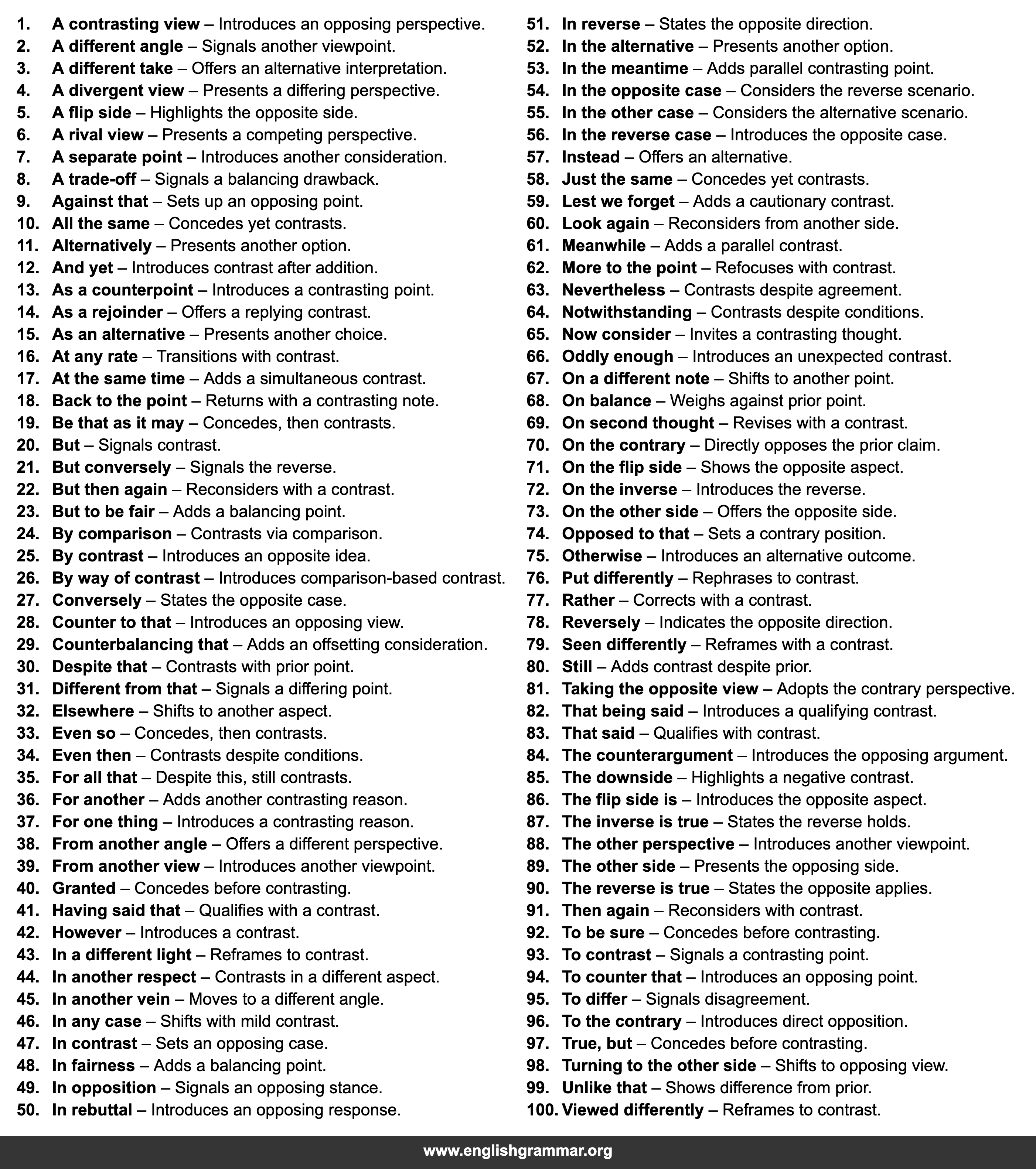
| 1. | A contrasting view | Introduces an opposing perspective. |
| 2. | A different angle | Signals another viewpoint. |
| 3. | A different take | Offers an alternative interpretation. |
| 4. | A divergent view | Presents a differing perspective. |
| 5. | A flip side | Highlights the opposite side. |
| 6. | A rival view | Presents a competing perspective. |
| 7. | A separate point | Introduces another consideration. |
| 8. | A trade-off | Signals a balancing drawback. |
| 9. | Against that | Sets up an opposing point. |
| 10. | All the same | Concedes yet contrasts. |
| 11. | Alternatively | Presents another option. |
| 12. | And yet | Introduces contrast after addition. |
| 13. | As a counterpoint | Introduces a contrasting point. |
| 14. | As a rejoinder | Offers a replying contrast. |
| 15. | As an alternative | Presents another choice. |
| 16. | At any rate | Transitions with contrast. |
| 17. | At the same time | Adds a simultaneous contrast. |
| 18. | Back to the point | Returns with a contrasting note. |
| 19. | Be that as it may | Concedes, then contrasts. |
| 20. | But | Signals contrast. |
| 21. | But conversely | Signals the reverse. |
| 22. | But then again | Reconsiders with a contrast. |
| 23. | But to be fair | Adds a balancing point. |
| 24. | By comparison | Contrasts via comparison. |
| 25. | By contrast | Introduces an opposite idea. |
| 26. | By way of contrast | Introduces comparison-based contrast. |
| 27. | Conversely | States the opposite case. |
| 28. | Counter to that | Introduces an opposing view. |
| 29. | Counterbalancing that | Adds an offsetting consideration. |
| 30. | Despite that | Contrasts with prior point. |
| 31. | Different from that | Signals a differing point. |
| 32. | Elsewhere | Shifts to another aspect. |
| 33. | Even so | Concedes, then contrasts. |
| 34. | Even then | Contrasts despite conditions. |
| 35. | For all that | Despite this, still contrasts. |
| 36. | For another | Adds another contrasting reason. |
| 37. | For one thing | Introduces a contrasting reason. |
| 38. | From another angle | Offers a different perspective. |
| 39. | From another view | Introduces another viewpoint. |
| 40. | Granted | Concedes before contrasting. |
| 41. | Having said that | Qualifies with a contrast. |
| 42. | However | Introduces a contrast. |
| 43. | In a different light | Reframes to contrast. |
| 44. | In another respect | Contrasts in a different aspect. |
| 45. | In another vein | Moves to a different angle. |
| 46. | In any case | Shifts with mild contrast. |
| 47. | In contrast | Sets an opposing case. |
| 48. | In fairness | Adds a balancing point. |
| 49. | In opposition | Signals an opposing stance. |
| 50. | In rebuttal | Introduces an opposing response. |
| 51. | In reverse | States the opposite direction. |
| 52. | In the alternative | Presents another option. |
| 53. | In the meantime | Adds parallel contrasting point. |
| 54. | In the opposite case | Considers the reverse scenario. |
| 55. | In the other case | Considers the alternative scenario. |
| 56. | In the reverse case | Introduces the opposite case. |
| 57. | Instead | Offers an alternative. |
| 58. | Just the same | Concedes yet contrasts. |
| 59. | Lest we forget | Adds a cautionary contrast. |
| 60. | Look again | Reconsiders from another side. |
| 61. | Meanwhile | Adds a parallel contrast. |
| 62. | More to the point | Refocuses with contrast. |
| 63. | Nevertheless | Contrasts despite agreement. |
| 64. | Notwithstanding | Contrasts despite conditions. |
| 65. | Now consider | Invites a contrasting thought. |
| 66. | Oddly enough | Introduces an unexpected contrast. |
| 67. | On a different note | Shifts to another point. |
| 68. | On balance | Weighs against prior point. |
| 69. | On second thought | Revises with a contrast. |
| 70. | On the contrary | Directly opposes the prior claim. |
| 71. | On the flip side | Shows the opposite aspect. |
| 72. | On the inverse | Introduces the reverse. |
| 73. | On the other side | Offers the opposite side. |
| 74. | Opposed to that | Sets a contrary position. |
| 75. | Otherwise | Introduces an alternative outcome. |
| 76. | Put differently | Rephrases to contrast. |
| 77. | Rather | Corrects with a contrast. |
| 78. | Reversely | Indicates the opposite direction. |
| 79. | Seen differently | Reframes with a contrast. |
| 80. | Still | Adds contrast despite prior. |
| 81. | Taking the opposite view | Adopts the contrary perspective. |
| 82. | That being said | Introduces a qualifying contrast. |
| 83. | That said | Qualifies with contrast. |
| 84. | The counterargument | Introduces the opposing argument. |
| 85. | The downside | Highlights a negative contrast. |
| 86. | The flip side is | Introduces the opposite aspect. |
| 87. | The inverse is true | States the reverse holds. |
| 88. | The other perspective | Introduces another viewpoint. |
| 89. | The other side | Presents the opposing side. |
| 90. | The reverse is true | States the opposite applies. |
| 91. | Then again | Reconsiders with contrast. |
| 92. | To be sure | Concedes before contrasting. |
| 93. | To contrast | Signals a contrasting point. |
| 94. | To counter that | Introduces an opposing point. |
| 95. | To differ | Signals disagreement. |
| 96. | To the contrary | Introduces direct opposition. |
| 97. | True, but | Concedes before contrasting. |
| 98. | Turning to the other side | Shifts to opposing view. |
| 99. | Unlike that | Shows difference from prior. |
| 100. | Viewed differently | Reframes to contrast. |