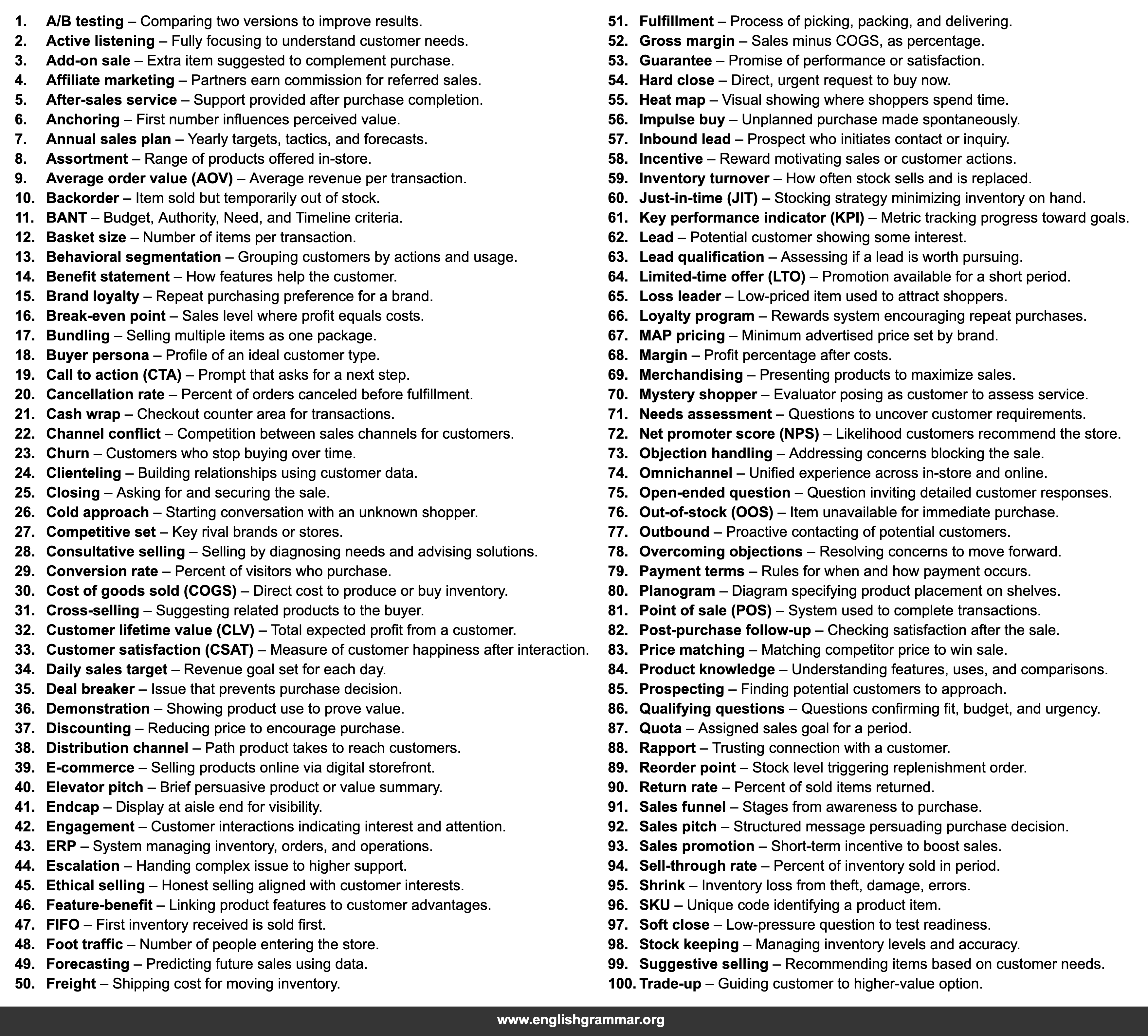
| No. | Term | Definition |
|---|---|---|
| 1. | A/B testing | Comparing two versions to improve results. |
| 2. | Active listening | Fully focusing to understand customer needs. |
| 3. | Add-on sale | Extra item suggested to complement purchase. |
| 4. | Affiliate marketing | Partners earn commission for referred sales. |
| 5. | After-sales service | Support provided after purchase completion. |
| 6. | Anchoring | First number influences perceived value. |
| 7. | Annual sales plan | Yearly targets, tactics, and forecasts. |
| 8. | Assortment | Range of products offered in-store. |
| 9. | Average order value (AOV) | Average revenue per transaction. |
| 10. | Backorder | Item sold but temporarily out of stock. |
| 11. | BANT | Budget, Authority, Need, and Timeline criteria. |
| 12. | Basket size | Number of items per transaction. |
| 13. | Behavioral segmentation | Grouping customers by actions and usage. |
| 14. | Benefit statement | How features help the customer. |
| 15. | Brand loyalty | Repeat purchasing preference for a brand. |
| 16. | Break-even point | Sales level where profit equals costs. |
| 17. | Bundling | Selling multiple items as one package. |
| 18. | Buyer persona | Profile of an ideal customer type. |
| 19. | Call to action (CTA) | Prompt that asks for a next step. |
| 20. | Cancellation rate | Percent of orders canceled before fulfillment. |
| 21. | Cash wrap | Checkout counter area for transactions. |
| 22. | Channel conflict | Competition between sales channels for customers. |
| 23. | Churn | Customers who stop buying over time. |
| 24. | Clienteling | Building relationships using customer data. |
| 25. | Closing | Asking for and securing the sale. |
| 26. | Cold approach | Starting conversation with an unknown shopper. |
| 27. | Competitive set | Key rival brands or stores. |
| 28. | Consultative selling | Selling by diagnosing needs and advising solutions. |
| 29. | Conversion rate | Percent of visitors who purchase. |
| 30. | Cost of goods sold (COGS) | Direct cost to produce or buy inventory. |
| 31. | Cross-selling | Suggesting related products to the buyer. |
| 32. | Customer lifetime value (CLV) | Total expected profit from a customer. |
| 33. | Customer satisfaction (CSAT) | Measure of customer happiness after interaction. |
| 34. | Daily sales target | Revenue goal set for each day. |
| 35. | Deal breaker | Issue that prevents purchase decision. |
| 36. | Demonstration | Showing product use to prove value. |
| 37. | Discounting | Reducing price to encourage purchase. |
| 38. | Distribution channel | Path product takes to reach customers. |
| 39. | E-commerce | Selling products online via digital storefront. |
| 40. | Elevator pitch | Brief persuasive product or value summary. |
| 41. | Endcap | Display at aisle end for visibility. |
| 42. | Engagement | Customer interactions indicating interest and attention. |
| 43. | ERP | System managing inventory, orders, and operations. |
| 44. | Escalation | Handing complex issue to higher support. |
| 45. | Ethical selling | Honest selling aligned with customer interests. |
| 46. | Feature-benefit | Linking product features to customer advantages. |
| 47. | FIFO | First inventory received is sold first. |
| 48. | Foot traffic | Number of people entering the store. |
| 49. | Forecasting | Predicting future sales using data. |
| 50. | Freight | Shipping cost for moving inventory. |
| 51. | Fulfillment | Process of picking, packing, and delivering. |
| 52. | Gross margin | Sales minus COGS, as percentage. |
| 53. | Guarantee | Promise of performance or satisfaction. |
| 54. | Hard close | Direct, urgent request to buy now. |
| 55. | Heat map | Visual showing where shoppers spend time. |
| 56. | Impulse buy | Unplanned purchase made spontaneously. |
| 57. | Inbound lead | Prospect who initiates contact or inquiry. |
| 58. | Incentive | Reward motivating sales or customer actions. |
| 59. | Inventory turnover | How often stock sells and is replaced. |
| 60. | Just-in-time (JIT) | Stocking strategy minimizing inventory on hand. |
| 61. | Key performance indicator (KPI) | Metric tracking progress toward goals. |
| 62. | Lead | Potential customer showing some interest. |
| 63. | Lead qualification | Assessing if a lead is worth pursuing. |
| 64. | Limited-time offer (LTO) | Promotion available for a short period. |
| 65. | Loss leader | Low-priced item used to attract shoppers. |
| 66. | Loyalty program | Rewards system encouraging repeat purchases. |
| 67. | MAP pricing | Minimum advertised price set by brand. |
| 68. | Margin | Profit percentage after costs. |
| 69. | Merchandising | Presenting products to maximize sales. |
| 70. | Mystery shopper | Evaluator posing as customer to assess service. |
| 71. | Needs assessment | Questions to uncover customer requirements. |
| 72. | Net promoter score (NPS) | Likelihood customers recommend the store. |
| 73. | Objection handling | Addressing concerns blocking the sale. |
| 74. | Omnichannel | Unified experience across in-store and online. |
| 75. | Open-ended question | Question inviting detailed customer responses. |
| 76. | Out-of-stock (OOS) | Item unavailable for immediate purchase. |
| 77. | Outbound | Proactive contacting of potential customers. |
| 78. | Overcoming objections | Resolving concerns to move forward. |
| 79. | Payment terms | Rules for when and how payment occurs. |
| 80. | Planogram | Diagram specifying product placement on shelves. |
| 81. | Point of sale (POS) | System used to complete transactions. |
| 82. | Post-purchase follow-up | Checking satisfaction after the sale. |
| 83. | Price matching | Matching competitor price to win sale. |
| 84. | Product knowledge | Understanding features, uses, and comparisons. |
| 85. | Prospecting | Finding potential customers to approach. |
| 86. | Qualifying questions | Questions confirming fit, budget, and urgency. |
| 87. | Quota | Assigned sales goal for a period. |
| 88. | Rapport | Trusting connection with a customer. |
| 89. | Reorder point | Stock level triggering replenishment order. |
| 90. | Return rate | Percent of sold items returned. |
| 91. | Sales funnel | Stages from awareness to purchase. |
| 92. | Sales pitch | Structured message persuading purchase decision. |
| 93. | Sales promotion | Short-term incentive to boost sales. |
| 94. | Sell-through rate | Percent of inventory sold in period. |
| 95. | Shrink | Inventory loss from theft, damage, errors. |
| 96. | SKU | Unique code identifying a product item. |
| 97. | Soft close | Low-pressure question to test readiness. |
| 98. | Stock keeping | Managing inventory levels and accuracy. |
| 99. | Suggestive selling | Recommending items based on customer needs. |
| 100. | Trade-up | Guiding customer to higher-value option. |
