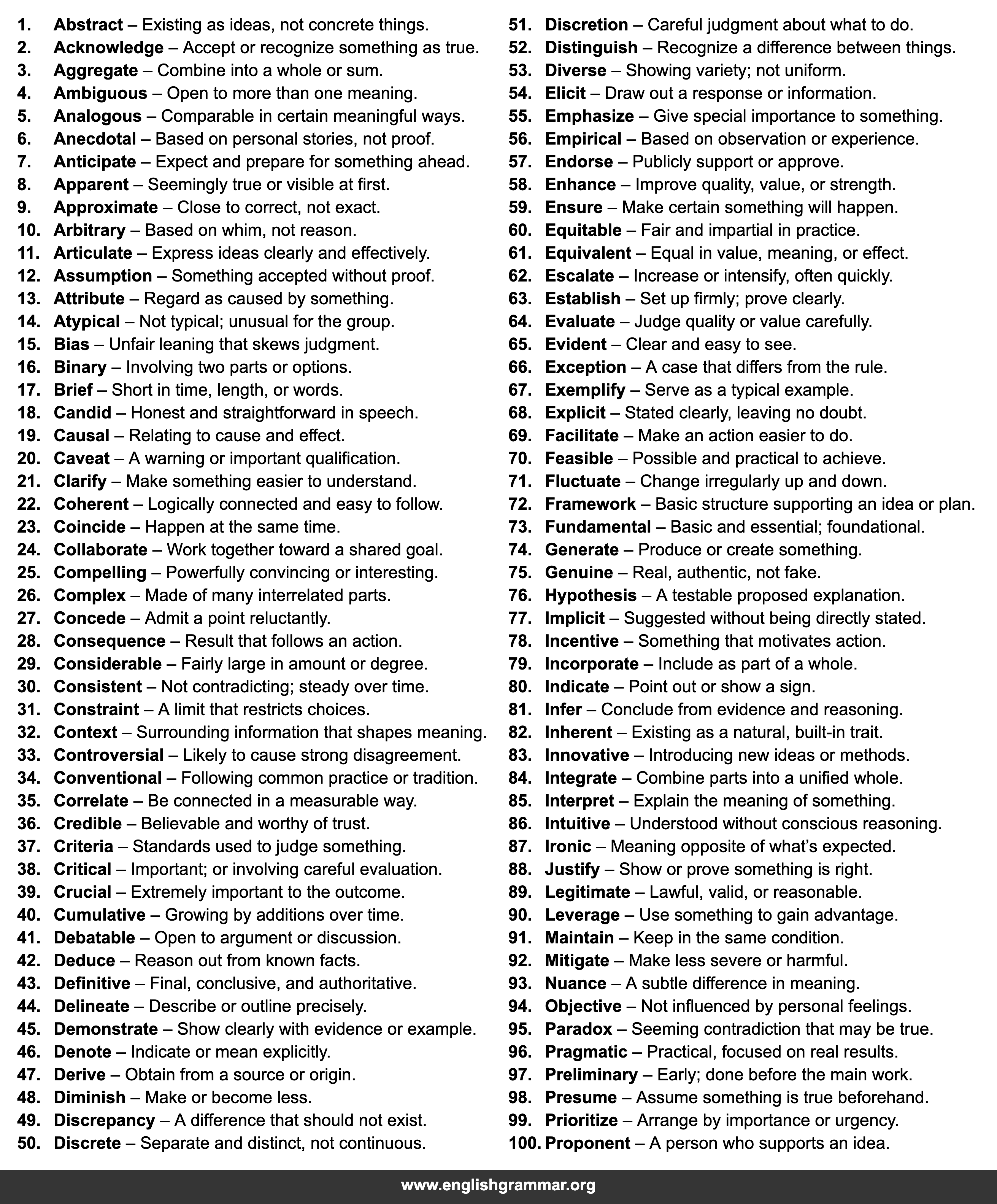
| No. | Term | Definition |
|---|---|---|
| 1. | Abstract | Existing as ideas, not concrete things. |
| 2. | Acknowledge | Accept or recognize something as true. |
| 3. | Aggregate | Combine into a whole or sum. |
| 4. | Ambiguous | Open to more than one meaning. |
| 5. | Analogous | Comparable in certain meaningful ways. |
| 6. | Anecdotal | Based on personal stories, not proof. |
| 7. | Anticipate | Expect and prepare for something ahead. |
| 8. | Apparent | Seemingly true or visible at first. |
| 9. | Approximate | Close to correct, not exact. |
| 10. | Arbitrary | Based on whim, not reason. |
| 11. | Articulate | Express ideas clearly and effectively. |
| 12. | Assumption | Something accepted without proof. |
| 13. | Attribute | Regard as caused by something. |
| 14. | Atypical | Not typical; unusual for the group. |
| 15. | Bias | Unfair leaning that skews judgment. |
| 16. | Binary | Involving two parts or options. |
| 17. | Brief | Short in time, length, or words. |
| 18. | Candid | Honest and straightforward in speech. |
| 19. | Causal | Relating to cause and effect. |
| 20. | Caveat | A warning or important qualification. |
| 21. | Clarify | Make something easier to understand. |
| 22. | Coherent | Logically connected and easy to follow. |
| 23. | Coincide | Happen at the same time. |
| 24. | Collaborate | Work together toward a shared goal. |
| 25. | Compelling | Powerfully convincing or interesting. |
| 26. | Complex | Made of many interrelated parts. |
| 27. | Concede | Admit a point reluctantly. |
| 28. | Consequence | Result that follows an action. |
| 29. | Considerable | Fairly large in amount or degree. |
| 30. | Consistent | Not contradicting; steady over time. |
| 31. | Constraint | A limit that restricts choices. |
| 32. | Context | Surrounding information that shapes meaning. |
| 33. | Controversial | Likely to cause strong disagreement. |
| 34. | Conventional | Following common practice or tradition. |
| 35. | Correlate | Be connected in a measurable way. |
| 36. | Credible | Believable and worthy of trust. |
| 37. | Criteria | Standards used to judge something. |
| 38. | Critical | Important; or involving careful evaluation. |
| 39. | Crucial | Extremely important to the outcome. |
| 40. | Cumulative | Growing by additions over time. |
| 41. | Debatable | Open to argument or discussion. |
| 42. | Deduce | Reason out from known facts. |
| 43. | Definitive | Final, conclusive, and authoritative. |
| 44. | Delineate | Describe or outline precisely. |
| 45. | Demonstrate | Show clearly with evidence or example. |
| 46. | Denote | Indicate or mean explicitly. |
| 47. | Derive | Obtain from a source or origin. |
| 48. | Diminish | Make or become less. |
| 49. | Discrepancy | A difference that should not exist. |
| 50. | Discrete | Separate and distinct, not continuous. |
| 51. | Discretion | Careful judgment about what to do. |
| 52. | Distinguish | Recognize a difference between things. |
| 53. | Diverse | Showing variety; not uniform. |
| 54. | Elicit | Draw out a response or information. |
| 55. | Emphasize | Give special importance to something. |
| 56. | Empirical | Based on observation or experience. |
| 57. | Endorse | Publicly support or approve. |
| 58. | Enhance | Improve quality, value, or strength. |
| 59. | Ensure | Make certain something will happen. |
| 60. | Equitable | Fair and impartial in practice. |
| 61. | Equivalent | Equal in value, meaning, or effect. |
| 62. | Escalate | Increase or intensify, often quickly. |
| 63. | Establish | Set up firmly; prove clearly. |
| 64. | Evaluate | Judge quality or value carefully. |
| 65. | Evident | Clear and easy to see. |
| 66. | Exception | A case that differs from the rule. |
| 67. | Exemplify | Serve as a typical example. |
| 68. | Explicit | Stated clearly, leaving no doubt. |
| 69. | Facilitate | Make an action easier to do. |
| 70. | Feasible | Possible and practical to achieve. |
| 71. | Fluctuate | Change irregularly up and down. |
| 72. | Framework | Basic structure supporting an idea or plan. |
| 73. | Fundamental | Basic and essential; foundational. |
| 74. | Generate | Produce or create something. |
| 75. | Genuine | Real, authentic, not fake. |
| 76. | Hypothesis | A testable proposed explanation. |
| 77. | Implicit | Suggested without being directly stated. |
| 78. | Incentive | Something that motivates action. |
| 79. | Incorporate | Include as part of a whole. |
| 80. | Indicate | Point out or show a sign. |
| 81. | Infer | Conclude from evidence and reasoning. |
| 82. | Inherent | Existing as a natural, built-in trait. |
| 83. | Innovative | Introducing new ideas or methods. |
| 84. | Integrate | Combine parts into a unified whole. |
| 85. | Interpret | Explain the meaning of something. |
| 86. | Intuitive | Understood without conscious reasoning. |
| 87. | Ironic | Meaning opposite of what’s expected. |
| 88. | Justify | Show or prove something is right. |
| 89. | Legitimate | Lawful, valid, or reasonable. |
| 90. | Leverage | Use something to gain advantage. |
| 91. | Maintain | Keep in the same condition. |
| 92. | Mitigate | Make less severe or harmful. |
| 93. | Nuance | A subtle difference in meaning. |
| 94. | Objective | Not influenced by personal feelings. |
| 95. | Paradox | Seeming contradiction that may be true. |
| 96. | Pragmatic | Practical, focused on real results. |
| 97. | Preliminary | Early; done before the main work. |
| 98. | Presume | Assume something is true beforehand. |
| 99. | Prioritize | Arrange by importance or urgency. |
| 100. | Proponent | A person who supports an idea. |
