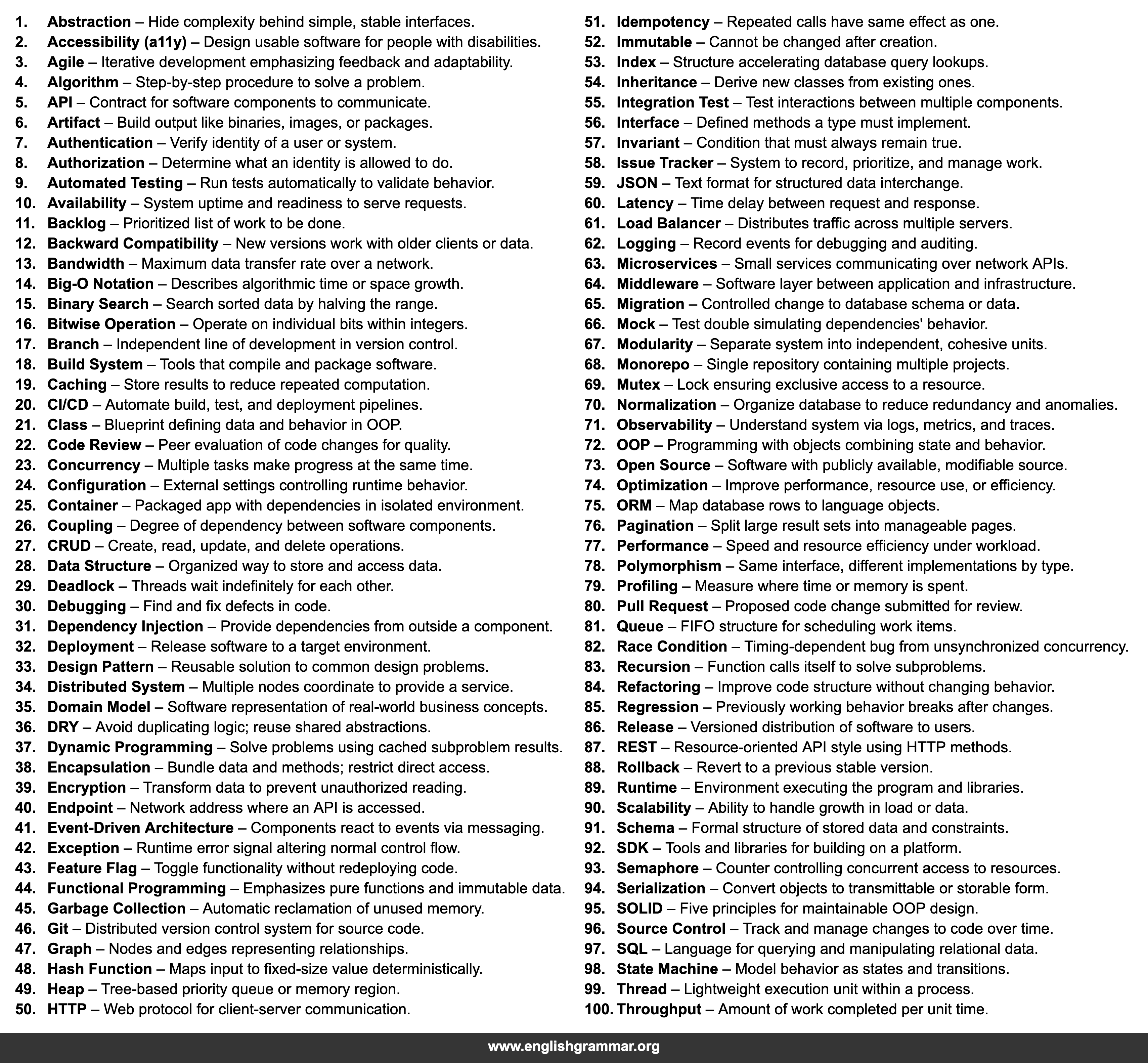
| No. | Term | Definition |
|---|---|---|
| 1. | Abstraction | Hide complexity behind simple, stable interfaces. |
| 2. | Accessibility (a11y) | Design usable software for people with disabilities. |
| 3. | Agile | Iterative development emphasizing feedback and adaptability. |
| 4. | Algorithm | Step-by-step procedure to solve a problem. |
| 5. | API | Contract for software components to communicate. |
| 6. | Artifact | Build output like binaries, images, or packages. |
| 7. | Authentication | Verify identity of a user or system. |
| 8. | Authorization | Determine what an identity is allowed to do. |
| 9. | Automated Testing | Run tests automatically to validate behavior. |
| 10. | Availability | System uptime and readiness to serve requests. |
| 11. | Backlog | Prioritized list of work to be done. |
| 12. | Backward Compatibility | New versions work with older clients or data. |
| 13. | Bandwidth | Maximum data transfer rate over a network. |
| 14. | Big-O Notation | Describes algorithmic time or space growth. |
| 15. | Binary Search | Search sorted data by halving the range. |
| 16. | Bitwise Operation | Operate on individual bits within integers. |
| 17. | Branch | Independent line of development in version control. |
| 18. | Build System | Tools that compile and package software. |
| 19. | Caching | Store results to reduce repeated computation. |
| 20. | CI/CD | Automate build, test, and deployment pipelines. |
| 21. | Class | Blueprint defining data and behavior in OOP. |
| 22. | Code Review | Peer evaluation of code changes for quality. |
| 23. | Concurrency | Multiple tasks make progress at the same time. |
| 24. | Configuration | External settings controlling runtime behavior. |
| 25. | Container | Packaged app with dependencies in isolated environment. |
| 26. | Coupling | Degree of dependency between software components. |
| 27. | CRUD | Create, read, update, and delete operations. |
| 28. | Data Structure | Organized way to store and access data. |
| 29. | Deadlock | Threads wait indefinitely for each other. |
| 30. | Debugging | Find and fix defects in code. |
| 31. | Dependency Injection | Provide dependencies from outside a component. |
| 32. | Deployment | Release software to a target environment. |
| 33. | Design Pattern | Reusable solution to common design problems. |
| 34. | Distributed System | Multiple nodes coordinate to provide a service. |
| 35. | Domain Model | Software representation of real-world business concepts. |
| 36. | DRY | Avoid duplicating logic; reuse shared abstractions. |
| 37. | Dynamic Programming | Solve problems using cached subproblem results. |
| 38. | Encapsulation | Bundle data and methods; restrict direct access. |
| 39. | Encryption | Transform data to prevent unauthorized reading. |
| 40. | Endpoint | Network address where an API is accessed. |
| 41. | Event-Driven Architecture | Components react to events via messaging. |
| 42. | Exception | Runtime error signal altering normal control flow. |
| 43. | Feature Flag | Toggle functionality without redeploying code. |
| 44. | Functional Programming | Emphasizes pure functions and immutable data. |
| 45. | Garbage Collection | Automatic reclamation of unused memory. |
| 46. | Git | Distributed version control system for source code. |
| 47. | Graph | Nodes and edges representing relationships. |
| 48. | Hash Function | Maps input to fixed-size value deterministically. |
| 49. | Heap | Tree-based priority queue or memory region. |
| 50. | HTTP | Web protocol for client-server communication. |
| 51. | Idempotency | Repeated calls have same effect as one. |
| 52. | Immutable | Cannot be changed after creation. |
| 53. | Index | Structure accelerating database query lookups. |
| 54. | Inheritance | Derive new classes from existing ones. |
| 55. | Integration Test | Test interactions between multiple components. |
| 56. | Interface | Defined methods a type must implement. |
| 57. | Invariant | Condition that must always remain true. |
| 58. | Issue Tracker | System to record, prioritize, and manage work. |
| 59. | JSON | Text format for structured data interchange. |
| 60. | Latency | Time delay between request and response. |
| 61. | Load Balancer | Distributes traffic across multiple servers. |
| 62. | Logging | Record events for debugging and auditing. |
| 63. | Microservices | Small services communicating over network APIs. |
| 64. | Middleware | Software layer between application and infrastructure. |
| 65. | Migration | Controlled change to database schema or data. |
| 66. | Mock | Test double simulating dependencies’ behavior. |
| 67. | Modularity | Separate system into independent, cohesive units. |
| 68. | Monorepo | Single repository containing multiple projects. |
| 69. | Mutex | Lock ensuring exclusive access to a resource. |
| 70. | Normalization | Organize database to reduce redundancy and anomalies. |
| 71. | Observability | Understand system via logs, metrics, and traces. |
| 72. | OOP | Programming with objects combining state and behavior. |
| 73. | Open Source | Software with publicly available, modifiable source. |
| 74. | Optimization | Improve performance, resource use, or efficiency. |
| 75. | ORM | Map database rows to language objects. |
| 76. | Pagination | Split large result sets into manageable pages. |
| 77. | Performance | Speed and resource efficiency under workload. |
| 78. | Polymorphism | Same interface, different implementations by type. |
| 79. | Profiling | Measure where time or memory is spent. |
| 80. | Pull Request | Proposed code change submitted for review. |
| 81. | Queue | FIFO structure for scheduling work items. |
| 82. | Race Condition | Timing-dependent bug from unsynchronized concurrency. |
| 83. | Recursion | Function calls itself to solve subproblems. |
| 84. | Refactoring | Improve code structure without changing behavior. |
| 85. | Regression | Previously working behavior breaks after changes. |
| 86. | Release | Versioned distribution of software to users. |
| 87. | REST | Resource-oriented API style using HTTP methods. |
| 88. | Rollback | Revert to a previous stable version. |
| 89. | Runtime | Environment executing the program and libraries. |
| 90. | Scalability | Ability to handle growth in load or data. |
| 91. | Schema | Formal structure of stored data and constraints. |
| 92. | SDK | Tools and libraries for building on a platform. |
| 93. | Semaphore | Counter controlling concurrent access to resources. |
| 94. | Serialization | Convert objects to transmittable or storable form. |
| 95. | SOLID | Five principles for maintainable OOP design. |
| 96. | Source Control | Track and manage changes to code over time. |
| 97. | SQL | Language for querying and manipulating relational data. |
| 98. | State Machine | Model behavior as states and transitions. |
| 99. | Thread | Lightweight execution unit within a process. |
| 100. | Throughput | Amount of work completed per unit time. |
