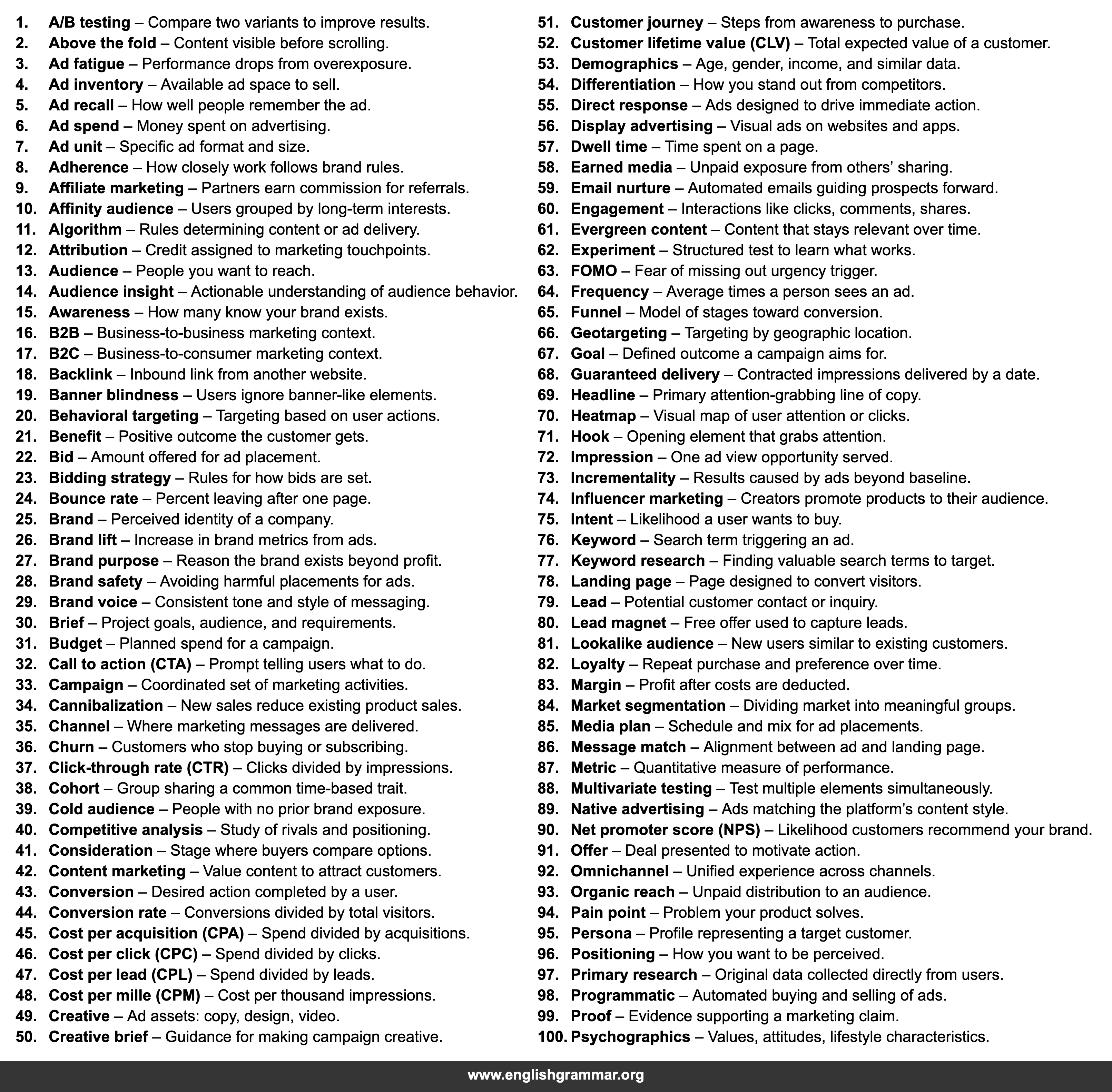
| No. | Term | Definition |
|---|---|---|
| 1. | A/B testing | Compare two variants to improve results. |
| 2. | Above the fold | Content visible before scrolling. |
| 3. | Ad fatigue | Performance drops from overexposure. |
| 4. | Ad inventory | Available ad space to sell. |
| 5. | Ad recall | How well people remember the ad. |
| 6. | Ad spend | Money spent on advertising. |
| 7. | Ad unit | Specific ad format and size. |
| 8. | Adherence | How closely work follows brand rules. |
| 9. | Affiliate marketing | Partners earn commission for referrals. |
| 10. | Affinity audience | Users grouped by long-term interests. |
| 11. | Algorithm | Rules determining content or ad delivery. |
| 12. | Attribution | Credit assigned to marketing touchpoints. |
| 13. | Audience | People you want to reach. |
| 14. | Audience insight | Actionable understanding of audience behavior. |
| 15. | Awareness | How many know your brand exists. |
| 16. | B2B | Business-to-business marketing context. |
| 17. | B2C | Business-to-consumer marketing context. |
| 18. | Backlink | Inbound link from another website. |
| 19. | Banner blindness | Users ignore banner-like elements. |
| 20. | Behavioral targeting | Targeting based on user actions. |
| 21. | Benefit | Positive outcome the customer gets. |
| 22. | Bid | Amount offered for ad placement. |
| 23. | Bidding strategy | Rules for how bids are set. |
| 24. | Bounce rate | Percent leaving after one page. |
| 25. | Brand | Perceived identity of a company. |
| 26. | Brand lift | Increase in brand metrics from ads. |
| 27. | Brand purpose | Reason the brand exists beyond profit. |
| 28. | Brand safety | Avoiding harmful placements for ads. |
| 29. | Brand voice | Consistent tone and style of messaging. |
| 30. | Brief | Project goals, audience, and requirements. |
| 31. | Budget | Planned spend for a campaign. |
| 32. | Call to action (CTA) | Prompt telling users what to do. |
| 33. | Campaign | Coordinated set of marketing activities. |
| 34. | Cannibalization | New sales reduce existing product sales. |
| 35. | Channel | Where marketing messages are delivered. |
| 36. | Churn | Customers who stop buying or subscribing. |
| 37. | Click-through rate (CTR) | Clicks divided by impressions. |
| 38. | Cohort | Group sharing a common time-based trait. |
| 39. | Cold audience | People with no prior brand exposure. |
| 40. | Competitive analysis | Study of rivals and positioning. |
| 41. | Consideration | Stage where buyers compare options. |
| 42. | Content marketing | Value content to attract customers. |
| 43. | Conversion | Desired action completed by a user. |
| 44. | Conversion rate | Conversions divided by total visitors. |
| 45. | Cost per acquisition (CPA) | Spend divided by acquisitions. |
| 46. | Cost per click (CPC) | Spend divided by clicks. |
| 47. | Cost per lead (CPL) | Spend divided by leads. |
| 48. | Cost per mille (CPM) | Cost per thousand impressions. |
| 49. | Creative | Ad assets: copy, design, video. |
| 50. | Creative brief | Guidance for making campaign creative. |
| 51. | Customer journey | Steps from awareness to purchase. |
| 52. | Customer lifetime value (CLV) | Total expected value of a customer. |
| 53. | Demographics | Age, gender, income, and similar data. |
| 54. | Differentiation | How you stand out from competitors. |
| 55. | Direct response | Ads designed to drive immediate action. |
| 56. | Display advertising | Visual ads on websites and apps. |
| 57. | Dwell time | Time spent on a page. |
| 58. | Earned media | Unpaid exposure from others’ sharing. |
| 59. | Email nurture | Automated emails guiding prospects forward. |
| 60. | Engagement | Interactions like clicks, comments, shares. |
| 61. | Evergreen content | Content that stays relevant over time. |
| 62. | Experiment | Structured test to learn what works. |
| 63. | FOMO | Fear of missing out urgency trigger. |
| 64. | Frequency | Average times a person sees an ad. |
| 65. | Funnel | Model of stages toward conversion. |
| 66. | Geotargeting | Targeting by geographic location. |
| 67. | Goal | Defined outcome a campaign aims for. |
| 68. | Guaranteed delivery | Contracted impressions delivered by a date. |
| 69. | Headline | Primary attention-grabbing line of copy. |
| 70. | Heatmap | Visual map of user attention or clicks. |
| 71. | Hook | Opening element that grabs attention. |
| 72. | Impression | One ad view opportunity served. |
| 73. | Incrementality | Results caused by ads beyond baseline. |
| 74. | Influencer marketing | Creators promote products to their audience. |
| 75. | Intent | Likelihood a user wants to buy. |
| 76. | Keyword | Search term triggering an ad. |
| 77. | Keyword research | Finding valuable search terms to target. |
| 78. | Landing page | Page designed to convert visitors. |
| 79. | Lead | Potential customer contact or inquiry. |
| 80. | Lead magnet | Free offer used to capture leads. |
| 81. | Lookalike audience | New users similar to existing customers. |
| 82. | Loyalty | Repeat purchase and preference over time. |
| 83. | Margin | Profit after costs are deducted. |
| 84. | Market segmentation | Dividing market into meaningful groups. |
| 85. | Media plan | Schedule and mix for ad placements. |
| 86. | Message match | Alignment between ad and landing page. |
| 87. | Metric | Quantitative measure of performance. |
| 88. | Multivariate testing | Test multiple elements simultaneously. |
| 89. | Native advertising | Ads matching the platform’s content style. |
| 90. | Net promoter score (NPS) | Likelihood customers recommend your brand. |
| 91. | Offer | Deal presented to motivate action. |
| 92. | Omnichannel | Unified experience across channels. |
| 93. | Organic reach | Unpaid distribution to an audience. |
| 94. | Pain point | Problem your product solves. |
| 95. | Persona | Profile representing a target customer. |
| 96. | Positioning | How you want to be perceived. |
| 97. | Primary research | Original data collected directly from users. |
| 98. | Programmatic | Automated buying and selling of ads. |
| 99. | Proof | Evidence supporting a marketing claim. |
| 100. | Psychographics | Values, attitudes, lifestyle characteristics. |