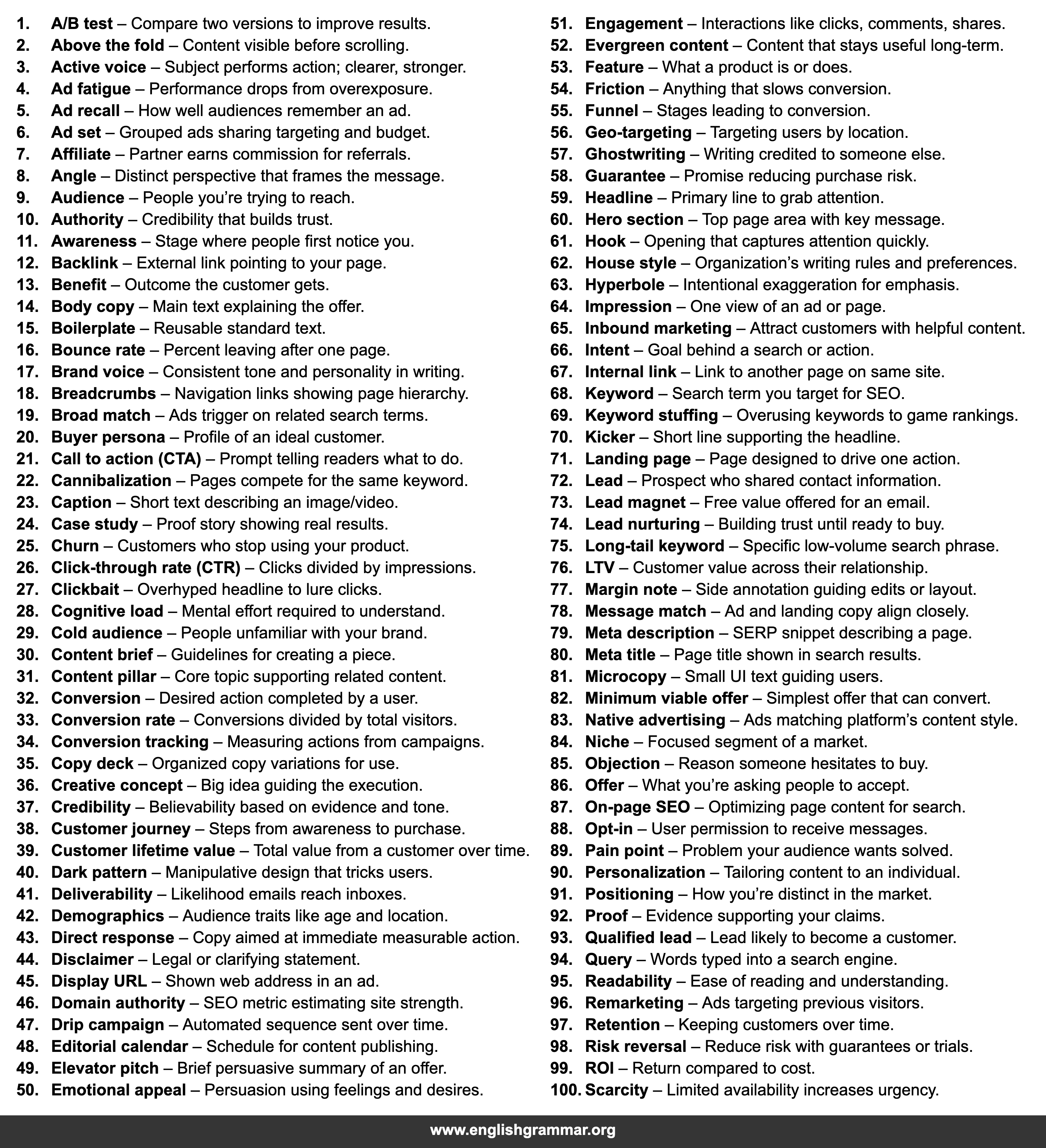
| No. | Term | Definition |
|---|---|---|
| 1. | A/B test | Compare two versions to improve results. |
| 2. | Above the fold | Content visible before scrolling. |
| 3. | Active voice | Subject performs action; clearer, stronger. |
| 4. | Ad fatigue | Performance drops from overexposure. |
| 5. | Ad recall | How well audiences remember an ad. |
| 6. | Ad set | Grouped ads sharing targeting and budget. |
| 7. | Affiliate | Partner earns commission for referrals. |
| 8. | Angle | Distinct perspective that frames the message. |
| 9. | Audience | People you’re trying to reach. |
| 10. | Authority | Credibility that builds trust. |
| 11. | Awareness | Stage where people first notice you. |
| 12. | Backlink | External link pointing to your page. |
| 13. | Benefit | Outcome the customer gets. |
| 14. | Body copy | Main text explaining the offer. |
| 15. | Boilerplate | Reusable standard text. |
| 16. | Bounce rate | Percent leaving after one page. |
| 17. | Brand voice | Consistent tone and personality in writing. |
| 18. | Breadcrumbs | Navigation links showing page hierarchy. |
| 19. | Broad match | Ads trigger on related search terms. |
| 20. | Buyer persona | Profile of an ideal customer. |
| 21. | Call to action (CTA) | Prompt telling readers what to do. |
| 22. | Cannibalization | Pages compete for the same keyword. |
| 23. | Caption | Short text describing an image/video. |
| 24. | Case study | Proof story showing real results. |
| 25. | Churn | Customers who stop using your product. |
| 26. | Click-through rate (CTR) | Clicks divided by impressions. |
| 27. | Clickbait | Overhyped headline to lure clicks. |
| 28. | Cognitive load | Mental effort required to understand. |
| 29. | Cold audience | People unfamiliar with your brand. |
| 30. | Content brief | Guidelines for creating a piece. |
| 31. | Content pillar | Core topic supporting related content. |
| 32. | Conversion | Desired action completed by a user. |
| 33. | Conversion rate | Conversions divided by total visitors. |
| 34. | Conversion tracking | Measuring actions from campaigns. |
| 35. | Copy deck | Organized copy variations for use. |
| 36. | Creative concept | Big idea guiding the execution. |
| 37. | Credibility | Believability based on evidence and tone. |
| 38. | Customer journey | Steps from awareness to purchase. |
| 39. | Customer lifetime value | Total value from a customer over time. |
| 40. | Dark pattern | Manipulative design that tricks users. |
| 41. | Deliverability | Likelihood emails reach inboxes. |
| 42. | Demographics | Audience traits like age and location. |
| 43. | Direct response | Copy aimed at immediate measurable action. |
| 44. | Disclaimer | Legal or clarifying statement. |
| 45. | Display URL | Shown web address in an ad. |
| 46. | Domain authority | SEO metric estimating site strength. |
| 47. | Drip campaign | Automated sequence sent over time. |
| 48. | Editorial calendar | Schedule for content publishing. |
| 49. | Elevator pitch | Brief persuasive summary of an offer. |
| 50. | Emotional appeal | Persuasion using feelings and desires. |
| 51. | Engagement | Interactions like clicks, comments, shares. |
| 52. | Evergreen content | Content that stays useful long-term. |
| 53. | Feature | What a product is or does. |
| 54. | Friction | Anything that slows conversion. |
| 55. | Funnel | Stages leading to conversion. |
| 56. | Geo-targeting | Targeting users by location. |
| 57. | Ghostwriting | Writing credited to someone else. |
| 58. | Guarantee | Promise reducing purchase risk. |
| 59. | Headline | Primary line to grab attention. |
| 60. | Hero section | Top page area with key message. |
| 61. | Hook | Opening that captures attention quickly. |
| 62. | House style | Organization’s writing rules and preferences. |
| 63. | Hyperbole | Intentional exaggeration for emphasis. |
| 64. | Impression | One view of an ad or page. |
| 65. | Inbound marketing | Attract customers with helpful content. |
| 66. | Intent | Goal behind a search or action. |
| 67. | Internal link | Link to another page on same site. |
| 68. | Keyword | Search term you target for SEO. |
| 69. | Keyword stuffing | Overusing keywords to game rankings. |
| 70. | Kicker | Short line supporting the headline. |
| 71. | Landing page | Page designed to drive one action. |
| 72. | Lead | Prospect who shared contact information. |
| 73. | Lead magnet | Free value offered for an email. |
| 74. | Lead nurturing | Building trust until ready to buy. |
| 75. | Long-tail keyword | Specific low-volume search phrase. |
| 76. | LTV | Customer value across their relationship. |
| 77. | Margin note | Side annotation guiding edits or layout. |
| 78. | Message match | Ad and landing copy align closely. |
| 79. | Meta description | SERP snippet describing a page. |
| 80. | Meta title | Page title shown in search results. |
| 81. | Microcopy | Small UI text guiding users. |
| 82. | Minimum viable offer | Simplest offer that can convert. |
| 83. | Native advertising | Ads matching platform’s content style. |
| 84. | Niche | Focused segment of a market. |
| 85. | Objection | Reason someone hesitates to buy. |
| 86. | Offer | What you’re asking people to accept. |
| 87. | On-page SEO | Optimizing page content for search. |
| 88. | Opt-in | User permission to receive messages. |
| 89. | Pain point | Problem your audience wants solved. |
| 90. | Personalization | Tailoring content to an individual. |
| 91. | Positioning | How you’re distinct in the market. |
| 92. | Proof | Evidence supporting your claims. |
| 93. | Qualified lead | Lead likely to become a customer. |
| 94. | Query | Words typed into a search engine. |
| 95. | Readability | Ease of reading and understanding. |
| 96. | Remarketing | Ads targeting previous visitors. |
| 97. | Retention | Keeping customers over time. |
| 98. | Risk reversal | Reduce risk with guarantees or trials. |
| 99. | ROI | Return compared to cost. |
| 100. | Scarcity | Limited availability increases urgency. |
