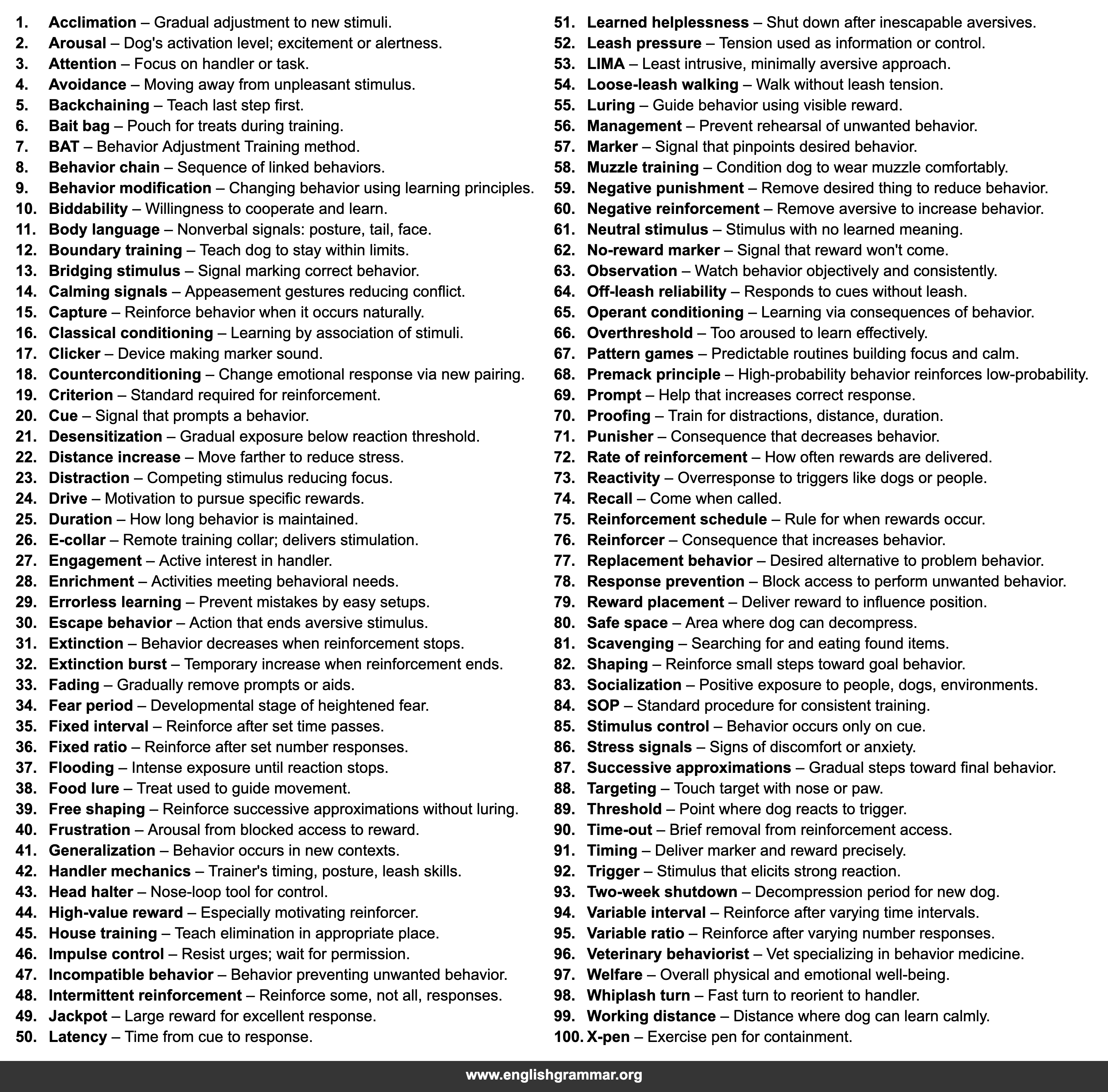
| No. | Term | Definition |
|---|---|---|
| 1. | Acclimation | Gradual adjustment to new stimuli. |
| 2. | Arousal | Dog’s activation level; excitement or alertness. |
| 3. | Attention | Focus on handler or task. |
| 4. | Avoidance | Moving away from unpleasant stimulus. |
| 5. | Backchaining | Teach last step first. |
| 6. | Bait bag | Pouch for treats during training. |
| 7. | BAT | Behavior Adjustment Training method. |
| 8. | Behavior chain | Sequence of linked behaviors. |
| 9. | Behavior modification | Changing behavior using learning principles. |
| 10. | Biddability | Willingness to cooperate and learn. |
| 11. | Body language | Nonverbal signals: posture, tail, face. |
| 12. | Boundary training | Teach dog to stay within limits. |
| 13. | Bridging stimulus | Signal marking correct behavior. |
| 14. | Calming signals | Appeasement gestures reducing conflict. |
| 15. | Capture | Reinforce behavior when it occurs naturally. |
| 16. | Classical conditioning | Learning by association of stimuli. |
| 17. | Clicker | Device making marker sound. |
| 18. | Counterconditioning | Change emotional response via new pairing. |
| 19. | Criterion | Standard required for reinforcement. |
| 20. | Cue | Signal that prompts a behavior. |
| 21. | Desensitization | Gradual exposure below reaction threshold. |
| 22. | Distance increase | Move farther to reduce stress. |
| 23. | Distraction | Competing stimulus reducing focus. |
| 24. | Drive | Motivation to pursue specific rewards. |
| 25. | Duration | How long behavior is maintained. |
| 26. | E-collar | Remote training collar; delivers stimulation. |
| 27. | Engagement | Active interest in handler. |
| 28. | Enrichment | Activities meeting behavioral needs. |
| 29. | Errorless learning | Prevent mistakes by easy setups. |
| 30. | Escape behavior | Action that ends aversive stimulus. |
| 31. | Extinction | Behavior decreases when reinforcement stops. |
| 32. | Extinction burst | Temporary increase when reinforcement ends. |
| 33. | Fading | Gradually remove prompts or aids. |
| 34. | Fear period | Developmental stage of heightened fear. |
| 35. | Fixed interval | Reinforce after set time passes. |
| 36. | Fixed ratio | Reinforce after set number responses. |
| 37. | Flooding | Intense exposure until reaction stops. |
| 38. | Food lure | Treat used to guide movement. |
| 39. | Free shaping | Reinforce successive approximations without luring. |
| 40. | Frustration | Arousal from blocked access to reward. |
| 41. | Generalization | Behavior occurs in new contexts. |
| 42. | Handler mechanics | Trainer’s timing, posture, leash skills. |
| 43. | Head halter | Nose-loop tool for control. |
| 44. | High-value reward | Especially motivating reinforcer. |
| 45. | House training | Teach elimination in appropriate place. |
| 46. | Impulse control | Resist urges; wait for permission. |
| 47. | Incompatible behavior | Behavior preventing unwanted behavior. |
| 48. | Intermittent reinforcement | Reinforce some, not all, responses. |
| 49. | Jackpot | Large reward for excellent response. |
| 50. | Latency | Time from cue to response. |
| 51. | Learned helplessness | Shut down after inescapable aversives. |
| 52. | Leash pressure | Tension used as information or control. |
| 53. | LIMA | Least intrusive, minimally aversive approach. |
| 54. | Loose-leash walking | Walk without leash tension. |
| 55. | Luring | Guide behavior using visible reward. |
| 56. | Management | Prevent rehearsal of unwanted behavior. |
| 57. | Marker | Signal that pinpoints desired behavior. |
| 58. | Muzzle training | Condition dog to wear muzzle comfortably. |
| 59. | Negative punishment | Remove desired thing to reduce behavior. |
| 60. | Negative reinforcement | Remove aversive to increase behavior. |
| 61. | Neutral stimulus | Stimulus with no learned meaning. |
| 62. | No-reward marker | Signal that reward won’t come. |
| 63. | Observation | Watch behavior objectively and consistently. |
| 64. | Off-leash reliability | Responds to cues without leash. |
| 65. | Operant conditioning | Learning via consequences of behavior. |
| 66. | Overthreshold | Too aroused to learn effectively. |
| 67. | Pattern games | Predictable routines building focus and calm. |
| 68. | Premack principle | High-probability behavior reinforces low-probability. |
| 69. | Prompt | Help that increases correct response. |
| 70. | Proofing | Train for distractions, distance, duration. |
| 71. | Punisher | Consequence that decreases behavior. |
| 72. | Rate of reinforcement | How often rewards are delivered. |
| 73. | Reactivity | Overresponse to triggers like dogs or people. |
| 74. | Recall | Come when called. |
| 75. | Reinforcement schedule | Rule for when rewards occur. |
| 76. | Reinforcer | Consequence that increases behavior. |
| 77. | Replacement behavior | Desired alternative to problem behavior. |
| 78. | Response prevention | Block access to perform unwanted behavior. |
| 79. | Reward placement | Deliver reward to influence position. |
| 80. | Safe space | Area where dog can decompress. |
| 81. | Scavenging | Searching for and eating found items. |
| 82. | Shaping | Reinforce small steps toward goal behavior. |
| 83. | Socialization | Positive exposure to people, dogs, environments. |
| 84. | SOP | Standard procedure for consistent training. |
| 85. | Stimulus control | Behavior occurs only on cue. |
| 86. | Stress signals | Signs of discomfort or anxiety. |
| 87. | Successive approximations | Gradual steps toward final behavior. |
| 88. | Targeting | Touch target with nose or paw. |
| 89. | Threshold | Point where dog reacts to trigger. |
| 90. | Time-out | Brief removal from reinforcement access. |
| 91. | Timing | Deliver marker and reward precisely. |
| 92. | Trigger | Stimulus that elicits strong reaction. |
| 93. | Two-week shutdown | Decompression period for new dog. |
| 94. | Variable interval | Reinforce after varying time intervals. |
| 95. | Variable ratio | Reinforce after varying number responses. |
| 96. | Veterinary behaviorist | Vet specializing in behavior medicine. |
| 97. | Welfare | Overall physical and emotional well-being. |
| 98. | Whiplash turn | Fast turn to reorient to handler. |
| 99. | Working distance | Distance where dog can learn calmly. |
| 100. | X-pen | Exercise pen for containment. |
