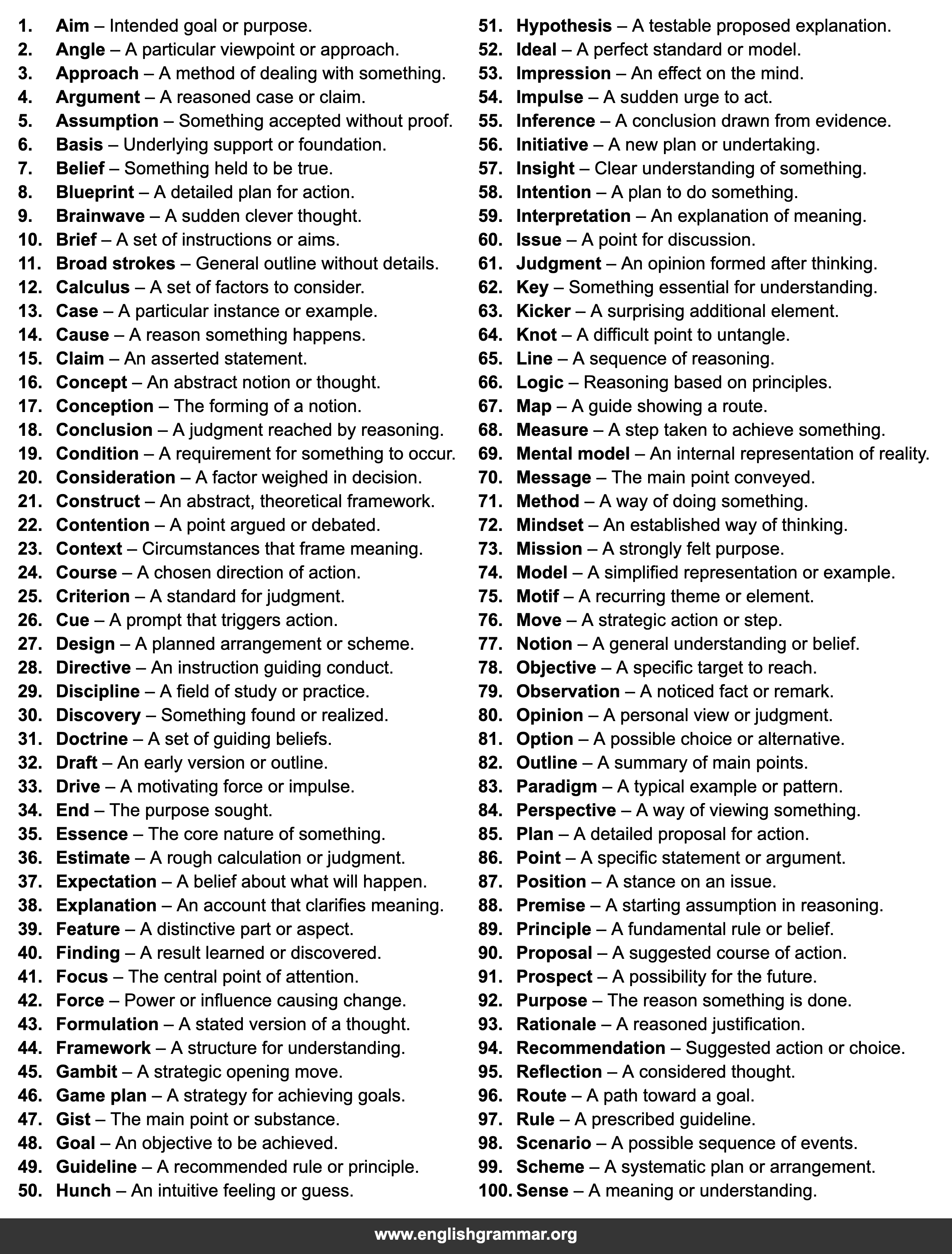
| No. | Term | Definition |
|---|---|---|
| 1. | Aim | Intended goal or purpose. |
| 2. | Angle | A particular viewpoint or approach. |
| 3. | Approach | A method of dealing with something. |
| 4. | Argument | A reasoned case or claim. |
| 5. | Assumption | Something accepted without proof. |
| 6. | Basis | Underlying support or foundation. |
| 7. | Belief | Something held to be true. |
| 8. | Blueprint | A detailed plan for action. |
| 9. | Brainwave | A sudden clever thought. |
| 10. | Brief | A set of instructions or aims. |
| 11. | Broad strokes | General outline without details. |
| 12. | Calculus | A set of factors to consider. |
| 13. | Case | A particular instance or example. |
| 14. | Cause | A reason something happens. |
| 15. | Claim | An asserted statement. |
| 16. | Concept | An abstract notion or thought. |
| 17. | Conception | The forming of a notion. |
| 18. | Conclusion | A judgment reached by reasoning. |
| 19. | Condition | A requirement for something to occur. |
| 20. | Consideration | A factor weighed in decision. |
| 21. | Construct | An abstract, theoretical framework. |
| 22. | Contention | A point argued or debated. |
| 23. | Context | Circumstances that frame meaning. |
| 24. | Course | A chosen direction of action. |
| 25. | Criterion | A standard for judgment. |
| 26. | Cue | A prompt that triggers action. |
| 27. | Design | A planned arrangement or scheme. |
| 28. | Directive | An instruction guiding conduct. |
| 29. | Discipline | A field of study or practice. |
| 30. | Discovery | Something found or realized. |
| 31. | Doctrine | A set of guiding beliefs. |
| 32. | Draft | An early version or outline. |
| 33. | Drive | A motivating force or impulse. |
| 34. | End | The purpose sought. |
| 35. | Essence | The core nature of something. |
| 36. | Estimate | A rough calculation or judgment. |
| 37. | Expectation | A belief about what will happen. |
| 38. | Explanation | An account that clarifies meaning. |
| 39. | Feature | A distinctive part or aspect. |
| 40. | Finding | A result learned or discovered. |
| 41. | Focus | The central point of attention. |
| 42. | Force | Power or influence causing change. |
| 43. | Formulation | A stated version of a thought. |
| 44. | Framework | A structure for understanding. |
| 45. | Gambit | A strategic opening move. |
| 46. | Game plan | A strategy for achieving goals. |
| 47. | Gist | The main point or substance. |
| 48. | Goal | An objective to be achieved. |
| 49. | Guideline | A recommended rule or principle. |
| 50. | Hunch | An intuitive feeling or guess. |
| 51. | Hypothesis | A testable proposed explanation. |
| 52. | Ideal | A perfect standard or model. |
| 53. | Impression | An effect on the mind. |
| 54. | Impulse | A sudden urge to act. |
| 55. | Inference | A conclusion drawn from evidence. |
| 56. | Initiative | A new plan or undertaking. |
| 57. | Insight | Clear understanding of something. |
| 58. | Intention | A plan to do something. |
| 59. | Interpretation | An explanation of meaning. |
| 60. | Issue | A point for discussion. |
| 61. | Judgment | An opinion formed after thinking. |
| 62. | Key | Something essential for understanding. |
| 63. | Kicker | A surprising additional element. |
| 64. | Knot | A difficult point to untangle. |
| 65. | Line | A sequence of reasoning. |
| 66. | Logic | Reasoning based on principles. |
| 67. | Map | A guide showing a route. |
| 68. | Measure | A step taken to achieve something. |
| 69. | Mental model | An internal representation of reality. |
| 70. | Message | The main point conveyed. |
| 71. | Method | A way of doing something. |
| 72. | Mindset | An established way of thinking. |
| 73. | Mission | A strongly felt purpose. |
| 74. | Model | A simplified representation or example. |
| 75. | Motif | A recurring theme or element. |
| 76. | Move | A strategic action or step. |
| 77. | Notion | A general understanding or belief. |
| 78. | Objective | A specific target to reach. |
| 79. | Observation | A noticed fact or remark. |
| 80. | Opinion | A personal view or judgment. |
| 81. | Option | A possible choice or alternative. |
| 82. | Outline | A summary of main points. |
| 83. | Paradigm | A typical example or pattern. |
| 84. | Perspective | A way of viewing something. |
| 85. | Plan | A detailed proposal for action. |
| 86. | Point | A specific statement or argument. |
| 87. | Position | A stance on an issue. |
| 88. | Premise | A starting assumption in reasoning. |
| 89. | Principle | A fundamental rule or belief. |
| 90. | Proposal | A suggested course of action. |
| 91. | Prospect | A possibility for the future. |
| 92. | Purpose | The reason something is done. |
| 93. | Rationale | A reasoned justification. |
| 94. | Recommendation | Suggested action or choice. |
| 95. | Reflection | A considered thought. |
| 96. | Route | A path toward a goal. |
| 97. | Rule | A prescribed guideline. |
| 98. | Scenario | A possible sequence of events. |
| 99. | Scheme | A systematic plan or arrangement. |
| 100. | Sense | A meaning or understanding. |
