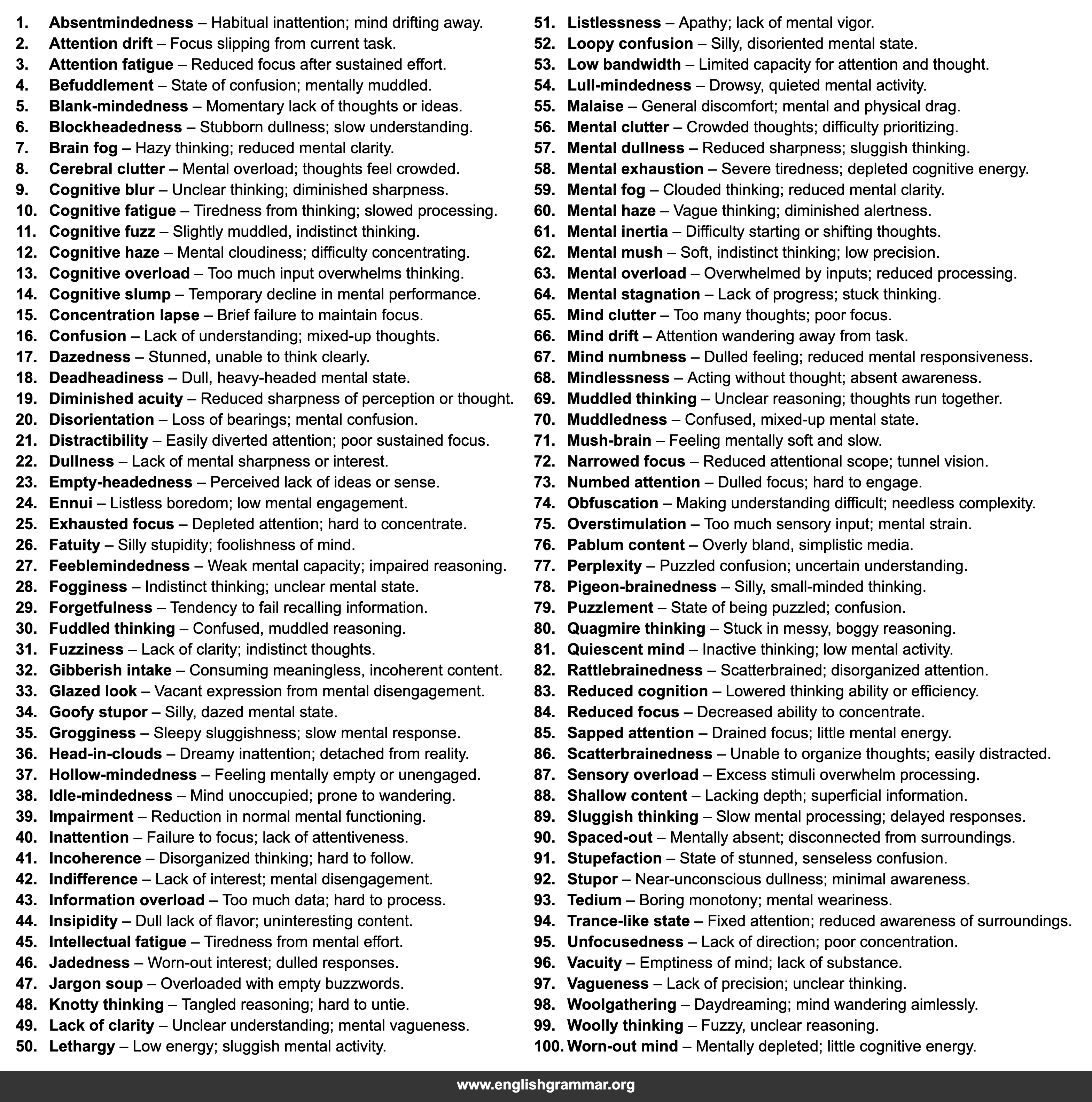
| No. | Term | Definition |
|---|---|---|
| 1. | Absentmindedness | Habitual inattention; mind drifting away. |
| 2. | Attention drift | Focus slipping from current task. |
| 3. | Attention fatigue | Reduced focus after sustained effort. |
| 4. | Befuddlement | State of confusion; mentally muddled. |
| 5. | Blank-mindedness | Momentary lack of thoughts or ideas. |
| 6. | Blockheadedness | Stubborn dullness; slow understanding. |
| 7. | Brain fog | Hazy thinking; reduced mental clarity. |
| 8. | Cerebral clutter | Mental overload; thoughts feel crowded. |
| 9. | Cognitive blur | Unclear thinking; diminished sharpness. |
| 10. | Cognitive fatigue | Tiredness from thinking; slowed processing. |
| 11. | Cognitive fuzz | Slightly muddled, indistinct thinking. |
| 12. | Cognitive haze | Mental cloudiness; difficulty concentrating. |
| 13. | Cognitive overload | Too much input overwhelms thinking. |
| 14. | Cognitive slump | Temporary decline in mental performance. |
| 15. | Concentration lapse | Brief failure to maintain focus. |
| 16. | Confusion | Lack of understanding; mixed-up thoughts. |
| 17. | Dazedness | Stunned, unable to think clearly. |
| 18. | Deadheadiness | Dull, heavy-headed mental state. |
| 19. | Diminished acuity | Reduced sharpness of perception or thought. |
| 20. | Disorientation | Loss of bearings; mental confusion. |
| 21. | Distractibility | Easily diverted attention; poor sustained focus. |
| 22. | Dullness | Lack of mental sharpness or interest. |
| 23. | Empty-headedness | Perceived lack of ideas or sense. |
| 24. | Ennui | Listless boredom; low mental engagement. |
| 25. | Exhausted focus | Depleted attention; hard to concentrate. |
| 26. | Fatuity | Silly stupidity; foolishness of mind. |
| 27. | Feeblemindedness | Weak mental capacity; impaired reasoning. |
| 28. | Fogginess | Indistinct thinking; unclear mental state. |
| 29. | Forgetfulness | Tendency to fail recalling information. |
| 30. | Fuddled thinking | Confused, muddled reasoning. |
| 31. | Fuzziness | Lack of clarity; indistinct thoughts. |
| 32. | Gibberish intake | Consuming meaningless, incoherent content. |
| 33. | Glazed look | Vacant expression from mental disengagement. |
| 34. | Goofy stupor | Silly, dazed mental state. |
| 35. | Grogginess | Sleepy sluggishness; slow mental response. |
| 36. | Head-in-clouds | Dreamy inattention; detached from reality. |
| 37. | Hollow-mindedness | Feeling mentally empty or unengaged. |
| 38. | Idle-mindedness | Mind unoccupied; prone to wandering. |
| 39. | Impairment | Reduction in normal mental functioning. |
| 40. | Inattention | Failure to focus; lack of attentiveness. |
| 41. | Incoherence | Disorganized thinking; hard to follow. |
| 42. | Indifference | Lack of interest; mental disengagement. |
| 43. | Information overload | Too much data; hard to process. |
| 44. | Insipidity | Dull lack of flavor; uninteresting content. |
| 45. | Intellectual fatigue | Tiredness from mental effort. |
| 46. | Jadedness | Worn-out interest; dulled responses. |
| 47. | Jargon soup | Overloaded with empty buzzwords. |
| 48. | Knotty thinking | Tangled reasoning; hard to untie. |
| 49. | Lack of clarity | Unclear understanding; mental vagueness. |
| 50. | Lethargy | Low energy; sluggish mental activity. |
| 51. | Listlessness | Apathy; lack of mental vigor. |
| 52. | Loopy confusion | Silly, disoriented mental state. |
| 53. | Low bandwidth | Limited capacity for attention and thought. |
| 54. | Lull-mindedness | Drowsy, quieted mental activity. |
| 55. | Malaise | General discomfort; mental and physical drag. |
| 56. | Mental clutter | Crowded thoughts; difficulty prioritizing. |
| 57. | Mental dullness | Reduced sharpness; sluggish thinking. |
| 58. | Mental exhaustion | Severe tiredness; depleted cognitive energy. |
| 59. | Mental fog | Clouded thinking; reduced mental clarity. |
| 60. | Mental haze | Vague thinking; diminished alertness. |
| 61. | Mental inertia | Difficulty starting or shifting thoughts. |
| 62. | Mental mush | Soft, indistinct thinking; low precision. |
| 63. | Mental overload | Overwhelmed by inputs; reduced processing. |
| 64. | Mental stagnation | Lack of progress; stuck thinking. |
| 65. | Mind clutter | Too many thoughts; poor focus. |
| 66. | Mind drift | Attention wandering away from task. |
| 67. | Mind numbness | Dulled feeling; reduced mental responsiveness. |
| 68. | Mindlessness | Acting without thought; absent awareness. |
| 69. | Muddled thinking | Unclear reasoning; thoughts run together. |
| 70. | Muddledness | Confused, mixed-up mental state. |
| 71. | Mush-brain | Feeling mentally soft and slow. |
| 72. | Narrowed focus | Reduced attentional scope; tunnel vision. |
| 73. | Numbed attention | Dulled focus; hard to engage. |
| 74. | Obfuscation | Making understanding difficult; needless complexity. |
| 75. | Overstimulation | Too much sensory input; mental strain. |
| 76. | Pablum content | Overly bland, simplistic media. |
| 77. | Perplexity | Puzzled confusion; uncertain understanding. |
| 78. | Pigeon-brainedness | Silly, small-minded thinking. |
| 79. | Puzzlement | State of being puzzled; confusion. |
| 80. | Quagmire thinking | Stuck in messy, boggy reasoning. |
| 81. | Quiescent mind | Inactive thinking; low mental activity. |
| 82. | Rattlebrainedness | Scatterbrained; disorganized attention. |
| 83. | Reduced cognition | Lowered thinking ability or efficiency. |
| 84. | Reduced focus | Decreased ability to concentrate. |
| 85. | Sapped attention | Drained focus; little mental energy. |
| 86. | Scatterbrainedness | Unable to organize thoughts; easily distracted. |
| 87. | Sensory overload | Excess stimuli overwhelm processing. |
| 88. | Shallow content | Lacking depth; superficial information. |
| 89. | Sluggish thinking | Slow mental processing; delayed responses. |
| 90. | Spaced-out | Mentally absent; disconnected from surroundings. |
| 91. | Stupefaction | State of stunned, senseless confusion. |
| 92. | Stupor | Near-unconscious dullness; minimal awareness. |
| 93. | Tedium | Boring monotony; mental weariness. |
| 94. | Trance-like state | Fixed attention; reduced awareness of surroundings. |
| 95. | Unfocusedness | Lack of direction; poor concentration. |
| 96. | Vacuity | Emptiness of mind; lack of substance. |
| 97. | Vagueness | Lack of precision; unclear thinking. |
| 98. | Woolgathering | Daydreaming; mind wandering aimlessly. |
| 99. | Woolly thinking | Fuzzy, unclear reasoning. |
| 100. | Worn-out mind | Mentally depleted; little cognitive energy. |
