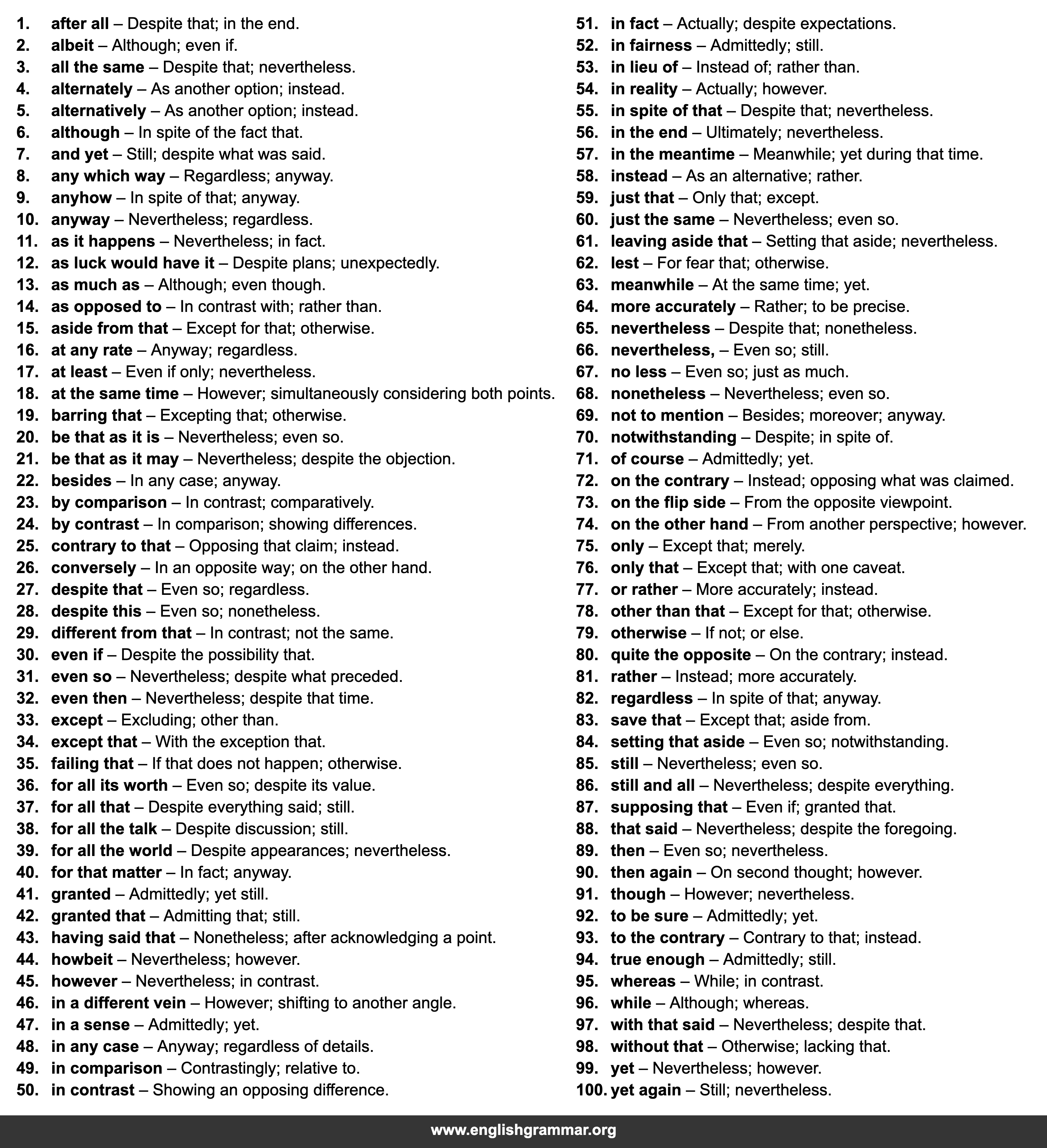
| No. | Term | Definition |
|---|---|---|
| 1. | after all | Despite that; in the end. |
| 2. | albeit | Although; even if. |
| 3. | all the same | Despite that; nevertheless. |
| 4. | alternately | As another option; instead. |
| 5. | alternatively | As another option; instead. |
| 6. | although | In spite of the fact that. |
| 7. | and yet | Still; despite what was said. |
| 8. | any which way | Regardless; anyway. |
| 9. | anyhow | In spite of that; anyway. |
| 10. | anyway | Nevertheless; regardless. |
| 11. | as it happens | Nevertheless; in fact. |
| 12. | as luck would have it | Despite plans; unexpectedly. |
| 13. | as much as | Although; even though. |
| 14. | as opposed to | In contrast with; rather than. |
| 15. | aside from that | Except for that; otherwise. |
| 16. | at any rate | Anyway; regardless. |
| 17. | at least | Even if only; nevertheless. |
| 18. | at the same time | However; simultaneously considering both points. |
| 19. | barring that | Excepting that; otherwise. |
| 20. | be that as it is | Nevertheless; even so. |
| 21. | be that as it may | Nevertheless; despite the objection. |
| 22. | besides | In any case; anyway. |
| 23. | by comparison | In contrast; comparatively. |
| 24. | by contrast | In comparison; showing differences. |
| 25. | contrary to that | Opposing that claim; instead. |
| 26. | conversely | In an opposite way; on the other hand. |
| 27. | despite that | Even so; regardless. |
| 28. | despite this | Even so; nonetheless. |
| 29. | different from that | In contrast; not the same. |
| 30. | even if | Despite the possibility that. |
| 31. | even so | Nevertheless; despite what preceded. |
| 32. | even then | Nevertheless; despite that time. |
| 33. | except | Excluding; other than. |
| 34. | except that | With the exception that. |
| 35. | failing that | If that does not happen; otherwise. |
| 36. | for all its worth | Even so; despite its value. |
| 37. | for all that | Despite everything said; still. |
| 38. | for all the talk | Despite discussion; still. |
| 39. | for all the world | Despite appearances; nevertheless. |
| 40. | for that matter | In fact; anyway. |
| 41. | granted | Admittedly; yet still. |
| 42. | granted that | Admitting that; still. |
| 43. | having said that | Nonetheless; after acknowledging a point. |
| 44. | howbeit | Nevertheless; however. |
| 45. | however | Nevertheless; in contrast. |
| 46. | in a different vein | However; shifting to another angle. |
| 47. | in a sense | Admittedly; yet. |
| 48. | in any case | Anyway; regardless of details. |
| 49. | in comparison | Contrastingly; relative to. |
| 50. | in contrast | Showing an opposing difference. |
| 51. | in fact | Actually; despite expectations. |
| 52. | in fairness | Admittedly; still. |
| 53. | in lieu of | Instead of; rather than. |
| 54. | in reality | Actually; however. |
| 55. | in spite of that | Despite that; nevertheless. |
| 56. | in the end | Ultimately; nevertheless. |
| 57. | in the meantime | Meanwhile; yet during that time. |
| 58. | instead | As an alternative; rather. |
| 59. | just that | Only that; except. |
| 60. | just the same | Nevertheless; even so. |
| 61. | leaving aside that | Setting that aside; nevertheless. |
| 62. | lest | For fear that; otherwise. |
| 63. | meanwhile | At the same time; yet. |
| 64. | more accurately | Rather; to be precise. |
| 65. | nevertheless | Despite that; nonetheless. |
| 66. | nevertheless, | Even so; still. |
| 67. | no less | Even so; just as much. |
| 68. | nonetheless | Nevertheless; even so. |
| 69. | not to mention | Besides; moreover; anyway. |
| 70. | notwithstanding | Despite; in spite of. |
| 71. | of course | Admittedly; yet. |
| 72. | on the contrary | Instead; opposing what was claimed. |
| 73. | on the flip side | From the opposite viewpoint. |
| 74. | on the other hand | From another perspective; however. |
| 75. | only | Except that; merely. |
| 76. | only that | Except that; with one caveat. |
| 77. | or rather | More accurately; instead. |
| 78. | other than that | Except for that; otherwise. |
| 79. | otherwise | If not; or else. |
| 80. | quite the opposite | On the contrary; instead. |
| 81. | rather | Instead; more accurately. |
| 82. | regardless | In spite of that; anyway. |
| 83. | save that | Except that; aside from. |
| 84. | setting that aside | Even so; notwithstanding. |
| 85. | still | Nevertheless; even so. |
| 86. | still and all | Nevertheless; despite everything. |
| 87. | supposing that | Even if; granted that. |
| 88. | that said | Nevertheless; despite the foregoing. |
| 89. | then | Even so; nevertheless. |
| 90. | then again | On second thought; however. |
| 91. | though | However; nevertheless. |
| 92. | to be sure | Admittedly; yet. |
| 93. | to the contrary | Contrary to that; instead. |
| 94. | true enough | Admittedly; still. |
| 95. | whereas | While; in contrast. |
| 96. | while | Although; whereas. |
| 97. | with that said | Nevertheless; despite that. |
| 98. | without that | Otherwise; lacking that. |
| 99. | yet | Nevertheless; however. |
| 100. | yet again | Still; nevertheless. |
