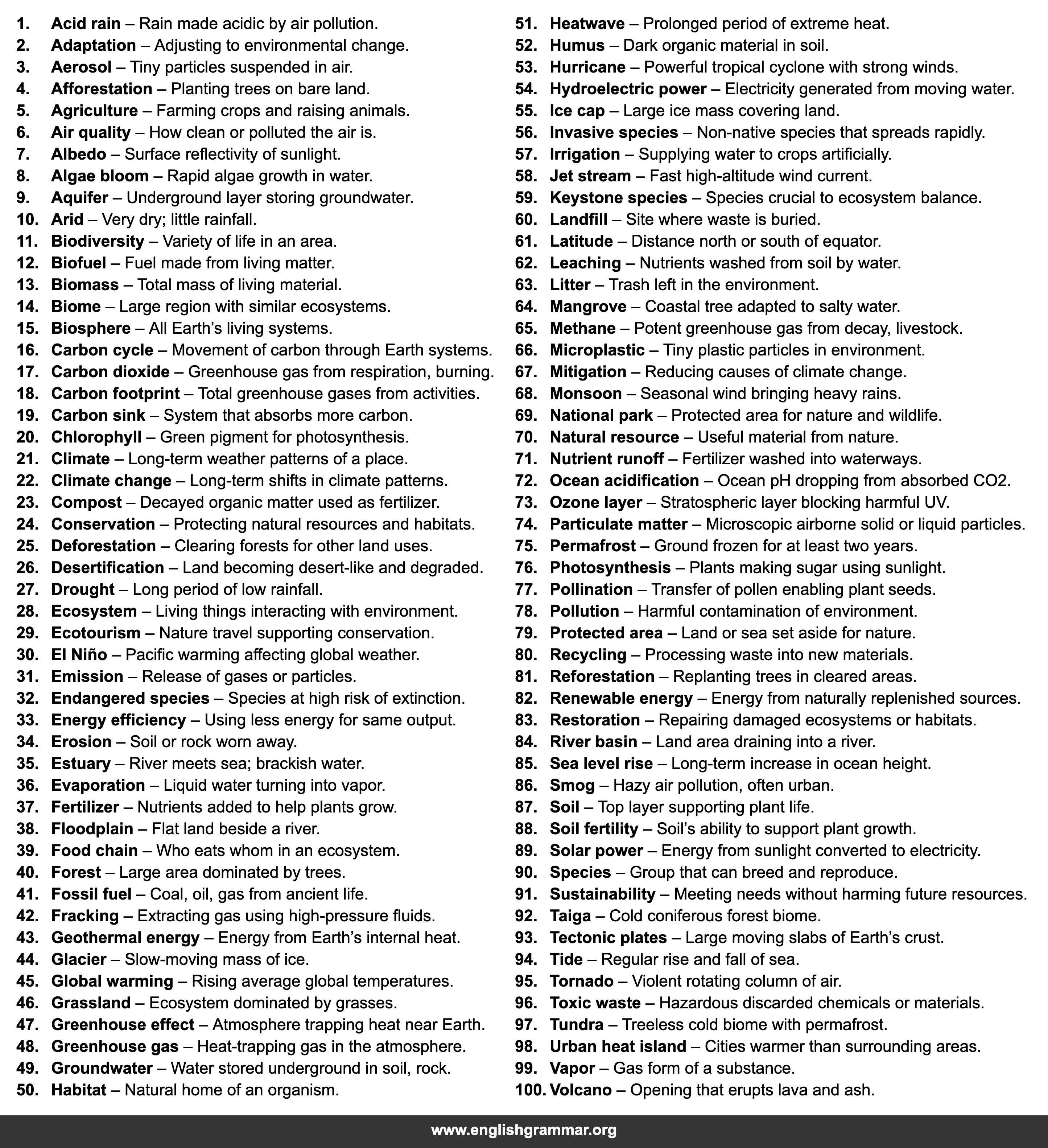
| No. | Term | Definition |
|---|---|---|
| 1. | Acid rain | Rain made acidic by air pollution. |
| 2. | Adaptation | Adjusting to environmental change. |
| 3. | Aerosol | Tiny particles suspended in air. |
| 4. | Afforestation | Planting trees on bare land. |
| 5. | Agriculture | Farming crops and raising animals. |
| 6. | Air quality | How clean or polluted the air is. |
| 7. | Albedo | Surface reflectivity of sunlight. |
| 8. | Algae bloom | Rapid algae growth in water. |
| 9. | Aquifer | Underground layer storing groundwater. |
| 10. | Arid | Very dry; little rainfall. |
| 11. | Biodiversity | Variety of life in an area. |
| 12. | Biofuel | Fuel made from living matter. |
| 13. | Biomass | Total mass of living material. |
| 14. | Biome | Large region with similar ecosystems. |
| 15. | Biosphere | All Earth’s living systems. |
| 16. | Carbon cycle | Movement of carbon through Earth systems. |
| 17. | Carbon dioxide | Greenhouse gas from respiration, burning. |
| 18. | Carbon footprint | Total greenhouse gases from activities. |
| 19. | Carbon sink | System that absorbs more carbon. |
| 20. | Chlorophyll | Green pigment for photosynthesis. |
| 21. | Climate | Long-term weather patterns of a place. |
| 22. | Climate change | Long-term shifts in climate patterns. |
| 23. | Compost | Decayed organic matter used as fertilizer. |
| 24. | Conservation | Protecting natural resources and habitats. |
| 25. | Deforestation | Clearing forests for other land uses. |
| 26. | Desertification | Land becoming desert-like and degraded. |
| 27. | Drought | Long period of low rainfall. |
| 28. | Ecosystem | Living things interacting with environment. |
| 29. | Ecotourism | Nature travel supporting conservation. |
| 30. | El Niño | Pacific warming affecting global weather. |
| 31. | Emission | Release of gases or particles. |
| 32. | Endangered species | Species at high risk of extinction. |
| 33. | Energy efficiency | Using less energy for same output. |
| 34. | Erosion | Soil or rock worn away. |
| 35. | Estuary | River meets sea; brackish water. |
| 36. | Evaporation | Liquid water turning into vapor. |
| 37. | Fertilizer | Nutrients added to help plants grow. |
| 38. | Floodplain | Flat land beside a river. |
| 39. | Food chain | Who eats whom in an ecosystem. |
| 40. | Forest | Large area dominated by trees. |
| 41. | Fossil fuel | Coal, oil, gas from ancient life. |
| 42. | Fracking | Extracting gas using high-pressure fluids. |
| 43. | Geothermal energy | Energy from Earth’s internal heat. |
| 44. | Glacier | Slow-moving mass of ice. |
| 45. | Global warming | Rising average global temperatures. |
| 46. | Grassland | Ecosystem dominated by grasses. |
| 47. | Greenhouse effect | Atmosphere trapping heat near Earth. |
| 48. | Greenhouse gas | Heat-trapping gas in the atmosphere. |
| 49. | Groundwater | Water stored underground in soil, rock. |
| 50. | Habitat | Natural home of an organism. |
| 51. | Heatwave | Prolonged period of extreme heat. |
| 52. | Humus | Dark organic material in soil. |
| 53. | Hurricane | Powerful tropical cyclone with strong winds. |
| 54. | Hydroelectric power | Electricity generated from moving water. |
| 55. | Ice cap | Large ice mass covering land. |
| 56. | Invasive species | Non-native species that spreads rapidly. |
| 57. | Irrigation | Supplying water to crops artificially. |
| 58. | Jet stream | Fast high-altitude wind current. |
| 59. | Keystone species | Species crucial to ecosystem balance. |
| 60. | Landfill | Site where waste is buried. |
| 61. | Latitude | Distance north or south of equator. |
| 62. | Leaching | Nutrients washed from soil by water. |
| 63. | Litter | Trash left in the environment. |
| 64. | Mangrove | Coastal tree adapted to salty water. |
| 65. | Methane | Potent greenhouse gas from decay, livestock. |
| 66. | Microplastic | Tiny plastic particles in environment. |
| 67. | Mitigation | Reducing causes of climate change. |
| 68. | Monsoon | Seasonal wind bringing heavy rains. |
| 69. | National park | Protected area for nature and wildlife. |
| 70. | Natural resource | Useful material from nature. |
| 71. | Nutrient runoff | Fertilizer washed into waterways. |
| 72. | Ocean acidification | Ocean pH dropping from absorbed CO2. |
| 73. | Ozone layer | Stratospheric layer blocking harmful UV. |
| 74. | Particulate matter | Microscopic airborne solid or liquid particles. |
| 75. | Permafrost | Ground frozen for at least two years. |
| 76. | Photosynthesis | Plants making sugar using sunlight. |
| 77. | Pollination | Transfer of pollen enabling plant seeds. |
| 78. | Pollution | Harmful contamination of environment. |
| 79. | Protected area | Land or sea set aside for nature. |
| 80. | Recycling | Processing waste into new materials. |
| 81. | Reforestation | Replanting trees in cleared areas. |
| 82. | Renewable energy | Energy from naturally replenished sources. |
| 83. | Restoration | Repairing damaged ecosystems or habitats. |
| 84. | River basin | Land area draining into a river. |
| 85. | Sea level rise | Long-term increase in ocean height. |
| 86. | Smog | Hazy air pollution, often urban. |
| 87. | Soil | Top layer supporting plant life. |
| 88. | Soil fertility | Soil’s ability to support plant growth. |
| 89. | Solar power | Energy from sunlight converted to electricity. |
| 90. | Species | Group that can breed and reproduce. |
| 91. | Sustainability | Meeting needs without harming future resources. |
| 92. | Taiga | Cold coniferous forest biome. |
| 93. | Tectonic plates | Large moving slabs of Earth’s crust. |
| 94. | Tide | Regular rise and fall of sea. |
| 95. | Tornado | Violent rotating column of air. |
| 96. | Toxic waste | Hazardous discarded chemicals or materials. |
| 97. | Tundra | Treeless cold biome with permafrost. |
| 98. | Urban heat island | Cities warmer than surrounding areas. |
| 99. | Vapor | Gas form of a substance. |
| 100. | Volcano | Opening that erupts lava and ash. |
