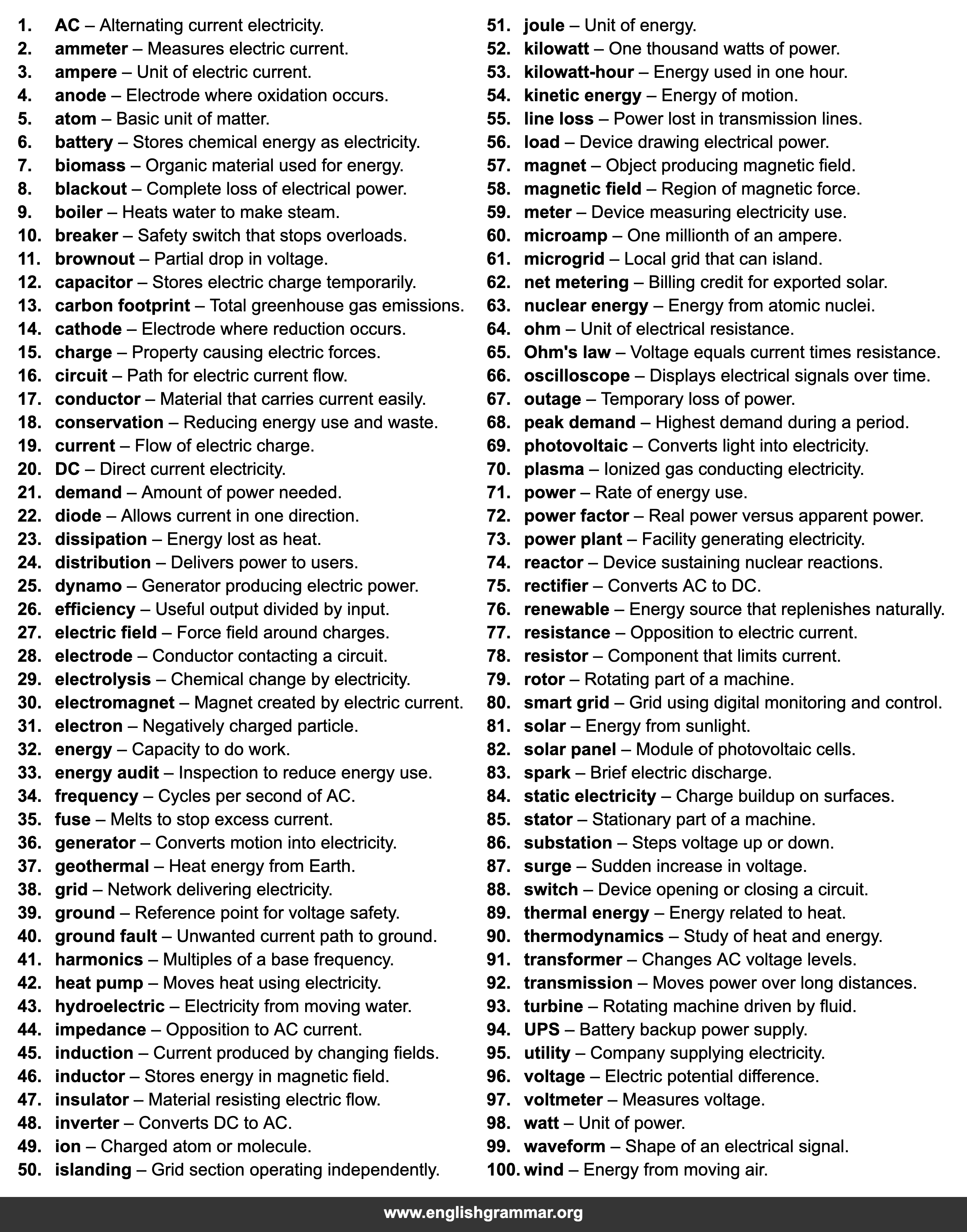
| No. | Term | Definition |
|---|---|---|
| 1. | AC | Alternating current electricity. |
| 2. | ammeter | Measures electric current. |
| 3. | ampere | Unit of electric current. |
| 4. | anode | Electrode where oxidation occurs. |
| 5. | atom | Basic unit of matter. |
| 6. | battery | Stores chemical energy as electricity. |
| 7. | biomass | Organic material used for energy. |
| 8. | blackout | Complete loss of electrical power. |
| 9. | boiler | Heats water to make steam. |
| 10. | breaker | Safety switch that stops overloads. |
| 11. | brownout | Partial drop in voltage. |
| 12. | capacitor | Stores electric charge temporarily. |
| 13. | carbon footprint | Total greenhouse gas emissions. |
| 14. | cathode | Electrode where reduction occurs. |
| 15. | charge | Property causing electric forces. |
| 16. | circuit | Path for electric current flow. |
| 17. | conductor | Material that carries current easily. |
| 18. | conservation | Reducing energy use and waste. |
| 19. | current | Flow of electric charge. |
| 20. | DC | Direct current electricity. |
| 21. | demand | Amount of power needed. |
| 22. | diode | Allows current in one direction. |
| 23. | dissipation | Energy lost as heat. |
| 24. | distribution | Delivers power to users. |
| 25. | dynamo | Generator producing electric power. |
| 26. | efficiency | Useful output divided by input. |
| 27. | electric field | Force field around charges. |
| 28. | electrode | Conductor contacting a circuit. |
| 29. | electrolysis | Chemical change by electricity. |
| 30. | electromagnet | Magnet created by electric current. |
| 31. | electron | Negatively charged particle. |
| 32. | energy | Capacity to do work. |
| 33. | energy audit | Inspection to reduce energy use. |
| 34. | frequency | Cycles per second of AC. |
| 35. | fuse | Melts to stop excess current. |
| 36. | generator | Converts motion into electricity. |
| 37. | geothermal | Heat energy from Earth. |
| 38. | grid | Network delivering electricity. |
| 39. | ground | Reference point for voltage safety. |
| 40. | ground fault | Unwanted current path to ground. |
| 41. | harmonics | Multiples of a base frequency. |
| 42. | heat pump | Moves heat using electricity. |
| 43. | hydroelectric | Electricity from moving water. |
| 44. | impedance | Opposition to AC current. |
| 45. | induction | Current produced by changing fields. |
| 46. | inductor | Stores energy in magnetic field. |
| 47. | insulator | Material resisting electric flow. |
| 48. | inverter | Converts DC to AC. |
| 49. | ion | Charged atom or molecule. |
| 50. | islanding | Grid section operating independently. |
| 51. | joule | Unit of energy. |
| 52. | kilowatt | One thousand watts of power. |
| 53. | kilowatt-hour | Energy used in one hour. |
| 54. | kinetic energy | Energy of motion. |
| 55. | line loss | Power lost in transmission lines. |
| 56. | load | Device drawing electrical power. |
| 57. | magnet | Object producing magnetic field. |
| 58. | magnetic field | Region of magnetic force. |
| 59. | meter | Device measuring electricity use. |
| 60. | microamp | One millionth of an ampere. |
| 61. | microgrid | Local grid that can island. |
| 62. | net metering | Billing credit for exported solar. |
| 63. | nuclear energy | Energy from atomic nuclei. |
| 64. | ohm | Unit of electrical resistance. |
| 65. | Ohm’s law | Voltage equals current times resistance. |
| 66. | oscilloscope | Displays electrical signals over time. |
| 67. | outage | Temporary loss of power. |
| 68. | peak demand | Highest demand during a period. |
| 69. | photovoltaic | Converts light into electricity. |
| 70. | plasma | Ionized gas conducting electricity. |
| 71. | power | Rate of energy use. |
| 72. | power factor | Real power versus apparent power. |
| 73. | power plant | Facility generating electricity. |
| 74. | reactor | Device sustaining nuclear reactions. |
| 75. | rectifier | Converts AC to DC. |
| 76. | renewable | Energy source that replenishes naturally. |
| 77. | resistance | Opposition to electric current. |
| 78. | resistor | Component that limits current. |
| 79. | rotor | Rotating part of a machine. |
| 80. | smart grid | Grid using digital monitoring and control. |
| 81. | solar | Energy from sunlight. |
| 82. | solar panel | Module of photovoltaic cells. |
| 83. | spark | Brief electric discharge. |
| 84. | static electricity | Charge buildup on surfaces. |
| 85. | stator | Stationary part of a machine. |
| 86. | substation | Steps voltage up or down. |
| 87. | surge | Sudden increase in voltage. |
| 88. | switch | Device opening or closing a circuit. |
| 89. | thermal energy | Energy related to heat. |
| 90. | thermodynamics | Study of heat and energy. |
| 91. | transformer | Changes AC voltage levels. |
| 92. | transmission | Moves power over long distances. |
| 93. | turbine | Rotating machine driven by fluid. |
| 94. | UPS | Battery backup power supply. |
| 95. | utility | Company supplying electricity. |
| 96. | voltage | Electric potential difference. |
| 97. | voltmeter | Measures voltage. |
| 98. | watt | Unit of power. |
| 99. | waveform | Shape of an electrical signal. |
| 100. | wind | Energy from moving air. |
