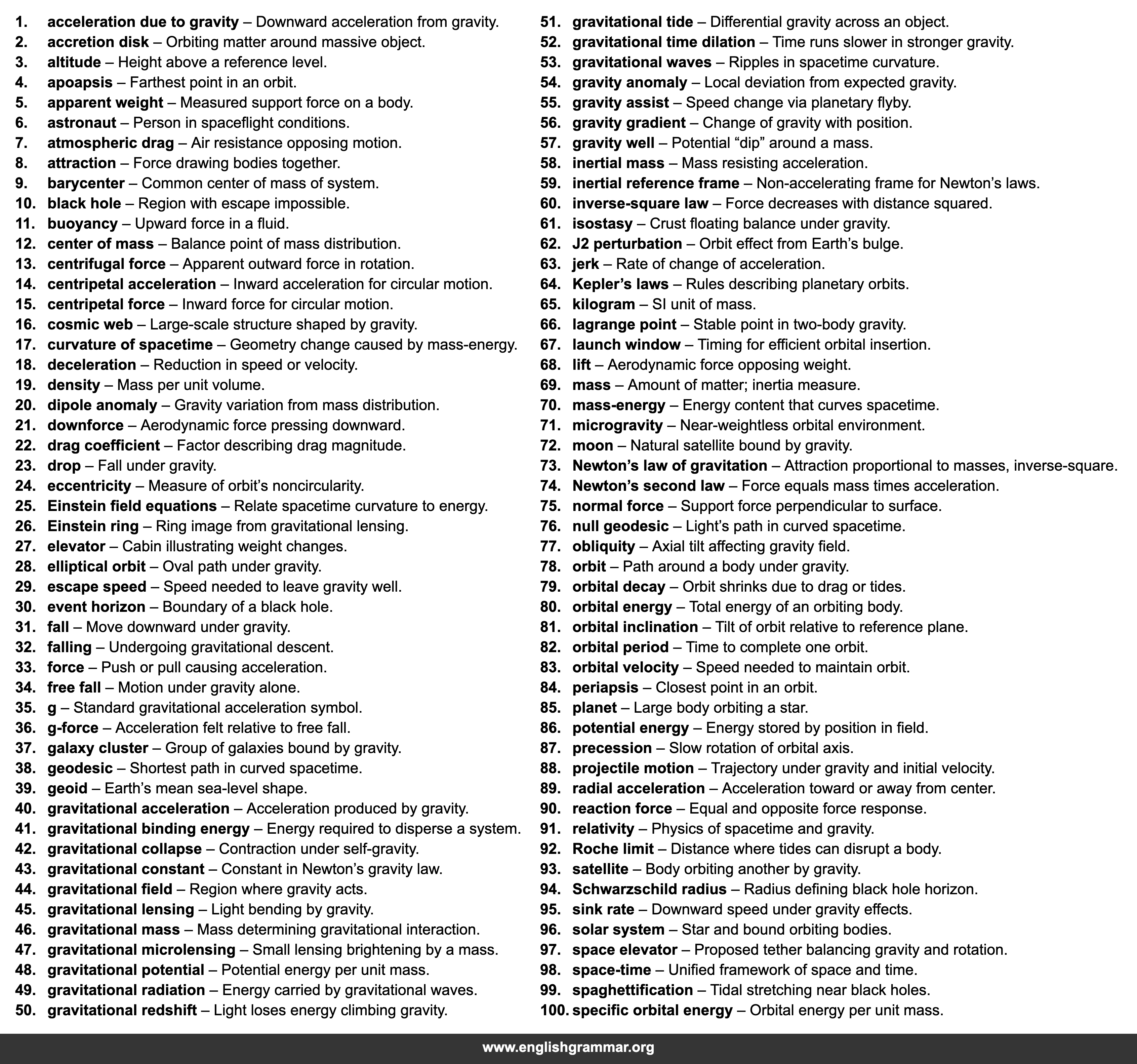
| No. | Term | Definition |
|---|---|---|
| 1. | acceleration due to gravity | Downward acceleration from gravity. |
| 2. | accretion disk | Orbiting matter around massive object. |
| 3. | altitude | Height above a reference level. |
| 4. | apoapsis | Farthest point in an orbit. |
| 5. | apparent weight | Measured support force on a body. |
| 6. | astronaut | Person in spaceflight conditions. |
| 7. | atmospheric drag | Air resistance opposing motion. |
| 8. | attraction | Force drawing bodies together. |
| 9. | barycenter | Common center of mass of system. |
| 10. | black hole | Region with escape impossible. |
| 11. | buoyancy | Upward force in a fluid. |
| 12. | center of mass | Balance point of mass distribution. |
| 13. | centrifugal force | Apparent outward force in rotation. |
| 14. | centripetal acceleration | Inward acceleration for circular motion. |
| 15. | centripetal force | Inward force for circular motion. |
| 16. | cosmic web | Large-scale structure shaped by gravity. |
| 17. | curvature of spacetime | Geometry change caused by mass-energy. |
| 18. | deceleration | Reduction in speed or velocity. |
| 19. | density | Mass per unit volume. |
| 20. | dipole anomaly | Gravity variation from mass distribution. |
| 21. | downforce | Aerodynamic force pressing downward. |
| 22. | drag coefficient | Factor describing drag magnitude. |
| 23. | drop | Fall under gravity. |
| 24. | eccentricity | Measure of orbit’s noncircularity. |
| 25. | Einstein field equations | Relate spacetime curvature to energy. |
| 26. | Einstein ring | Ring image from gravitational lensing. |
| 27. | elevator | Cabin illustrating weight changes. |
| 28. | elliptical orbit | Oval path under gravity. |
| 29. | escape speed | Speed needed to leave gravity well. |
| 30. | event horizon | Boundary of a black hole. |
| 31. | fall | Move downward under gravity. |
| 32. | falling | Undergoing gravitational descent. |
| 33. | force | Push or pull causing acceleration. |
| 34. | free fall | Motion under gravity alone. |
| 35. | g | Standard gravitational acceleration symbol. |
| 36. | g-force | Acceleration felt relative to free fall. |
| 37. | galaxy cluster | Group of galaxies bound by gravity. |
| 38. | geodesic | Shortest path in curved spacetime. |
| 39. | geoid | Earth’s mean sea-level shape. |
| 40. | gravitational acceleration | Acceleration produced by gravity. |
| 41. | gravitational binding energy | Energy required to disperse a system. |
| 42. | gravitational collapse | Contraction under self-gravity. |
| 43. | gravitational constant | Constant in Newton’s gravity law. |
| 44. | gravitational field | Region where gravity acts. |
| 45. | gravitational lensing | Light bending by gravity. |
| 46. | gravitational mass | Mass determining gravitational interaction. |
| 47. | gravitational microlensing | Small lensing brightening by a mass. |
| 48. | gravitational potential | Potential energy per unit mass. |
| 49. | gravitational radiation | Energy carried by gravitational waves. |
| 50. | gravitational redshift | Light loses energy climbing gravity. |
| 51. | gravitational tide | Differential gravity across an object. |
| 52. | gravitational time dilation | Time runs slower in stronger gravity. |
| 53. | gravitational waves | Ripples in spacetime curvature. |
| 54. | gravity anomaly | Local deviation from expected gravity. |
| 55. | gravity assist | Speed change via planetary flyby. |
| 56. | gravity gradient | Change of gravity with position. |
| 57. | gravity well | Potential “dip” around a mass. |
| 58. | inertial mass | Mass resisting acceleration. |
| 59. | inertial reference frame | Non-accelerating frame for Newton’s laws. |
| 60. | inverse-square law | Force decreases with distance squared. |
| 61. | isostasy | Crust floating balance under gravity. |
| 62. | J2 perturbation | Orbit effect from Earth’s bulge. |
| 63. | jerk | Rate of change of acceleration. |
| 64. | Kepler’s laws | Rules describing planetary orbits. |
| 65. | kilogram | SI unit of mass. |
| 66. | lagrange point | Stable point in two-body gravity. |
| 67. | launch window | Timing for efficient orbital insertion. |
| 68. | lift | Aerodynamic force opposing weight. |
| 69. | mass | Amount of matter; inertia measure. |
| 70. | mass-energy | Energy content that curves spacetime. |
| 71. | microgravity | Near-weightless orbital environment. |
| 72. | moon | Natural satellite bound by gravity. |
| 73. | Newton’s law of gravitation | Attraction proportional to masses, inverse-square. |
| 74. | Newton’s second law | Force equals mass times acceleration. |
| 75. | normal force | Support force perpendicular to surface. |
| 76. | null geodesic | Light’s path in curved spacetime. |
| 77. | obliquity | Axial tilt affecting gravity field. |
| 78. | orbit | Path around a body under gravity. |
| 79. | orbital decay | Orbit shrinks due to drag or tides. |
| 80. | orbital energy | Total energy of an orbiting body. |
| 81. | orbital inclination | Tilt of orbit relative to reference plane. |
| 82. | orbital period | Time to complete one orbit. |
| 83. | orbital velocity | Speed needed to maintain orbit. |
| 84. | periapsis | Closest point in an orbit. |
| 85. | planet | Large body orbiting a star. |
| 86. | potential energy | Energy stored by position in field. |
| 87. | precession | Slow rotation of orbital axis. |
| 88. | projectile motion | Trajectory under gravity and initial velocity. |
| 89. | radial acceleration | Acceleration toward or away from center. |
| 90. | reaction force | Equal and opposite force response. |
| 91. | relativity | Physics of spacetime and gravity. |
| 92. | Roche limit | Distance where tides can disrupt a body. |
| 93. | satellite | Body orbiting another by gravity. |
| 94. | Schwarzschild radius | Radius defining black hole horizon. |
| 95. | sink rate | Downward speed under gravity effects. |
| 96. | solar system | Star and bound orbiting bodies. |
| 97. | space elevator | Proposed tether balancing gravity and rotation. |
| 98. | space-time | Unified framework of space and time. |
| 99. | spaghettification | Tidal stretching near black holes. |
| 100. | specific orbital energy | Orbital energy per unit mass. |
