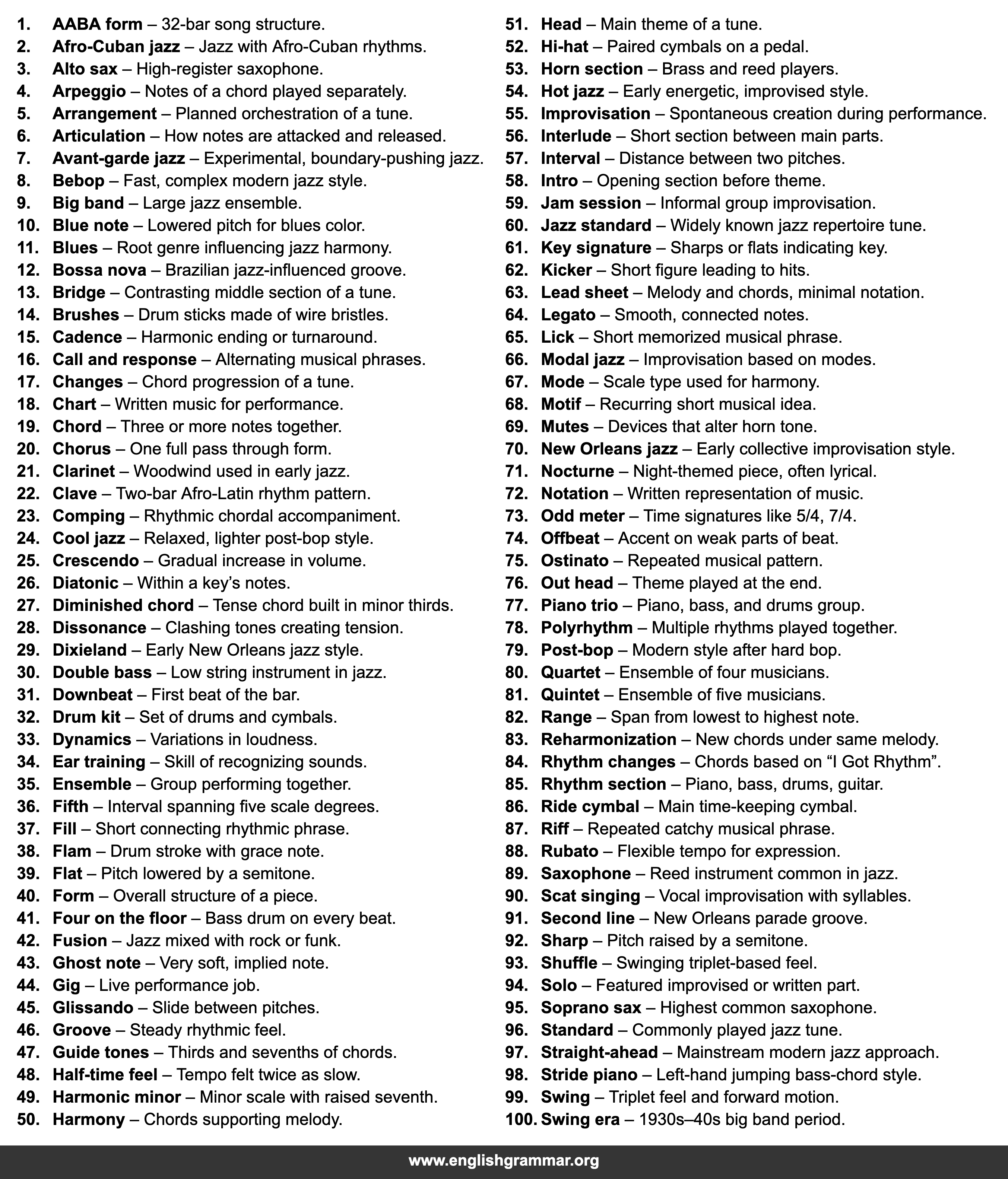
| No. | Term | Definition |
|---|---|---|
| 1. | AABA form | 32-bar song structure. |
| 2. | Afro-Cuban jazz | Jazz with Afro-Cuban rhythms. |
| 3. | Alto sax | High-register saxophone. |
| 4. | Arpeggio | Notes of a chord played separately. |
| 5. | Arrangement | Planned orchestration of a tune. |
| 6. | Articulation | How notes are attacked and released. |
| 7. | Avant-garde jazz | Experimental, boundary-pushing jazz. |
| 8. | Bebop | Fast, complex modern jazz style. |
| 9. | Big band | Large jazz ensemble. |
| 10. | Blue note | Lowered pitch for blues color. |
| 11. | Blues | Root genre influencing jazz harmony. |
| 12. | Bossa nova | Brazilian jazz-influenced groove. |
| 13. | Bridge | Contrasting middle section of a tune. |
| 14. | Brushes | Drum sticks made of wire bristles. |
| 15. | Cadence | Harmonic ending or turnaround. |
| 16. | Call and response | Alternating musical phrases. |
| 17. | Changes | Chord progression of a tune. |
| 18. | Chart | Written music for performance. |
| 19. | Chord | Three or more notes together. |
| 20. | Chorus | One full pass through form. |
| 21. | Clarinet | Woodwind used in early jazz. |
| 22. | Clave | Two-bar Afro-Latin rhythm pattern. |
| 23. | Comping | Rhythmic chordal accompaniment. |
| 24. | Cool jazz | Relaxed, lighter post-bop style. |
| 25. | Crescendo | Gradual increase in volume. |
| 26. | Diatonic | Within a key’s notes. |
| 27. | Diminished chord | Tense chord built in minor thirds. |
| 28. | Dissonance | Clashing tones creating tension. |
| 29. | Dixieland | Early New Orleans jazz style. |
| 30. | Double bass | Low string instrument in jazz. |
| 31. | Downbeat | First beat of the bar. |
| 32. | Drum kit | Set of drums and cymbals. |
| 33. | Dynamics | Variations in loudness. |
| 34. | Ear training | Skill of recognizing sounds. |
| 35. | Ensemble | Group performing together. |
| 36. | Fifth | Interval spanning five scale degrees. |
| 37. | Fill | Short connecting rhythmic phrase. |
| 38. | Flam | Drum stroke with grace note. |
| 39. | Flat | Pitch lowered by a semitone. |
| 40. | Form | Overall structure of a piece. |
| 41. | Four on the floor | Bass drum on every beat. |
| 42. | Fusion | Jazz mixed with rock or funk. |
| 43. | Ghost note | Very soft, implied note. |
| 44. | Gig | Live performance job. |
| 45. | Glissando | Slide between pitches. |
| 46. | Groove | Steady rhythmic feel. |
| 47. | Guide tones | Thirds and sevenths of chords. |
| 48. | Half-time feel | Tempo felt twice as slow. |
| 49. | Harmonic minor | Minor scale with raised seventh. |
| 50. | Harmony | Chords supporting melody. |
| 51. | Head | Main theme of a tune. |
| 52. | Hi-hat | Paired cymbals on a pedal. |
| 53. | Horn section | Brass and reed players. |
| 54. | Hot jazz | Early energetic, improvised style. |
| 55. | Improvisation | Spontaneous creation during performance. |
| 56. | Interlude | Short section between main parts. |
| 57. | Interval | Distance between two pitches. |
| 58. | Intro | Opening section before theme. |
| 59. | Jam session | Informal group improvisation. |
| 60. | Jazz standard | Widely known jazz repertoire tune. |
| 61. | Key signature | Sharps or flats indicating key. |
| 62. | Kicker | Short figure leading to hits. |
| 63. | Lead sheet | Melody and chords, minimal notation. |
| 64. | Legato | Smooth, connected notes. |
| 65. | Lick | Short memorized musical phrase. |
| 66. | Modal jazz | Improvisation based on modes. |
| 67. | Mode | Scale type used for harmony. |
| 68. | Motif | Recurring short musical idea. |
| 69. | Mutes | Devices that alter horn tone. |
| 70. | New Orleans jazz | Early collective improvisation style. |
| 71. | Nocturne | Night-themed piece, often lyrical. |
| 72. | Notation | Written representation of music. |
| 73. | Odd meter | Time signatures like 5/4, 7/4. |
| 74. | Offbeat | Accent on weak parts of beat. |
| 75. | Ostinato | Repeated musical pattern. |
| 76. | Out head | Theme played at the end. |
| 77. | Piano trio | Piano, bass, and drums group. |
| 78. | Polyrhythm | Multiple rhythms played together. |
| 79. | Post-bop | Modern style after hard bop. |
| 80. | Quartet | Ensemble of four musicians. |
| 81. | Quintet | Ensemble of five musicians. |
| 82. | Range | Span from lowest to highest note. |
| 83. | Reharmonization | New chords under same melody. |
| 84. | Rhythm changes | Chords based on “I Got Rhythm”. |
| 85. | Rhythm section | Piano, bass, drums, guitar. |
| 86. | Ride cymbal | Main time-keeping cymbal. |
| 87. | Riff | Repeated catchy musical phrase. |
| 88. | Rubato | Flexible tempo for expression. |
| 89. | Saxophone | Reed instrument common in jazz. |
| 90. | Scat singing | Vocal improvisation with syllables. |
| 91. | Second line | New Orleans parade groove. |
| 92. | Sharp | Pitch raised by a semitone. |
| 93. | Shuffle | Swinging triplet-based feel. |
| 94. | Solo | Featured improvised or written part. |
| 95. | Soprano sax | Highest common saxophone. |
| 96. | Standard | Commonly played jazz tune. |
| 97. | Straight-ahead | Mainstream modern jazz approach. |
| 98. | Stride piano | Left-hand jumping bass-chord style. |
| 99. | Swing | Triplet feel and forward motion. |
| 100. | Swing era | 1930s–40s big band period. |