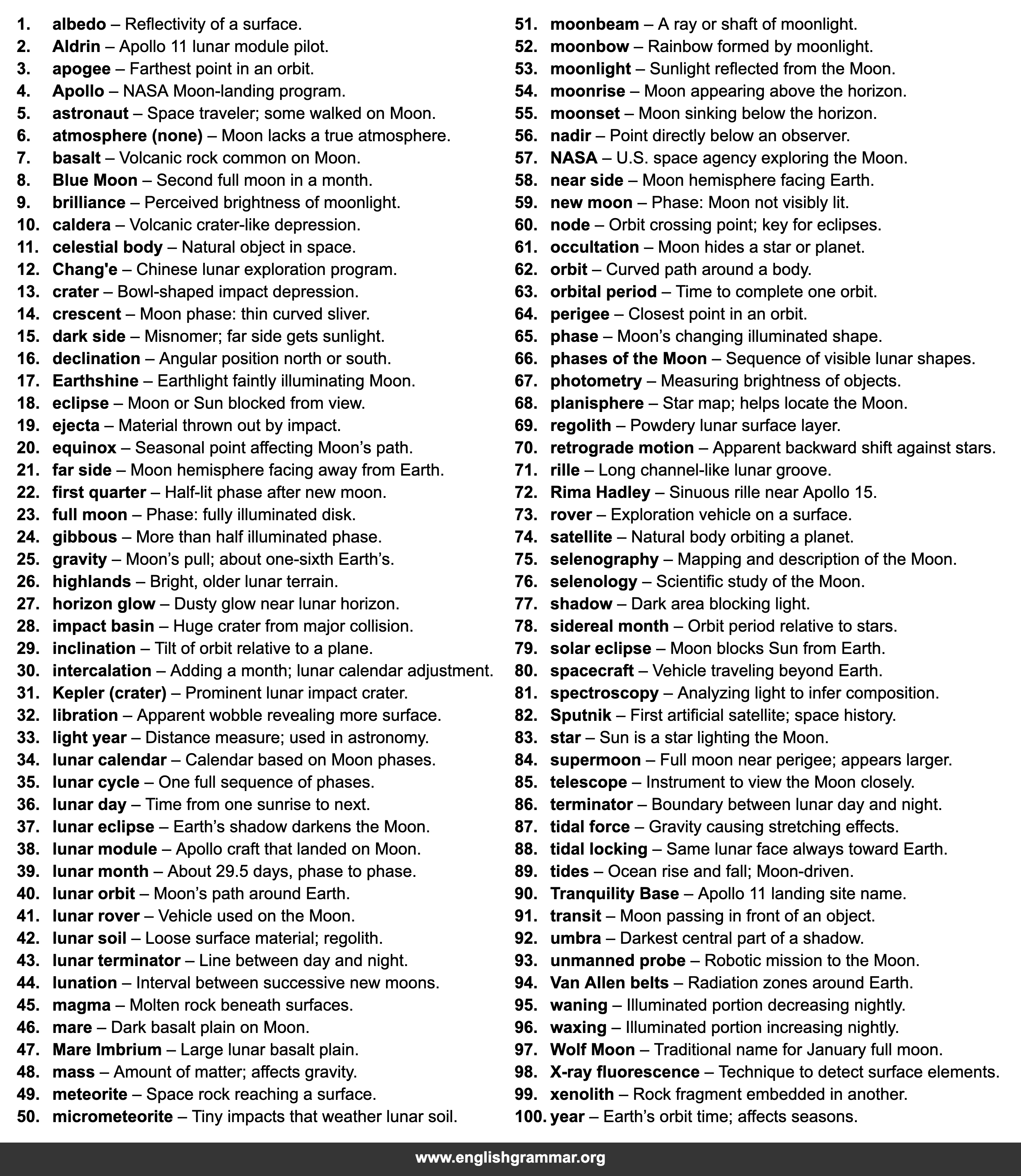
| No. | Term | Definition |
|---|---|---|
| 1. | albedo | Reflectivity of a surface. |
| 2. | Aldrin | Apollo 11 lunar module pilot. |
| 3. | apogee | Farthest point in an orbit. |
| 4. | Apollo | NASA Moon-landing program. |
| 5. | astronaut | Space traveler; some walked on Moon. |
| 6. | atmosphere (none) | Moon lacks a true atmosphere. |
| 7. | basalt | Volcanic rock common on Moon. |
| 8. | Blue Moon | Second full moon in a month. |
| 9. | brilliance | Perceived brightness of moonlight. |
| 10. | caldera | Volcanic crater-like depression. |
| 11. | celestial body | Natural object in space. |
| 12. | Chang’e | Chinese lunar exploration program. |
| 13. | crater | Bowl-shaped impact depression. |
| 14. | crescent | Moon phase: thin curved sliver. |
| 15. | dark side | Misnomer; far side gets sunlight. |
| 16. | declination | Angular position north or south. |
| 17. | Earthshine | Earthlight faintly illuminating Moon. |
| 18. | eclipse | Moon or Sun blocked from view. |
| 19. | ejecta | Material thrown out by impact. |
| 20. | equinox | Seasonal point affecting Moon’s path. |
| 21. | far side | Moon hemisphere facing away from Earth. |
| 22. | first quarter | Half-lit phase after new moon. |
| 23. | full moon | Phase: fully illuminated disk. |
| 24. | gibbous | More than half illuminated phase. |
| 25. | gravity | Moon’s pull; about one-sixth Earth’s. |
| 26. | highlands | Bright, older lunar terrain. |
| 27. | horizon glow | Dusty glow near lunar horizon. |
| 28. | impact basin | Huge crater from major collision. |
| 29. | inclination | Tilt of orbit relative to a plane. |
| 30. | intercalation | Adding a month; lunar calendar adjustment. |
| 31. | Kepler (crater) | Prominent lunar impact crater. |
| 32. | libration | Apparent wobble revealing more surface. |
| 33. | light year | Distance measure; used in astronomy. |
| 34. | lunar calendar | Calendar based on Moon phases. |
| 35. | lunar cycle | One full sequence of phases. |
| 36. | lunar day | Time from one sunrise to next. |
| 37. | lunar eclipse | Earth’s shadow darkens the Moon. |
| 38. | lunar module | Apollo craft that landed on Moon. |
| 39. | lunar month | About 29.5 days, phase to phase. |
| 40. | lunar orbit | Moon’s path around Earth. |
| 41. | lunar rover | Vehicle used on the Moon. |
| 42. | lunar soil | Loose surface material; regolith. |
| 43. | lunar terminator | Line between day and night. |
| 44. | lunation | Interval between successive new moons. |
| 45. | magma | Molten rock beneath surfaces. |
| 46. | mare | Dark basalt plain on Moon. |
| 47. | Mare Imbrium | Large lunar basalt plain. |
| 48. | mass | Amount of matter; affects gravity. |
| 49. | meteorite | Space rock reaching a surface. |
| 50. | micrometeorite | Tiny impacts that weather lunar soil. |
| 51. | moonbeam | A ray or shaft of moonlight. |
| 52. | moonbow | Rainbow formed by moonlight. |
| 53. | moonlight | Sunlight reflected from the Moon. |
| 54. | moonrise | Moon appearing above the horizon. |
| 55. | moonset | Moon sinking below the horizon. |
| 56. | nadir | Point directly below an observer. |
| 57. | NASA | U.S. space agency exploring the Moon. |
| 58. | near side | Moon hemisphere facing Earth. |
| 59. | new moon | Phase: Moon not visibly lit. |
| 60. | node | Orbit crossing point; key for eclipses. |
| 61. | occultation | Moon hides a star or planet. |
| 62. | orbit | Curved path around a body. |
| 63. | orbital period | Time to complete one orbit. |
| 64. | perigee | Closest point in an orbit. |
| 65. | phase | Moon’s changing illuminated shape. |
| 66. | phases of the Moon | Sequence of visible lunar shapes. |
| 67. | photometry | Measuring brightness of objects. |
| 68. | planisphere | Star map; helps locate the Moon. |
| 69. | regolith | Powdery lunar surface layer. |
| 70. | retrograde motion | Apparent backward shift against stars. |
| 71. | rille | Long channel-like lunar groove. |
| 72. | Rima Hadley | Sinuous rille near Apollo 15. |
| 73. | rover | Exploration vehicle on a surface. |
| 74. | satellite | Natural body orbiting a planet. |
| 75. | selenography | Mapping and description of the Moon. |
| 76. | selenology | Scientific study of the Moon. |
| 77. | shadow | Dark area blocking light. |
| 78. | sidereal month | Orbit period relative to stars. |
| 79. | solar eclipse | Moon blocks Sun from Earth. |
| 80. | spacecraft | Vehicle traveling beyond Earth. |
| 81. | spectroscopy | Analyzing light to infer composition. |
| 82. | Sputnik | First artificial satellite; space history. |
| 83. | star | Sun is a star lighting the Moon. |
| 84. | supermoon | Full moon near perigee; appears larger. |
| 85. | telescope | Instrument to view the Moon closely. |
| 86. | terminator | Boundary between lunar day and night. |
| 87. | tidal force | Gravity causing stretching effects. |
| 88. | tidal locking | Same lunar face always toward Earth. |
| 89. | tides | Ocean rise and fall; Moon-driven. |
| 90. | Tranquility Base | Apollo 11 landing site name. |
| 91. | transit | Moon passing in front of an object. |
| 92. | umbra | Darkest central part of a shadow. |
| 93. | unmanned probe | Robotic mission to the Moon. |
| 94. | Van Allen belts | Radiation zones around Earth. |
| 95. | waning | Illuminated portion decreasing nightly. |
| 96. | waxing | Illuminated portion increasing nightly. |
| 97. | Wolf Moon | Traditional name for January full moon. |
| 98. | X-ray fluorescence | Technique to detect surface elements. |
| 99. | xenolith | Rock fragment embedded in another. |
| 100. | year | Earth’s orbit time; affects seasons. |
