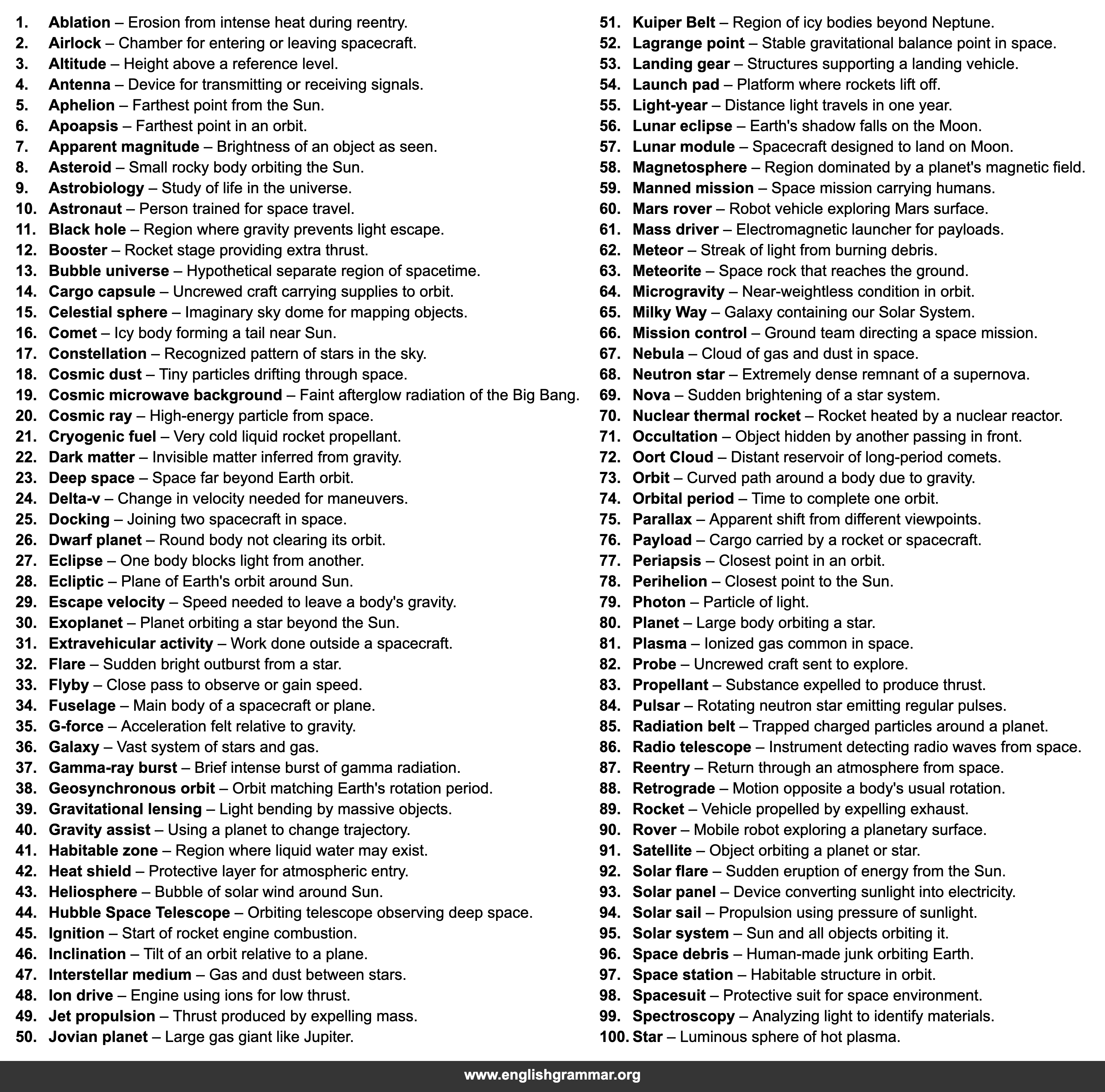
| No. | Term | Definition |
|---|---|---|
| 1. | Ablation | Erosion from intense heat during reentry. |
| 2. | Airlock | Chamber for entering or leaving spacecraft. |
| 3. | Altitude | Height above a reference level. |
| 4. | Antenna | Device for transmitting or receiving signals. |
| 5. | Aphelion | Farthest point from the Sun. |
| 6. | Apoapsis | Farthest point in an orbit. |
| 7. | Apparent magnitude | Brightness of an object as seen. |
| 8. | Asteroid | Small rocky body orbiting the Sun. |
| 9. | Astrobiology | Study of life in the universe. |
| 10. | Astronaut | Person trained for space travel. |
| 11. | Black hole | Region where gravity prevents light escape. |
| 12. | Booster | Rocket stage providing extra thrust. |
| 13. | Bubble universe | Hypothetical separate region of spacetime. |
| 14. | Cargo capsule | Uncrewed craft carrying supplies to orbit. |
| 15. | Celestial sphere | Imaginary sky dome for mapping objects. |
| 16. | Comet | Icy body forming a tail near Sun. |
| 17. | Constellation | Recognized pattern of stars in the sky. |
| 18. | Cosmic dust | Tiny particles drifting through space. |
| 19. | Cosmic microwave background | Faint afterglow radiation of the Big Bang. |
| 20. | Cosmic ray | High-energy particle from space. |
| 21. | Cryogenic fuel | Very cold liquid rocket propellant. |
| 22. | Dark matter | Invisible matter inferred from gravity. |
| 23. | Deep space | Space far beyond Earth orbit. |
| 24. | Delta-v | Change in velocity needed for maneuvers. |
| 25. | Docking | Joining two spacecraft in space. |
| 26. | Dwarf planet | Round body not clearing its orbit. |
| 27. | Eclipse | One body blocks light from another. |
| 28. | Ecliptic | Plane of Earth’s orbit around Sun. |
| 29. | Escape velocity | Speed needed to leave a body’s gravity. |
| 30. | Exoplanet | Planet orbiting a star beyond the Sun. |
| 31. | Extravehicular activity | Work done outside a spacecraft. |
| 32. | Flare | Sudden bright outburst from a star. |
| 33. | Flyby | Close pass to observe or gain speed. |
| 34. | Fuselage | Main body of a spacecraft or plane. |
| 35. | G-force | Acceleration felt relative to gravity. |
| 36. | Galaxy | Vast system of stars and gas. |
| 37. | Gamma-ray burst | Brief intense burst of gamma radiation. |
| 38. | Geosynchronous orbit | Orbit matching Earth’s rotation period. |
| 39. | Gravitational lensing | Light bending by massive objects. |
| 40. | Gravity assist | Using a planet to change trajectory. |
| 41. | Habitable zone | Region where liquid water may exist. |
| 42. | Heat shield | Protective layer for atmospheric entry. |
| 43. | Heliosphere | Bubble of solar wind around Sun. |
| 44. | Hubble Space Telescope | Orbiting telescope observing deep space. |
| 45. | Ignition | Start of rocket engine combustion. |
| 46. | Inclination | Tilt of an orbit relative to a plane. |
| 47. | Interstellar medium | Gas and dust between stars. |
| 48. | Ion drive | Engine using ions for low thrust. |
| 49. | Jet propulsion | Thrust produced by expelling mass. |
| 50. | Jovian planet | Large gas giant like Jupiter. |
| 51. | Kuiper Belt | Region of icy bodies beyond Neptune. |
| 52. | Lagrange point | Stable gravitational balance point in space. |
| 53. | Landing gear | Structures supporting a landing vehicle. |
| 54. | Launch pad | Platform where rockets lift off. |
| 55. | Light-year | Distance light travels in one year. |
| 56. | Lunar eclipse | Earth’s shadow falls on the Moon. |
| 57. | Lunar module | Spacecraft designed to land on Moon. |
| 58. | Magnetosphere | Region dominated by a planet’s magnetic field. |
| 59. | Manned mission | Space mission carrying humans. |
| 60. | Mars rover | Robot vehicle exploring Mars surface. |
| 61. | Mass driver | Electromagnetic launcher for payloads. |
| 62. | Meteor | Streak of light from burning debris. |
| 63. | Meteorite | Space rock that reaches the ground. |
| 64. | Microgravity | Near-weightless condition in orbit. |
| 65. | Milky Way | Galaxy containing our Solar System. |
| 66. | Mission control | Ground team directing a space mission. |
| 67. | Nebula | Cloud of gas and dust in space. |
| 68. | Neutron star | Extremely dense remnant of a supernova. |
| 69. | Nova | Sudden brightening of a star system. |
| 70. | Nuclear thermal rocket | Rocket heated by a nuclear reactor. |
| 71. | Occultation | Object hidden by another passing in front. |
| 72. | Oort Cloud | Distant reservoir of long-period comets. |
| 73. | Orbit | Curved path around a body due to gravity. |
| 74. | Orbital period | Time to complete one orbit. |
| 75. | Parallax | Apparent shift from different viewpoints. |
| 76. | Payload | Cargo carried by a rocket or spacecraft. |
| 77. | Periapsis | Closest point in an orbit. |
| 78. | Perihelion | Closest point to the Sun. |
| 79. | Photon | Particle of light. |
| 80. | Planet | Large body orbiting a star. |
| 81. | Plasma | Ionized gas common in space. |
| 82. | Probe | Uncrewed craft sent to explore. |
| 83. | Propellant | Substance expelled to produce thrust. |
| 84. | Pulsar | Rotating neutron star emitting regular pulses. |
| 85. | Radiation belt | Trapped charged particles around a planet. |
| 86. | Radio telescope | Instrument detecting radio waves from space. |
| 87. | Reentry | Return through an atmosphere from space. |
| 88. | Retrograde | Motion opposite a body’s usual rotation. |
| 89. | Rocket | Vehicle propelled by expelling exhaust. |
| 90. | Rover | Mobile robot exploring a planetary surface. |
| 91. | Satellite | Object orbiting a planet or star. |
| 92. | Solar flare | Sudden eruption of energy from the Sun. |
| 93. | Solar panel | Device converting sunlight into electricity. |
| 94. | Solar sail | Propulsion using pressure of sunlight. |
| 95. | Solar system | Sun and all objects orbiting it. |
| 96. | Space debris | Human-made junk orbiting Earth. |
| 97. | Space station | Habitable structure in orbit. |
| 98. | Spacesuit | Protective suit for space environment. |
| 99. | Spectroscopy | Analyzing light to identify materials. |
| 100. | Star | Luminous sphere of hot plasma. |
