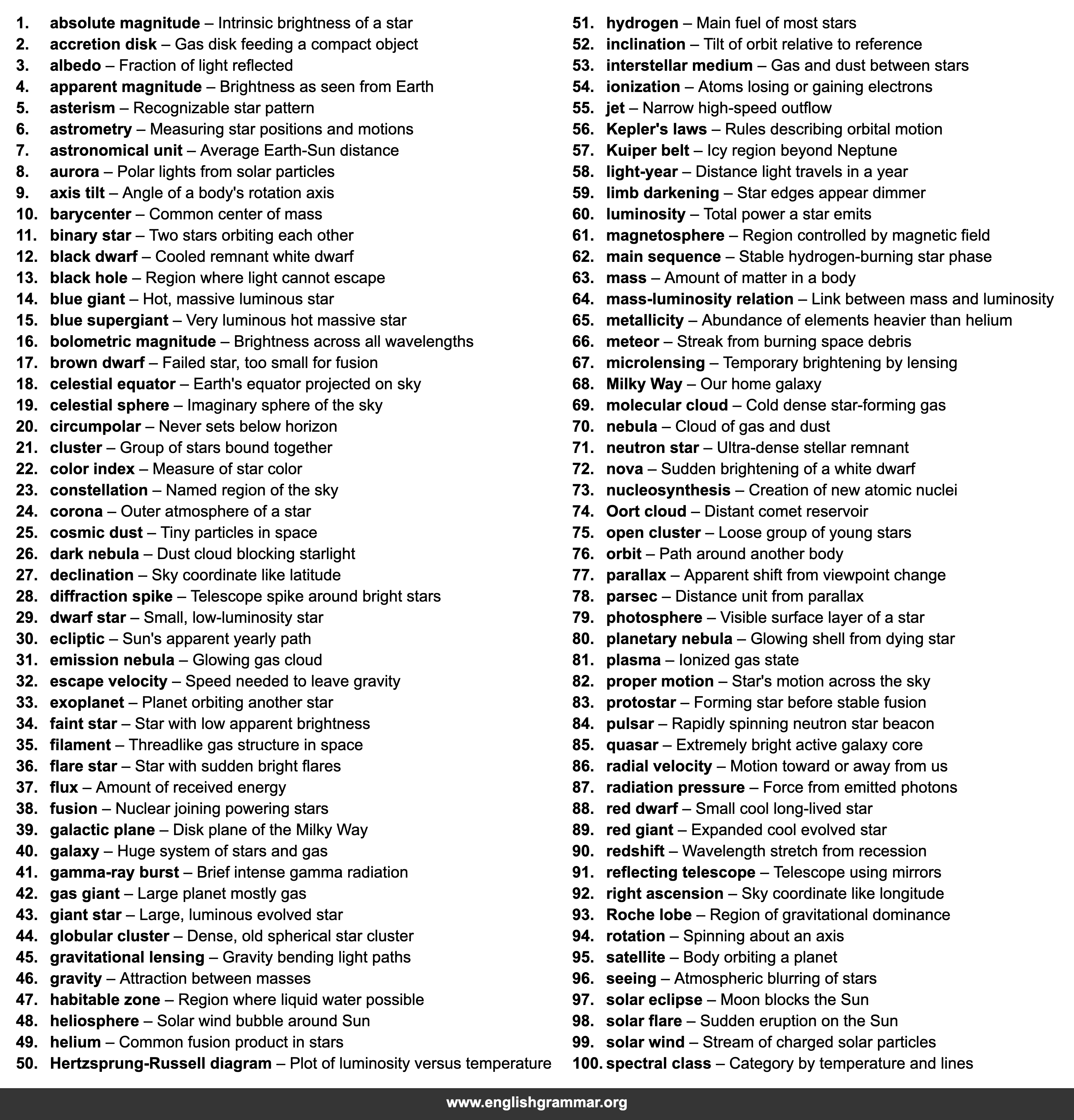
| No. | Term | Definition |
|---|---|---|
| 1. | absolute magnitude | Intrinsic brightness of a star |
| 2. | accretion disk | Gas disk feeding a compact object |
| 3. | albedo | Fraction of light reflected |
| 4. | apparent magnitude | Brightness as seen from Earth |
| 5. | asterism | Recognizable star pattern |
| 6. | astrometry | Measuring star positions and motions |
| 7. | astronomical unit | Average Earth-Sun distance |
| 8. | aurora | Polar lights from solar particles |
| 9. | axis tilt | Angle of a body’s rotation axis |
| 10. | barycenter | Common center of mass |
| 11. | binary star | Two stars orbiting each other |
| 12. | black dwarf | Cooled remnant white dwarf |
| 13. | black hole | Region where light cannot escape |
| 14. | blue giant | Hot, massive luminous star |
| 15. | blue supergiant | Very luminous hot massive star |
| 16. | bolometric magnitude | Brightness across all wavelengths |
| 17. | brown dwarf | Failed star, too small for fusion |
| 18. | celestial equator | Earth’s equator projected on sky |
| 19. | celestial sphere | Imaginary sphere of the sky |
| 20. | circumpolar | Never sets below horizon |
| 21. | cluster | Group of stars bound together |
| 22. | color index | Measure of star color |
| 23. | constellation | Named region of the sky |
| 24. | corona | Outer atmosphere of a star |
| 25. | cosmic dust | Tiny particles in space |
| 26. | dark nebula | Dust cloud blocking starlight |
| 27. | declination | Sky coordinate like latitude |
| 28. | diffraction spike | Telescope spike around bright stars |
| 29. | dwarf star | Small, low-luminosity star |
| 30. | ecliptic | Sun’s apparent yearly path |
| 31. | emission nebula | Glowing gas cloud |
| 32. | escape velocity | Speed needed to leave gravity |
| 33. | exoplanet | Planet orbiting another star |
| 34. | faint star | Star with low apparent brightness |
| 35. | filament | Threadlike gas structure in space |
| 36. | flare star | Star with sudden bright flares |
| 37. | flux | Amount of received energy |
| 38. | fusion | Nuclear joining powering stars |
| 39. | galactic plane | Disk plane of the Milky Way |
| 40. | galaxy | Huge system of stars and gas |
| 41. | gamma-ray burst | Brief intense gamma radiation |
| 42. | gas giant | Large planet mostly gas |
| 43. | giant star | Large, luminous evolved star |
| 44. | globular cluster | Dense, old spherical star cluster |
| 45. | gravitational lensing | Gravity bending light paths |
| 46. | gravity | Attraction between masses |
| 47. | habitable zone | Region where liquid water possible |
| 48. | heliosphere | Solar wind bubble around Sun |
| 49. | helium | Common fusion product in stars |
| 50. | Hertzsprung-Russell diagram | Plot of luminosity versus temperature |
| 51. | hydrogen | Main fuel of most stars |
| 52. | inclination | Tilt of orbit relative to reference |
| 53. | interstellar medium | Gas and dust between stars |
| 54. | ionization | Atoms losing or gaining electrons |
| 55. | jet | Narrow high-speed outflow |
| 56. | Kepler’s laws | Rules describing orbital motion |
| 57. | Kuiper belt | Icy region beyond Neptune |
| 58. | light-year | Distance light travels in a year |
| 59. | limb darkening | Star edges appear dimmer |
| 60. | luminosity | Total power a star emits |
| 61. | magnetosphere | Region controlled by magnetic field |
| 62. | main sequence | Stable hydrogen-burning star phase |
| 63. | mass | Amount of matter in a body |
| 64. | mass-luminosity relation | Link between mass and luminosity |
| 65. | metallicity | Abundance of elements heavier than helium |
| 66. | meteor | Streak from burning space debris |
| 67. | microlensing | Temporary brightening by lensing |
| 68. | Milky Way | Our home galaxy |
| 69. | molecular cloud | Cold dense star-forming gas |
| 70. | nebula | Cloud of gas and dust |
| 71. | neutron star | Ultra-dense stellar remnant |
| 72. | nova | Sudden brightening of a white dwarf |
| 73. | nucleosynthesis | Creation of new atomic nuclei |
| 74. | Oort cloud | Distant comet reservoir |
| 75. | open cluster | Loose group of young stars |
| 76. | orbit | Path around another body |
| 77. | parallax | Apparent shift from viewpoint change |
| 78. | parsec | Distance unit from parallax |
| 79. | photosphere | Visible surface layer of a star |
| 80. | planetary nebula | Glowing shell from dying star |
| 81. | plasma | Ionized gas state |
| 82. | proper motion | Star’s motion across the sky |
| 83. | protostar | Forming star before stable fusion |
| 84. | pulsar | Rapidly spinning neutron star beacon |
| 85. | quasar | Extremely bright active galaxy core |
| 86. | radial velocity | Motion toward or away from us |
| 87. | radiation pressure | Force from emitted photons |
| 88. | red dwarf | Small cool long-lived star |
| 89. | red giant | Expanded cool evolved star |
| 90. | redshift | Wavelength stretch from recession |
| 91. | reflecting telescope | Telescope using mirrors |
| 92. | right ascension | Sky coordinate like longitude |
| 93. | Roche lobe | Region of gravitational dominance |
| 94. | rotation | Spinning about an axis |
| 95. | satellite | Body orbiting a planet |
| 96. | seeing | Atmospheric blurring of stars |
| 97. | solar eclipse | Moon blocks the Sun |
| 98. | solar flare | Sudden eruption on the Sun |
| 99. | solar wind | Stream of charged solar particles |
| 100. | spectral class | Category by temperature and lines |
