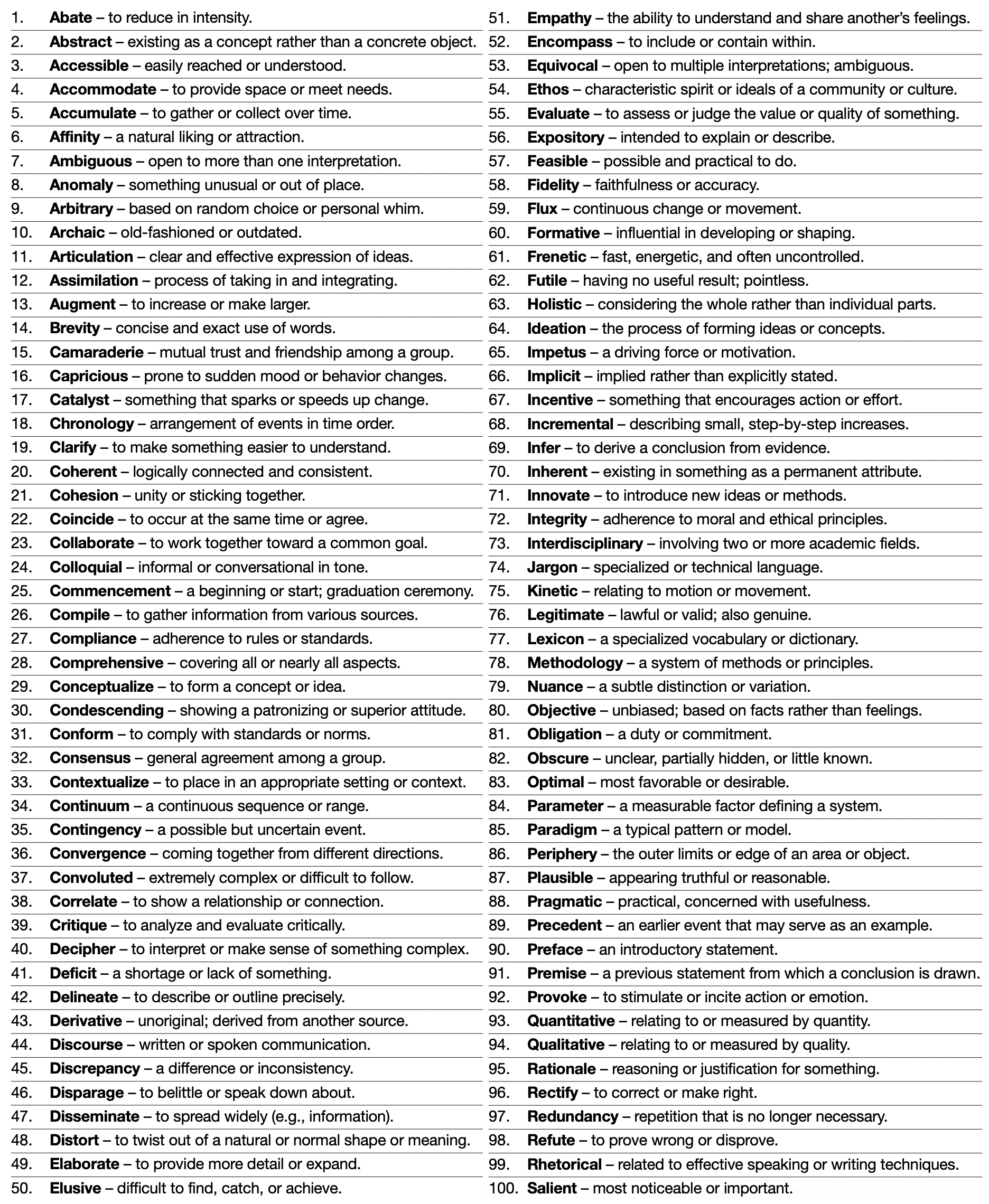
| No. | Term | Definition |
|---|---|---|
| 1. | Abate | To reduce in intensity. |
| 2. | Abstract | Existing as a concept rather than a concrete object. |
| 3. | Accessible | Easily reached or understood. |
| 4. | Accommodate | To provide space or meet needs. |
| 5. | Accumulate | To gather or collect over time. |
| 6. | Affinity | A natural liking or attraction. |
| 7. | Ambiguous | Open to more than one interpretation. |
| 8. | Anomaly | Something unusual or out of place. |
| 9. | Arbitrary | Based on random choice or personal whim. |
| 10. | Archae | Old-fashioned or outdated. |
| 11. | Articulation | Clear and effective expression of ideas. |
| 12. | Assimilation | Process of taking in and integrating. |
| 13. | Augment | To increase or make larger. |
| 14. | Brevity | Concise and exact use of words. |
| 15. | Camaraderie | Mutual trust and friendship among a group. |
| 16. | Capricious | Prone to sudden mood or behavior changes. |
| 17. | Catalyst | Something that sparks or speeds up change. |
| 18. | Chronology | Arrangement of events in time order. |
| 19. | Clarity | To make something easier to understand. |
| 20. | Coherent | Logically connected and consistent. |
| 21. | Cohesion | Unity or sticking together. |
| 22. | Coincide | To occur at the same time or agree. |
| 23. | Collaborate | To work together toward a common goal. |
| 24. | Colloquial | Informal or conversational in tone. |
| 25. | Commencement | A beginning or start; graduation ceremony. |
| 26. | Compile | To gather information from various sources. |
| 27. | Compliance | Adherence to rules or standards. |
| 28. | Comprehensive | Covering all or nearly all aspects. |
| 29. | Conceptualize | To form a concept or idea. |
| 30. | Condescending | Showing a patronizing or superior attitude. |
| 31. | Conform | To comply with standards or norms. |
| 32. | Consensus | General agreement among a group. |
| 33. | Contextualize | To place in an appropriate setting or context. |
| 34. | Continuum | A continuous sequence or range. |
| 35. | Contingency | A possible but uncertain event. |
| 36. | Convergence | Coming together from different directions. |
| 37. | Convoluted | Extremely complex or difficult to follow. |
| 38. | Correlate | To show a relationship or connection. |
| 39. | Critique | To analyze and evaluate critically. |
| 40. | Decipher | To interpret or make sense of something complex. |
| 41. | Deficit | A shortage or lack of something. |
| 42. | Delineate | To describe or outline precisely. |
| 43. | Derivative | Unoriginal; derived from another source. |
| 44. | Discourse | Written or spoken communication. |
| 45. | Discrepancy | A difference or inconsistency. |
| 46. | Disparage | To belittle or speak down about. |
| 47. | Disseminate | To spread widely (e.g., information). |
| 48. | Distort | To twist out of a natural or normal shape or meaning. |
| 49. | Elaborate | To provide more detail or expand. |
| 50. | Elusive | Difficult to find, catch, or achieve. |
| 51. | Empathy | The ability to understand and share another’s feelings. |
| 52. | Encompass | To include or contain within. |
| 53. | Equivocal | Open to multiple interpretations; ambiguous. |
| 54. | Ethos | Characteristic spirit or ideals of a community or culture. |
| 55. | Evaluate | To assess or judge the value or quality of something. |
| 56. | Expository | Intended to explain or describe. |
| 57. | Feasible | Possible and practical to do. |
| 58. | Fidelity | Faithfulness or accuracy. |
| 59. | Flux | Continuous change or movement. |
| 60. | Formative | Influential in developing or shaping. |
| 61. | Frenetic | Fast, energetic, and often uncontrolled. |
| 62. | Futile | Having no useful result; pointless. |
| 63. | Holistic | Considering the whole rather than individual parts. |
| 64. | Ideation | The process of forming ideas or concepts. |
| 65. | Impetus | A driving force or motivation. |
| 66. | Implicit | Implied rather than explicitly stated. |
| 67. | Incentive | Something that encourages action or effort. |
| 68. | Incremental | Describing small, step-by-step increases. |
| 69. | Infer | To derive a conclusion from evidence. |
| 70. | Inherent | Existing in something as a permanent attribute. |
| 71. | Innovate | To introduce new ideas or methods. |
| 72. | Integrity | Adherence to moral and ethical principles. |
| 73. | Interdisciplinary | Involving two or more academic fields. |
| 74. | Jargon | Specialized or technical language. |
| 75. | Kinetic | Relating to motion or movement. |
| 76. | Legitimate | Lawful or valid; also genuine. |
| 77. | Lexicon | A specialized vocabulary or dictionary. |
| 78. | Methodology | A system of methods or principles. |
| 79. | Nuance | A subtle distinction or variation. |
| 80. | Objective | Unbiased; based on facts rather than feelings. |
| 81. | Obligation | A duty or commitment. |
| 82. | Obscure | Unclear, partially hidden, or little known. |
| 83. | Optimal | Most favorable or desirable. |
| 84. | Parameter | A measurable factor defining a system. |
| 85. | Paradigm | A typical pattern or model. |
| 86. | Periphery | The outer limits or edge of an area or object. |
| 87. | Plausible | Appearing truthful or reasonable. |
| 88. | Pragmatic | Practical, concerned with usefulness. |
| 89. | Precedent | An earlier event that may serve as an example. |
| 90. | Preface | An introductory statement. |
| 91. | Premise | A previous statement from which a conclusion is drawn. |
| 92. | Provoke | To stimulate or incite action or emotion. |
| 93. | Quantitative | Relating to or measured by quantity. |
| 94. | Qualitative | Relating to or measured by quality. |
| 95. | Rationale | Reasoning or justification for something. |
| 96. | Rectify | To correct or make right. |
| 97. | Redundancy | Repetition that is no longer necessary. |
| 98. | Refute | To prove wrong or disprove. |
| 99. | Rhetorical | Related to effective speaking or writing techniques. |
| 100. | Salient | Most noticeable or important. |
