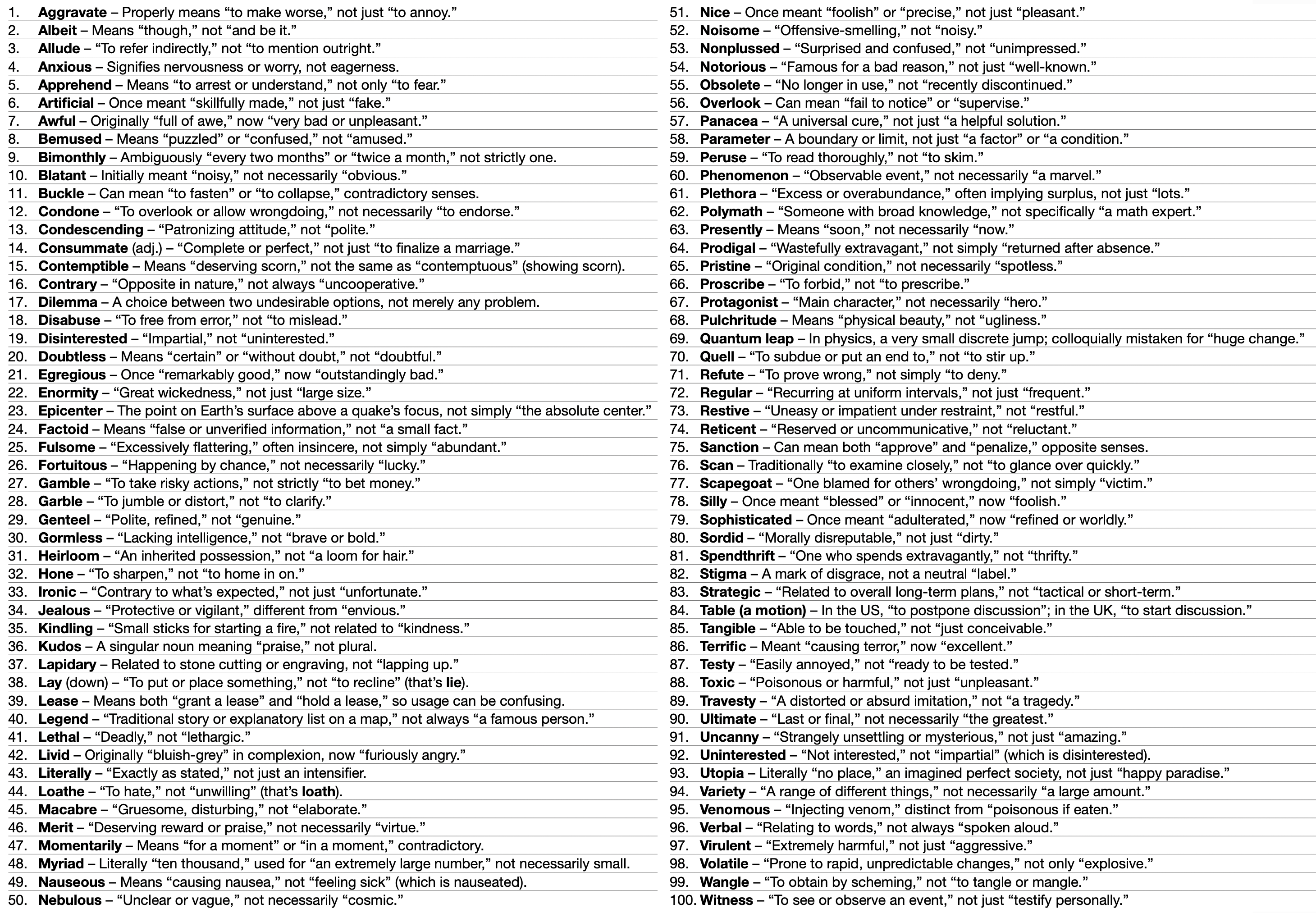
| No. | Term | Definition |
|---|---|---|
| 1. | Aggravate | Properly means “To make worse,” not just “to annoy.” |
| 2. | Albeit | Means “though,” not “and be it.” |
| 3. | Allude | “To refer indirectly,” not “to mention outright.” |
| 4. | Anxious | Signifies nervousness or worry, not eagerness. |
| 5. | Apprehend | Means “to arrest or understand,” not only “to fear.” |
| 6. | Artificial | Once meant “skillfully made,” not just “fake.” |
| 7. | Awful | Originally “full of awe,” now “very bad or unpleasant.” |
| 8. | Bemused | Means “puzzled” or “confused,” not “amused.” |
| 9. | Bimonthly | Ambiguously “every two months” or “twice a month,” not strictly one. |
| 10. | Blatant | Initially meant “noisy,” not necessarily “obvious.” |
| 11. | Buckle | Can mean “to fasten” or “to collapse,” contradictory senses. |
| 12. | Condone | “To overlook or allow wrongdoing,” not necessarily “to endorse.” |
| 13. | Condescending | “Patronizing attitude,” not “polite.” |
| 14. | Consummate (adj.) | “Complete or perfect,” not just “to finalize a marriage.” |
| 15. | Contemptible | Means “deserving scorn,” not the same as “contemptuous” (showing scorn). |
| 16. | Contrary | “Opposite in nature,” not always “uncooperative.” |
| 17. | Dilemma | A choice between two undesirable options, not merely any problem. |
| 18. | Disabuse | “To free from error,” not “to mislead.” |
| 19. | Disinterested | “Impartial,” not “uninterested.” |
| 20. | Doubtless | Means “certain” or “without doubt,” not “doubtful.” |
| 21. | Egregious | Once “remarkably good,” now “outstandingly bad.” |
| 22. | Enormity | “Great wickedness,” not just “large size.” |
| 23. | Epicenter | The point on earth’s surface above a quake’s focus, not simply “the absolute center.” |
| 24. | Factoid | Means “false or unverified information,” not “a small fact.” |
| 25. | Fulsome | “Excessively flattering,” often insincere, not simply “abundant.” |
| 26. | Fortuitous | “Happening by chance,” not necessarily “lucky.” |
| 27. | Gamble | “To take risky actions,” not strictly “to bet money.” |
| 28. | Garble | “To jumble or distort,” not “to clarify.” |
| 29. | Genteel | “Polite, refined,” not “genuine.” |
| 30. | Gormless | “Lacking intelligence,” not “brave or bold.” |
| 31. | Heirloom | “An inherited possession,” not “a loom for hair.” |
| 32. | Hone | “To sharpen,” not “to home in on.” |
| 33. | Ironic | “Contrary to what’s expected,” not just “unfortunate.” |
| 34. | Jealous | “Protective or vigilant,” different from “envious.” |
| 35. | Kindling | “Small sticks for starting a fire,” not related to “kindness.” |
| 36. | Kudos | A singular noun meaning “praise,” not plural. |
| 37. | Lapidary | Related to stone cutting or engraving, not “lapping up.” |
| 38. | Lay (down) | “To put or place something,” not “to recline” (that’s lie). |
| 39. | Lease | Means both “grant a lease” and “hold a lease,” so usage can be confusing. |
| 40. | Legend | “Traditional story or explanatory list on a map,” not always “a famous person.” |
| 41. | Lethal | “Deadly,” not “lethargic.” |
| 42. | Livid | Originally “bluish-grey” in complexion, now “furiously angry.” |
| 43. | Literally | “Exactly as stated,” not just an intensifier. |
| 44. | Loathe | “To hate,” not “unwilling” (that’s loath). |
| 45. | Macabre | “Gruesome, disturbing,” not “elaborate.” |
| 46. | Merit | “Deserving reward or praise,” not necessarily “virtue.” |
| 47. | Momentarily | Means “for a moment” or “in a moment,” contradictory. |
| 48. | Myriad | Literally “ten thousand,” used for “an extremely large number,” not necessarily small. |
| 49. | Nauseous | Means “causing nausea,” not “feeling sick” (which is nauseated). |
| 50. | Nebulous | “Unclear or vague,” not necessarily “cosmic.” |
| 51. | Nice | Once meant “foolish” or “precise,” not just “pleasant.” |
| 52. | Noisome | “Offensive-smelling,” not “noisy.” |
| 53. | Nonplussed | “Surprised and confused,” not “unimpressed.” |
| 54. | Notorious | “Famous for a bad reason,” not just “well-known.” |
| 55. | Obsolete | “No longer in use,” not “recently discontinued.” |
| 56. | Overlook | Can mean “fail to notice” or “supervise.” |
| 57. | Panacea | “A universal cure,” not just “a helpful solution.” |
| 58. | Parameter | A boundary or limit, not just “a factor” or “a condition.” |
| 59. | Peruse | “To read thoroughly,” not “to skim.” |
| 60. | Phenomenon | “Observable event,” not necessarily “a marvel.” |
| 61. | Plethora | “Excess or overabundance,” often implying surplus, not just “lots.” |
| 62. | Polymath | “Someone with broad knowledge,” not specifically “a math expert.” |
| 63. | Presently | Means “soon,” not necessarily “now.” |
| 64. | Prodigal | “Wastefully extravagant,” not simply “returned after absence.” |
| 65. | Pristine | “Original condition,” not necessarily “spotless.” |
| 66. | Proscribe | “To forbid,” not “to prescribe.” |
| 67. | Protagonist | “Main character,” not necessarily “hero.” |
| 68. | Pulchritude | Means “physical beauty,” not “ugliness.” |
| 69. | Quantum leap | In physics, a very small discrete jump; colloquially mistaken for “huge change.” |
| 70. | Quell | “To subdue or put an end to,” not “to stir up.” |
| 71. | Refute | “To prove wrong,” not simply “to deny.” |
| 72. | Regular | “Recurring at uniform intervals,” not just “frequent.” |
| 73. | Restive | “Uneasy or impatient under restraint,” not “restful.” |
| 74. | Reticent | “Reserved or uncommunicative,” not “reluctant.” |
| 75. | Sanction | Can mean both “approve” and “penalize,” opposite senses. |
| 76. | Scan | Traditionally “to examine closely,” not “to glance over quickly.” |
| 77. | Scapegoat | “One blamed for others’ wrongdoing,” not simply “victim.” |
| 78. | Silly | Once meant “blessed” or “innocent,” now “foolish.” |
| 79. | Sophisticated | Once meant “adulterated,” now “refined or worldly.” |
| 80. | Sordid | “Morally disreputable,” not just “dirty.” |
| 81. | Spendthrift | “One who spends extravagantly,” not “thrifty.” |
| 82. | Stigma | A mark of disgrace, not a neutral “label.” |
| 83. | Strategic | “Related to overall long-term plans,” not “tactical or short-term.” |
| 84. | Table (a motion) | In the us, “to postpone discussion”; in the uk, “to start discussion.” |
| 85. | Tangible | “Able to be touched,” not “just conceivable.” |
| 86. | Terrific | Meant “causing terror,” now “excellent.” |
| 87. | Testy | “Easily annoyed,” not “ready to be tested.” |
| 88. | Toxic | “Poisonous or harmful,” not just “unpleasant.” |
| 89. | Travesty | “A distorted or absurd imitation,” not “a tragedy.” |
| 90. | Ultimate | “Last or final,” not necessarily “the greatest.” |
| 91. | Uncanny | “Strangely unsettling or mysterious,” not just “amazing.” |
| 92. | Uninterested | “Not interested,” not “impartial” (which is disinterested). |
| 93. | Utopia | Literally “no place,” an imagined perfect society, not just “happy paradise.” |
| 94. | Variety | “A range of different things,” not necessarily “a large amount.” |
| 95. | Venomous | “Injecting venom,” distinct from “poisonous if eaten.” |
| 96. | Verbal | “Relating to words,” not always “spoken aloud.” |
| 97. | Virulent | “Extremely harmful,” not just “aggressive.” |
| 98. | Volatile | “Prone to rapid, unpredictable changes,” not only “explosive.” |
| 99. | Wangle | “To obtain by scheming,” not “to tangle or mangle.” |
| 100. | Witness | “To see or observe an event,” not just “testify personally.” |
