
• Skip to primary navigation
  • Skip to main content
  • Skip to primary sidebar
Home of English Grammar
  • Home
  • Course
  • Exercises
  • Grammar Rules
  • Matches
  • Posts
  • Tools
    • Grammar Checker
    • Very Replacer
    • Word Counter
  • Vocabulary Lists
  • Archives
    • Social Media Posts
    • Writing Guides
  • Join free

16 English tenses: a guide to four teaching groups

October 21, 2026

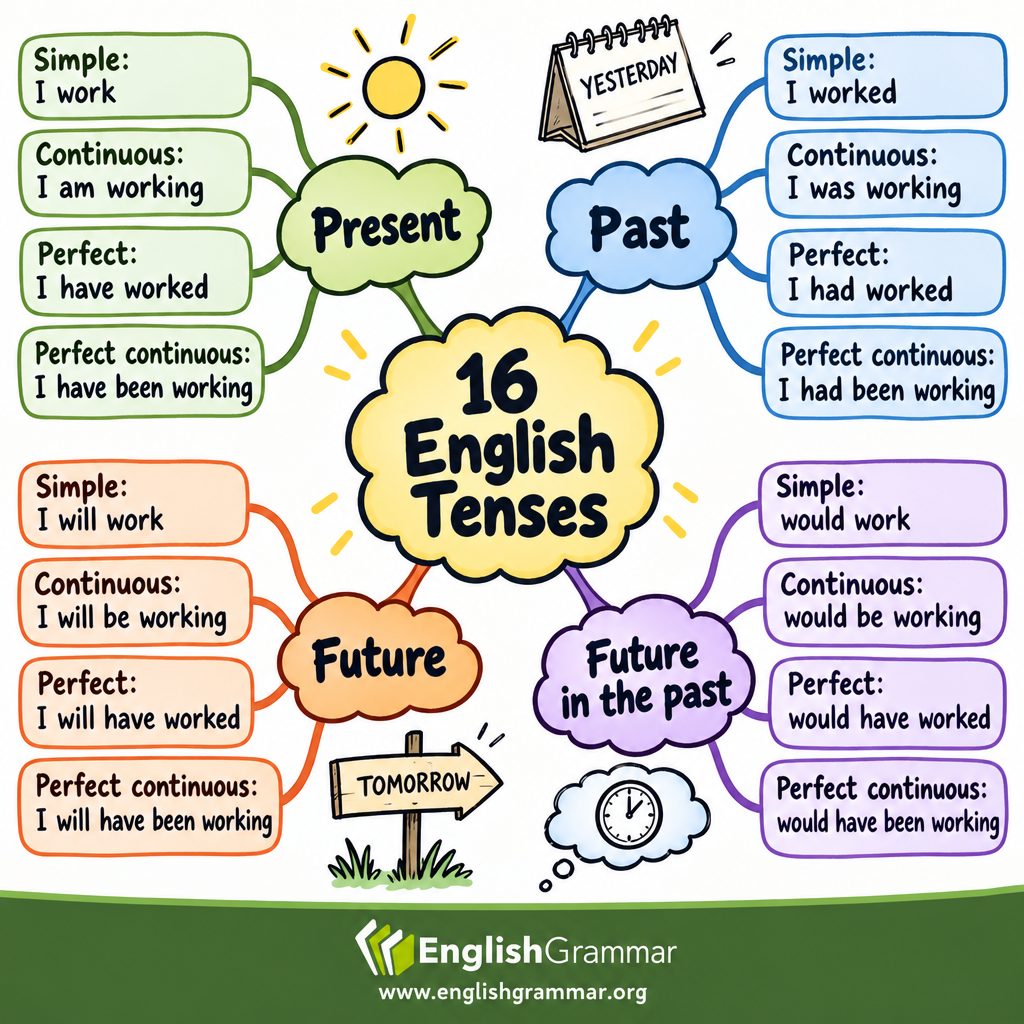
16 English Tenses

The label 16 English tenses describes a teaching framework: four time-reference groups, each with simple, continuous, perfect and perfect continuous forms. Many courses teach 12 main forms and discuss future in the past separately. Strictly speaking, English verbs have present and past tense inflections; future meanings use constructions such as will.

Across these groups, simple forms present situations without continuous or perfect marking. Continuous forms highlight activity in progress. Perfect forms look back from a reference point. Perfect continuous forms combine that backward view with an emphasis on ongoing activity or duration.

Present

  • Simple: I work can describe a habit or regular situation.
  • Continuous: I am working describes activity happening now or around now.
  • Perfect: I have worked here before connects past experience with the present.
  • Perfect continuous: I have been working for two hours emphasizes activity over a period leading up to now.

Past

  • Simple: I worked yesterday places an event in a finished past period.
  • Continuous: I was working when you called shows activity in progress at a past moment.
  • Perfect: I had worked there before we met looks back from a later past point.
  • Perfect continuous: I had been working for hours when you arrived emphasizes duration before that point.

Future

  • Simple: I will work tomorrow expresses a future situation.
  • Continuous: I will be working at noon presents activity in progress then.
  • Perfect: I will have finished by noon looks back from a future deadline.
  • Perfect continuous: I will have been working for six hours by noon emphasizes duration up to that point.

Future in the past

These forms describe something viewed as future from a past perspective. Compare She said she would work, would be working, would have worked and would have been working. The perfect forms look toward completion or duration before a later reference point. These patterns also occur in conditional sentences, but would does not always express a condition. Context determines the meaning.

Improve your English grammar, vocabulary and writing

We take you step by step from beginner to advanced, even if you struggled with English at school or have always had trouble remembering the rules.

  • 10 modules, 105 lessons and 688 questions
  • Just log in and learn anytime and anywhere
  • Your progress is saved in your account
  • Download the 2027 Grammar Guide (PDF)
Join free

Already have an account? Sign in

See what’s in the course

Primary Sidebar

2.4M761.4K165.8K

Free 2027 Grammar Guide

  • Download Grammar Guide (PDF)
  • Online grammar course, A1 to C2
  • Weekly exercises and vocabulary
  • Join over 3 million English learners

We respect your privacy. Unsubscribe anytime.

Already have an account? Sign in

Grammar Checker - Try Now

Latest Posts

  • 100 Best Synonyms for “Processing” October 21, 2026
  • 16 English tenses: a guide to four teaching groups October 21, 2026
  • Possible, feasible, viable, plausible, probable and inevitable: What’s the difference? October 21, 2026
  • Asking for Help Exercise October 21, 2026
  • 100 Best Synonyms for “Preposterous” October 21, 2026
  • 100 Best Synonyms for “Sneaky” October 21, 2026
  • 100 Best Synonyms for “Destroyed” October 21, 2026
  • 100 Best Synonyms for “Bothered” October 21, 2026
  • 100 Best Synonyms for “Pointed Out” October 21, 2026
  • Modals of Deduction Exercise October 21, 2026
Home of English Grammar

Free English grammar exercises, rules and vocabulary lists, with new exercises every week. Join the leading English grammar site with over 3 million followers.

Join free

Learn

  • Exercises
  • Matches
  • Grammar rules
  • Vocabulary lists
  • Writing guides
  • Online tools

More

  • Top social media posts
  • Various posts
  • Contact

Account

  • Join free
  • Grammar Course
  • Free grammar guide (PDF)

Copyright © 2026 EnglishGrammar.org

  • Disclaimer
  • Privacy policy
  • Terms
  • Sitemap