
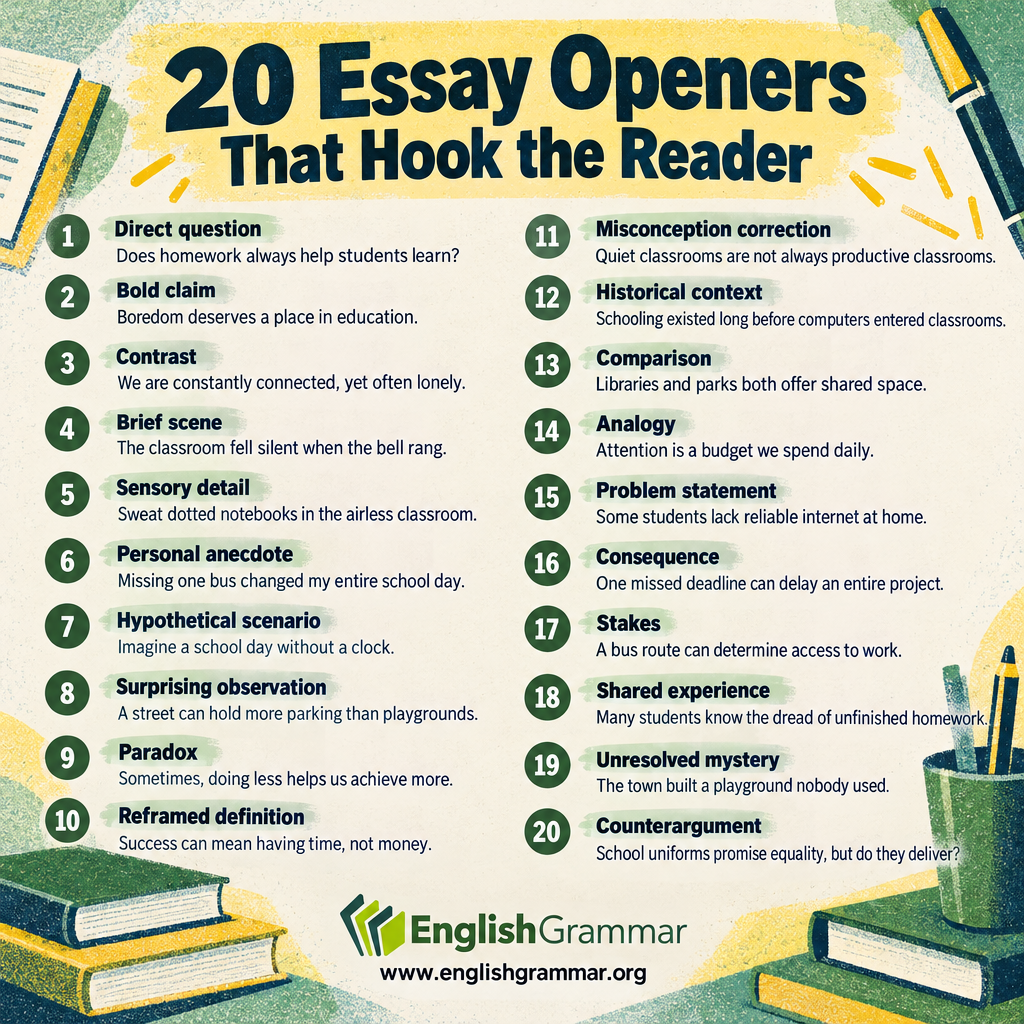
A strong essay opener gives readers a reason to continue. It might raise a question, establish a problem or make an ordinary subject feel unfamiliar. These 20 approaches offer different ways into a topic.
- Direct question: Ask something your essay will genuinely explore, such as whether homework always helps students learn.
- Bold claim: Begin with a debatable position, such as the value of boredom. Support it rather than relying on surprise alone.
- Contrast: Place opposing experiences together, such as a connected world and lonely people.
- Brief scene: Show a moment unfolding. A classroom falling silent can introduce a larger discussion.
- Sensory detail: Use a concrete sensation, such as classroom heat, to make an issue tangible.
- Personal anecdote: Introduce a relevant experience. Use the bus example only if it reflects something that actually happened to you.
- Hypothetical scenario: Invite readers to imagine a situation without presenting it as fact.
- Surprising observation: Draw attention to an overlooked detail, such as parking space on a busy street.
- Paradox: Present an apparent contradiction that your essay can unpack.
- Reframed definition: Offer a useful interpretation rather than a generic dictionary quotation.
- Misconception correction: Challenge a common assumption, while recognizing its limits.
- Historical context: Establish a relevant, accurate fact about the past.
- Comparison: Examine a meaningful similarity between subjects, such as libraries and parks.
- Analogy: Explain one idea through another. Unlike a straightforward comparison, the attention-budget analogy supplies an explanatory model.
- Problem statement: Identify the specific difficulty your essay addresses.
- Consequence: Lead with what an action can cause.
- Stakes: Show why an issue matters and who may be affected.
- Shared experience: Start with something familiar, without assuming everyone has experienced it.
- Unresolved mystery: Introduce a puzzling outcome that needs explanation.
- Counterargument: Begin with an opposing position before developing your response.
These sentences are models, not evidence. Verify factual claims and use truthful personal details. Choose an approach that fits your assignment, then connect the opener to your topic and thesis. An engaging beginning should lead into the argument, not distract from it.