
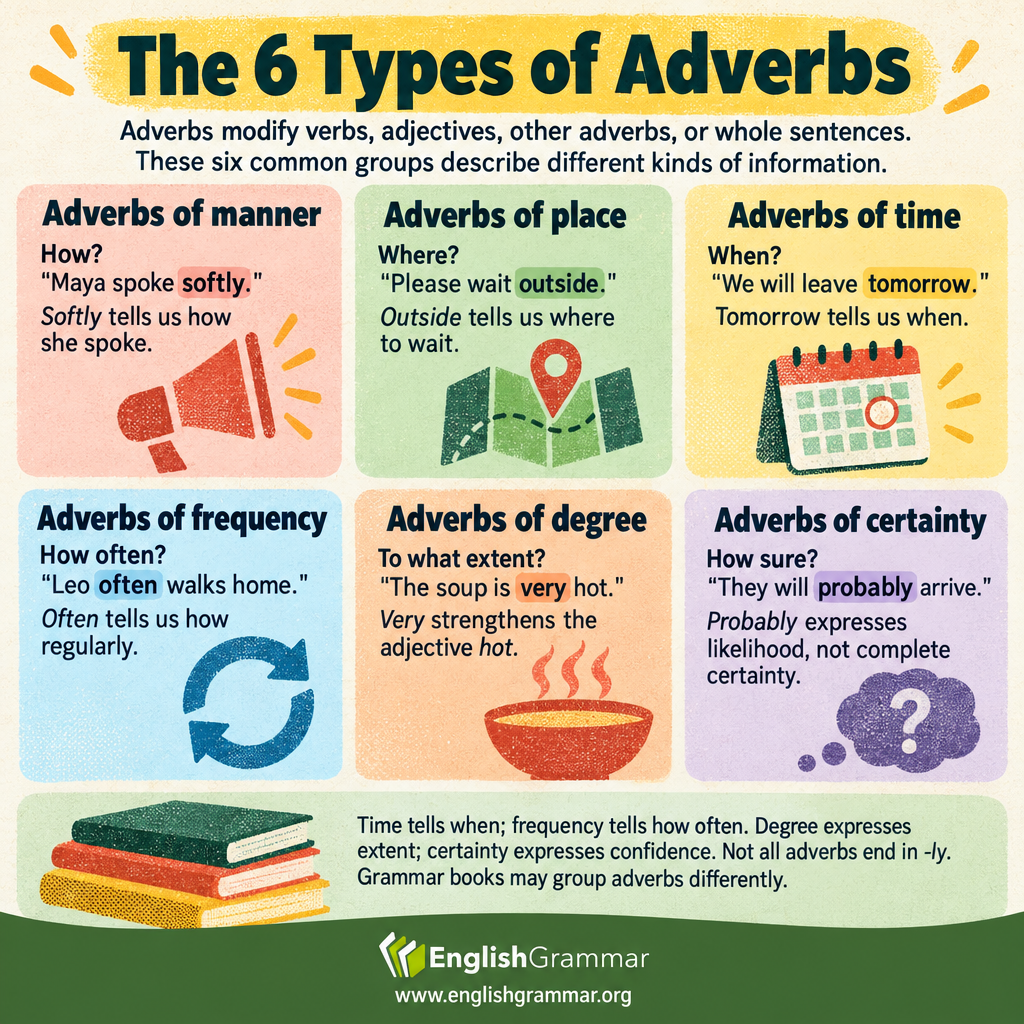
Adverbs add information to verbs, adjectives, other adverbs, or whole sentences. They can explain how something happens, where or when it happens, how often it happens, or how strong or certain something is. These six common groups offer a useful starting point, though grammar books sometimes classify adverbs differently.
- Adverbs of manner answer How? In “Maya spoke softly,” softly tells us how Maya spoke. Many manner adverbs end in -ly, but some, such as well, do not.
- Adverbs of place answer Where? In “Please wait outside,” outside tells us where to wait. Other examples include here, nearby, and everywhere.
- Adverbs of time answer When? In “We will leave tomorrow,” tomorrow tells us when the departure will happen. Soon and yesterday also express time.
- Adverbs of frequency answer How often? In “Leo often walks home,” often describes how regularly Leo does this. Frequency adverbs include always, sometimes, and never.
- Adverbs of degree answer To what extent? In “The soup is very hot,” very modifies the adjective hot. Degree adverbs can also modify verbs or other adverbs, as in “I almost fell” and “She ran quite quickly.”
- Adverbs of certainty express how sure the speaker is. In “They will probably arrive,” probably signals likelihood rather than complete certainty. Definitely expresses stronger confidence, while perhaps expresses possibility.
To distinguish similar groups, focus on meaning. Time identifies when, while frequency describes how often. Degree concerns intensity or extent, while certainty concerns confidence in a statement. Do not rely only on spelling: not every adverb ends in -ly, and not every word ending in -ly is an adverb.