
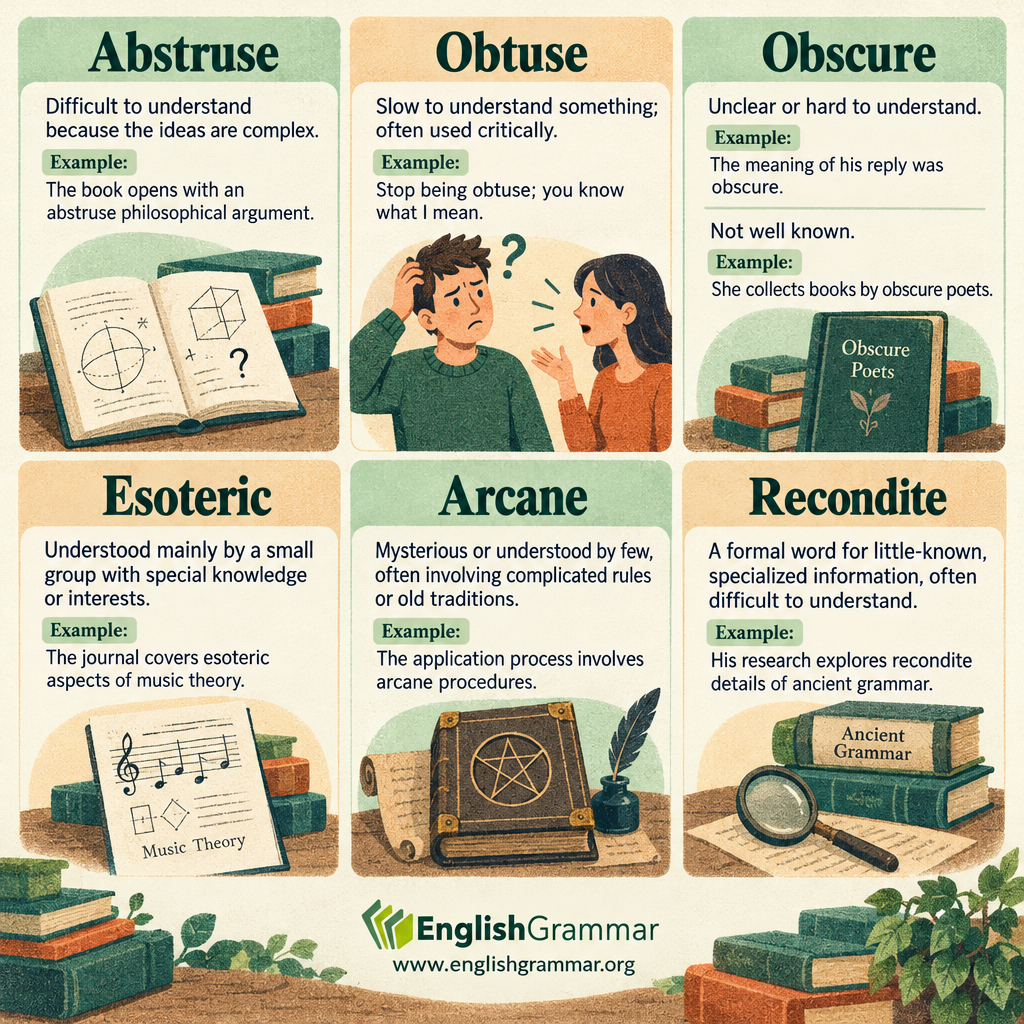
These six adjectives overlap, but they draw attention to different reasons something—or someone—is difficult to understand. The distinctions are useful tendencies, not strict boundaries.
- Abstruse describes ideas or explanations that are difficult because they are complex. The lecture explored an abstruse theory of consciousness. Choose it when intellectual difficulty is the main point.
- Obtuse usually criticizes a person for being slow to understand something, sometimes deliberately. He was being obtuse when he ignored her obvious hint. Unlike the other words, it commonly describes the person struggling to understand, not the difficult material.
- Obscure can mean unclear or not well known. The instructions were obscure, so we asked for help. In contrast, They performed a song by an obscure composer. A little-known song need not be difficult to understand.
- Esoteric describes knowledge understood mainly by a small group with special knowledge or interests. The discussion became too esoteric for most beginners. The emphasis is on a limited audience, not necessarily poor explanation.
- Arcane suggests something mysterious or understood by few people, often involving complicated rules or old traditions. She helped us navigate the arcane licensing rules. It does not necessarily mean ancient.
- Recondite is a formal word for little-known, specialized information that is often difficult to understand. The essay examines recondite questions of medieval law. It overlaps strongly with abstruse and esoteric, but sounds more scholarly.