
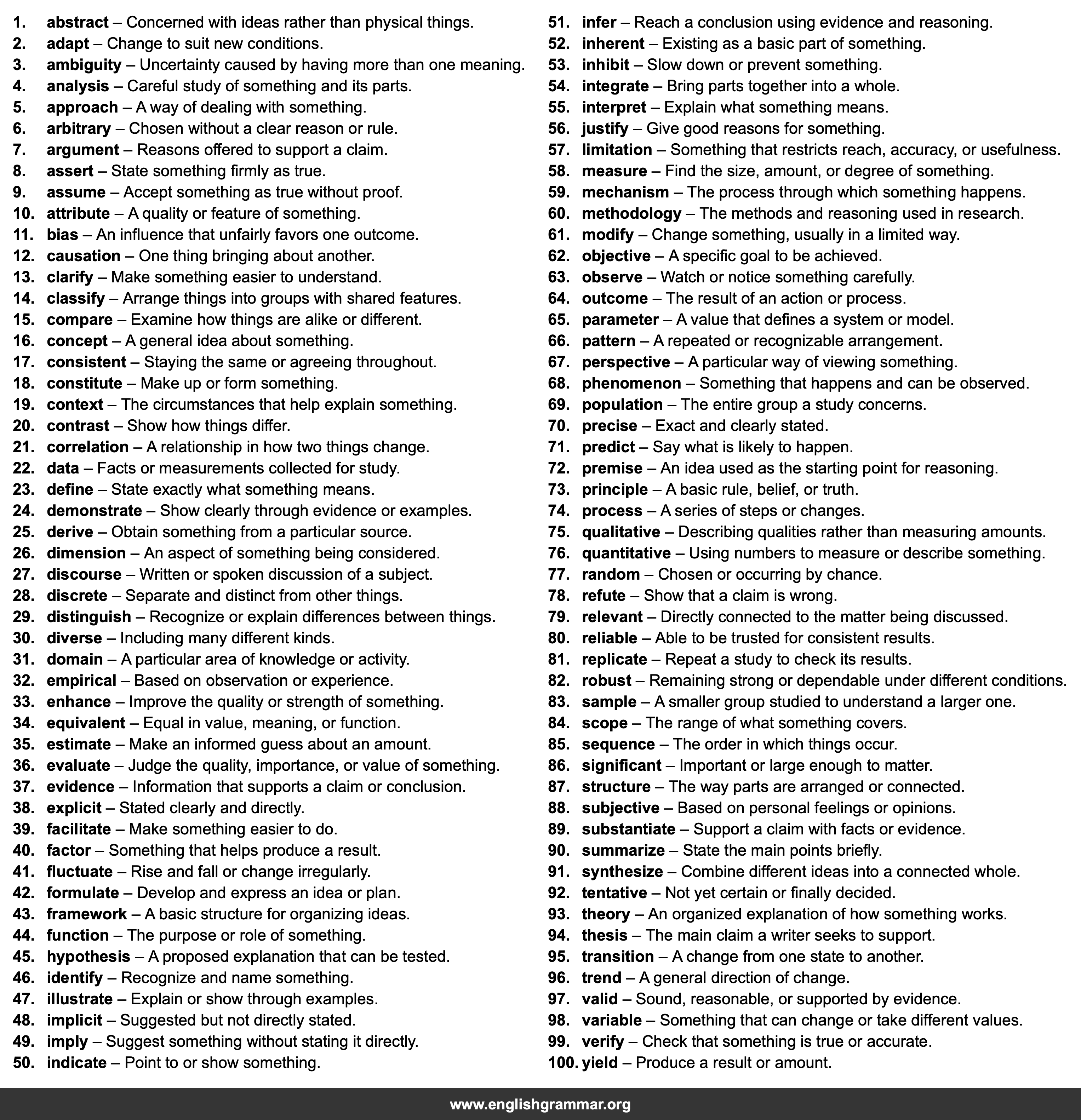
| No. | Item | Definition |
|---|---|---|
| 1. | abstract | Concerned with ideas rather than physical things. |
| 2. | adapt | Change to suit new conditions. |
| 3. | ambiguity | Uncertainty caused by having more than one meaning. |
| 4. | analysis | Careful study of something and its parts. |
| 5. | approach | A way of dealing with something. |
| 6. | arbitrary | Chosen without a clear reason or rule. |
| 7. | argument | Reasons offered to support a claim. |
| 8. | assert | State something firmly as true. |
| 9. | assume | Accept something as true without proof. |
| 10. | attribute | A quality or feature of something. |
| 11. | bias | An influence that unfairly favors one outcome. |
| 12. | causation | One thing bringing about another. |
| 13. | clarify | Make something easier to understand. |
| 14. | classify | Arrange things into groups with shared features. |
| 15. | compare | Examine how things are alike or different. |
| 16. | concept | A general idea about something. |
| 17. | consistent | Staying the same or agreeing throughout. |
| 18. | constitute | Make up or form something. |
| 19. | context | The circumstances that help explain something. |
| 20. | contrast | Show how things differ. |
| 21. | correlation | A relationship in how two things change. |
| 22. | data | Facts or measurements collected for study. |
| 23. | define | State exactly what something means. |
| 24. | demonstrate | Show clearly through evidence or examples. |
| 25. | derive | Obtain something from a particular source. |
| 26. | dimension | An aspect of something being considered. |
| 27. | discourse | Written or spoken discussion of a subject. |
| 28. | discrete | Separate and distinct from other things. |
| 29. | distinguish | Recognize or explain differences between things. |
| 30. | diverse | Including many different kinds. |
| 31. | domain | A particular area of knowledge or activity. |
| 32. | empirical | Based on observation or experience. |
| 33. | enhance | Improve the quality or strength of something. |
| 34. | equivalent | Equal in value, meaning, or function. |
| 35. | estimate | Make an informed guess about an amount. |
| 36. | evaluate | Judge the quality, importance, or value of something. |
| 37. | evidence | Information that supports a claim or conclusion. |
| 38. | explicit | Stated clearly and directly. |
| 39. | facilitate | Make something easier to do. |
| 40. | factor | Something that helps produce a result. |
| 41. | fluctuate | Rise and fall or change irregularly. |
| 42. | formulate | Develop and express an idea or plan. |
| 43. | framework | A basic structure for organizing ideas. |
| 44. | function | The purpose or role of something. |
| 45. | hypothesis | A proposed explanation that can be tested. |
| 46. | identify | Recognize and name something. |
| 47. | illustrate | Explain or show through examples. |
| 48. | implicit | Suggested but not directly stated. |
| 49. | imply | Suggest something without stating it directly. |
| 50. | indicate | Point to or show something. |
| 51. | infer | Reach a conclusion using evidence and reasoning. |
| 52. | inherent | Existing as a basic part of something. |
| 53. | inhibit | Slow down or prevent something. |
| 54. | integrate | Bring parts together into a whole. |
| 55. | interpret | Explain what something means. |
| 56. | justify | Give good reasons for something. |
| 57. | limitation | Something that restricts reach, accuracy, or usefulness. |
| 58. | measure | Find the size, amount, or degree of something. |
| 59. | mechanism | The process through which something happens. |
| 60. | methodology | The methods and reasoning used in research. |
| 61. | modify | Change something, usually in a limited way. |
| 62. | objective | A specific goal to be achieved. |
| 63. | observe | Watch or notice something carefully. |
| 64. | outcome | The result of an action or process. |
| 65. | parameter | A value that defines a system or model. |
| 66. | pattern | A repeated or recognizable arrangement. |
| 67. | perspective | A particular way of viewing something. |
| 68. | phenomenon | Something that happens and can be observed. |
| 69. | population | The entire group a study concerns. |
| 70. | precise | Exact and clearly stated. |
| 71. | predict | Say what is likely to happen. |
| 72. | premise | An idea used as the starting point for reasoning. |
| 73. | principle | A basic rule, belief, or truth. |
| 74. | process | A series of steps or changes. |
| 75. | qualitative | Describing qualities rather than measuring amounts. |
| 76. | quantitative | Using numbers to measure or describe something. |
| 77. | random | Chosen or occurring by chance. |
| 78. | refute | Show that a claim is wrong. |
| 79. | relevant | Directly connected to the matter being discussed. |
| 80. | reliable | Able to be trusted for consistent results. |
| 81. | replicate | Repeat a study to check its results. |
| 82. | robust | Remaining strong or dependable under different conditions. |
| 83. | sample | A smaller group studied to understand a larger one. |
| 84. | scope | The range of what something covers. |
| 85. | sequence | The order in which things occur. |
| 86. | significant | Important or large enough to matter. |
| 87. | structure | The way parts are arranged or connected. |
| 88. | subjective | Based on personal feelings or opinions. |
| 89. | substantiate | Support a claim with facts or evidence. |
| 90. | summarize | State the main points briefly. |
| 91. | synthesize | Combine different ideas into a connected whole. |
| 92. | tentative | Not yet certain or finally decided. |
| 93. | theory | An organized explanation of how something works. |
| 94. | thesis | The main claim a writer seeks to support. |
| 95. | transition | A change from one state to another. |
| 96. | trend | A general direction of change. |
| 97. | valid | Sound, reasonable, or supported by evidence. |
| 98. | variable | Something that can change or take different values. |
| 99. | verify | Check that something is true or accurate. |
| 100. | yield | Produce a result or amount. |