
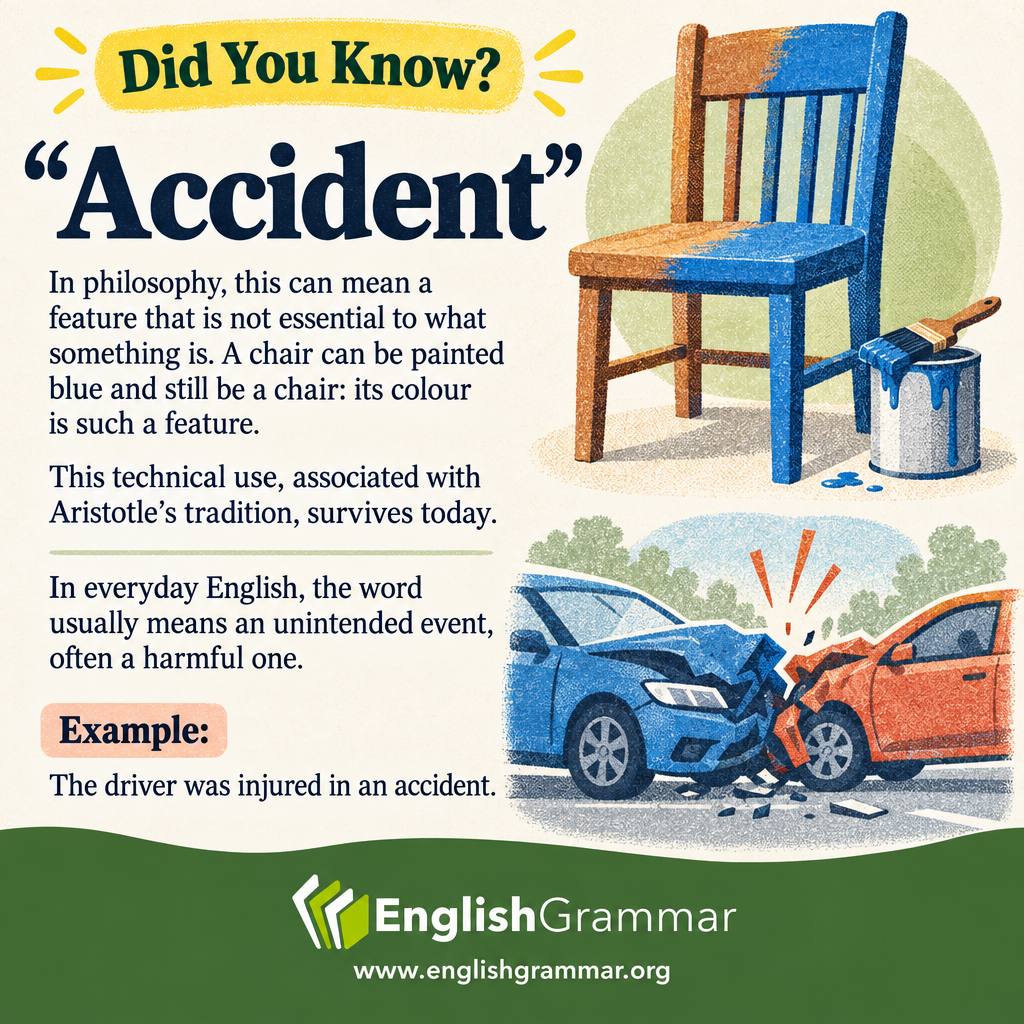
Today, an accident usually means an unintended event, often one that causes damage or injury. But the word also has a technical meaning in philosophy—and that meaning is still used.
In the tradition associated with Aristotle, an accident is a feature that something can have without that feature being essential to what it is. Here, essential means necessary for being that kind of thing, not simply important or useful.
For a simple illustration, imagine a wooden table. You could paint it green without making it stop being a table. Its green colour would be an accidental feature in this philosophical sense. That does not mean you painted it unintentionally: the painting could be completely deliberate.
The word’s history helps explain the connection. English received it through French from Latin accidens, meaning “happening” or “befalling”. Medieval philosophers used the Latin term for a feature that belongs to something without defining its essential nature.
Compare these uses:
- “Her height is an accident rather than part of her essence.” This philosophical use treats height as a nonessential feature.
- “The cyclist was injured in an accident.” This everyday use describes an unintended harmful event.
- “I opened your letter by accident.” The expression by accident means unintentionally.
So, in a philosophy text, the word may describe a property rather than an event. The surrounding discussion tells you which meaning is intended.