
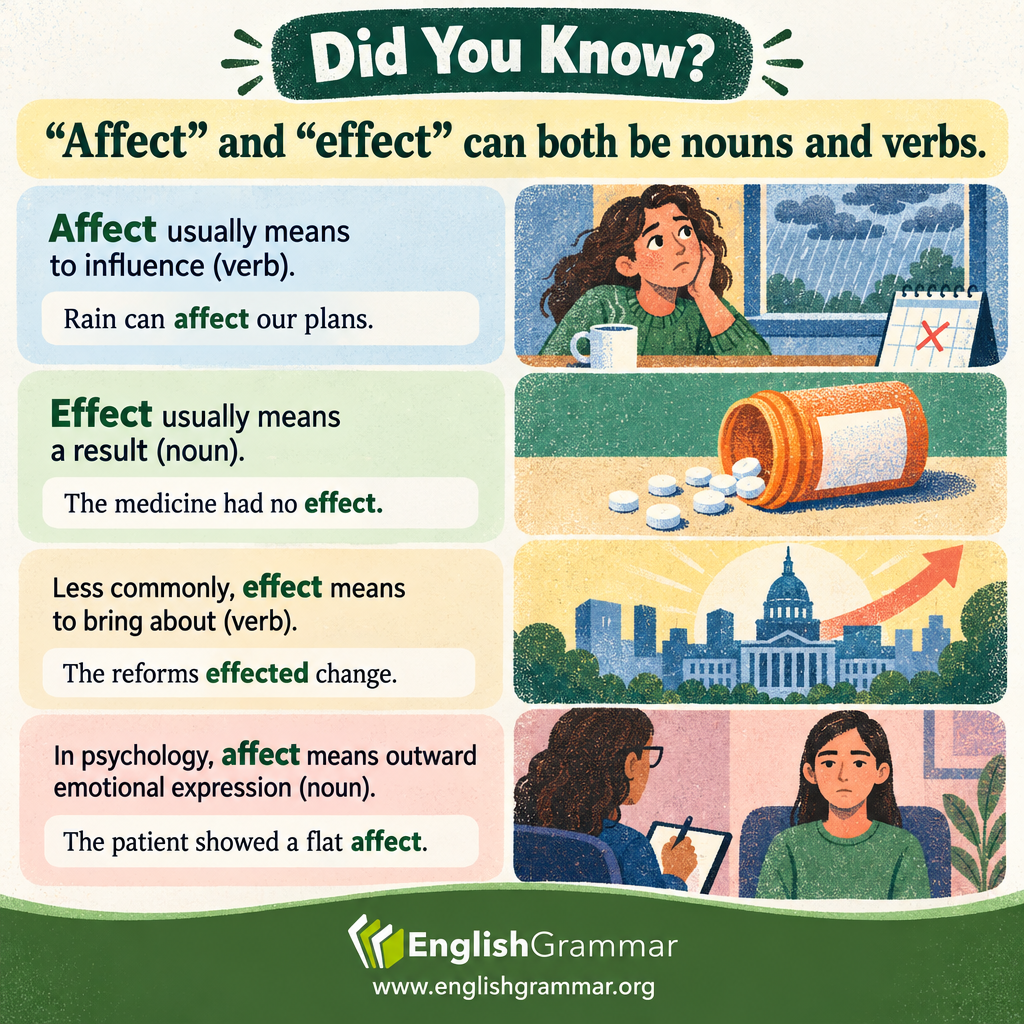
The familiar advice is to use affect as a verb and effect as a noun. That works in many everyday sentences, but it is not a complete rule. Both words can be nouns and verbs.
The two usual uses
- Affect as a verb usually means to influence or change something. “Lack of sleep can affect your concentration.” Here, sleep influences how well you can concentrate.
- Effect as a noun usually means a result. “The new timetable had a positive effect on attendance.” Here, better attendance is the result of the change.
The two less common uses
- Effect as a verb means to bring about or make something happen. It is more common in formal writing. “The new policy effected a major change.” The policy brought the change into existence; it did not merely influence it.
- Affect as a noun is a specialized term used in psychology and medicine for the outward expression of emotion. “The clinician noted the patient’s flat affect.” This describes little visible emotional expression, not necessarily an absence of inner feelings.
To choose the right word, ask what you mean: influencing something, naming a result, bringing something about, or describing emotional expression. Most everyday sentences use the first two meanings. The less common uses explain why the simple verb–noun shortcut sometimes fails.