
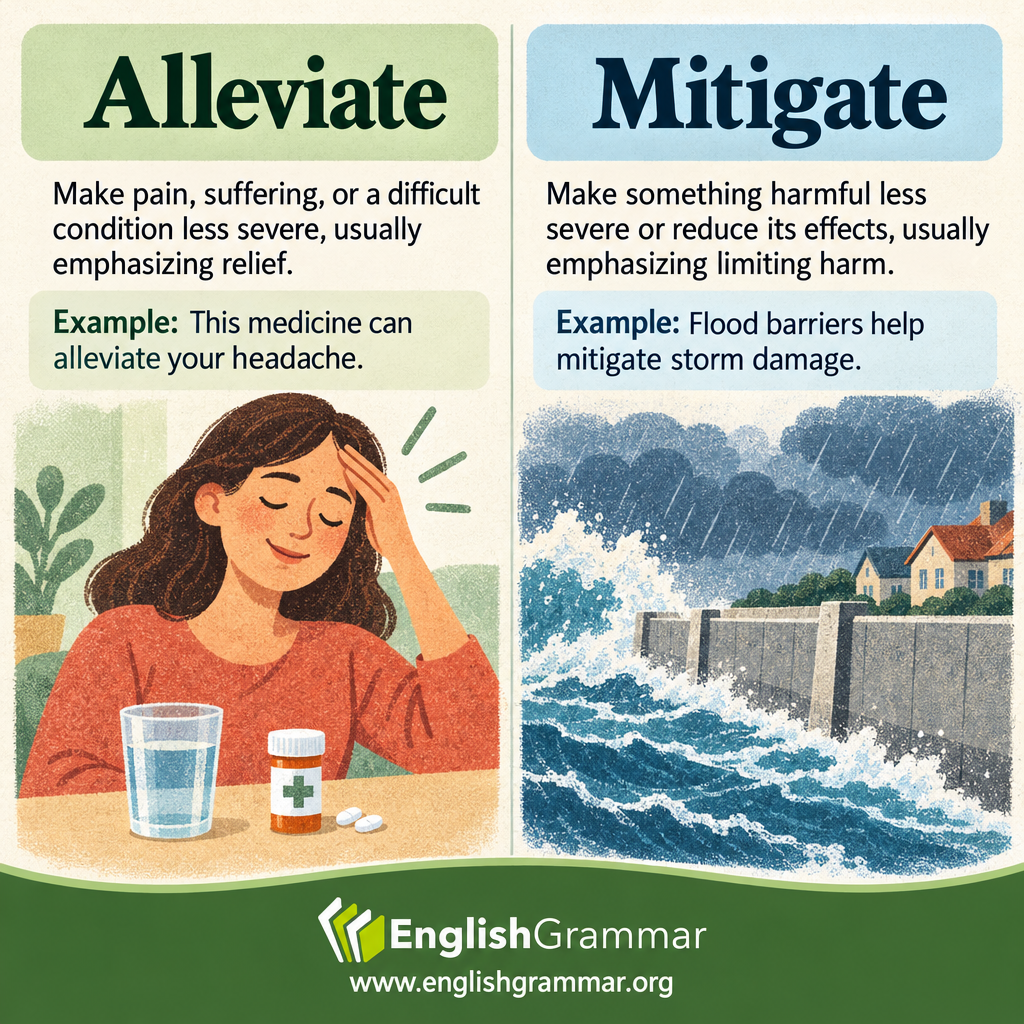
Alleviate and mitigate both mean making something less severe. The main difference is their usual focus, not a strict rule about when something happens.
Alleviate usually focuses on relieving pain, suffering, discomfort, or a difficult condition. Choose it when you want to emphasize making an unpleasant experience easier to bear.
- A warm bath may alleviate muscle pain.
- The emergency payments helped alleviate financial hardship.
Mitigate usually focuses on reducing the seriousness of something harmful or limiting its effects. It is common in discussions of risks, damage, and the consequences of a problem.
- The town planted trees to mitigate the effects of extreme heat.
- Regular backups help mitigate the risk of data loss.
Compare these two situations: a clinic offers treatment to alleviate patients’ discomfort, while a factory installs filters to mitigate the harmful effects of pollution. The first emphasizes relief; the second emphasizes limiting harm.
These patterns are useful, but they are not absolute boundaries. Both words can describe reducing suffering or the effects of a crisis. You may encounter either verb with stress, for example, depending on the writer’s emphasis.
Both are fairly formal verbs and normally take an object directly: alleviate anxiety or mitigate damage, without a preposition between the verb and its object. Neither word necessarily means removing the problem completely.