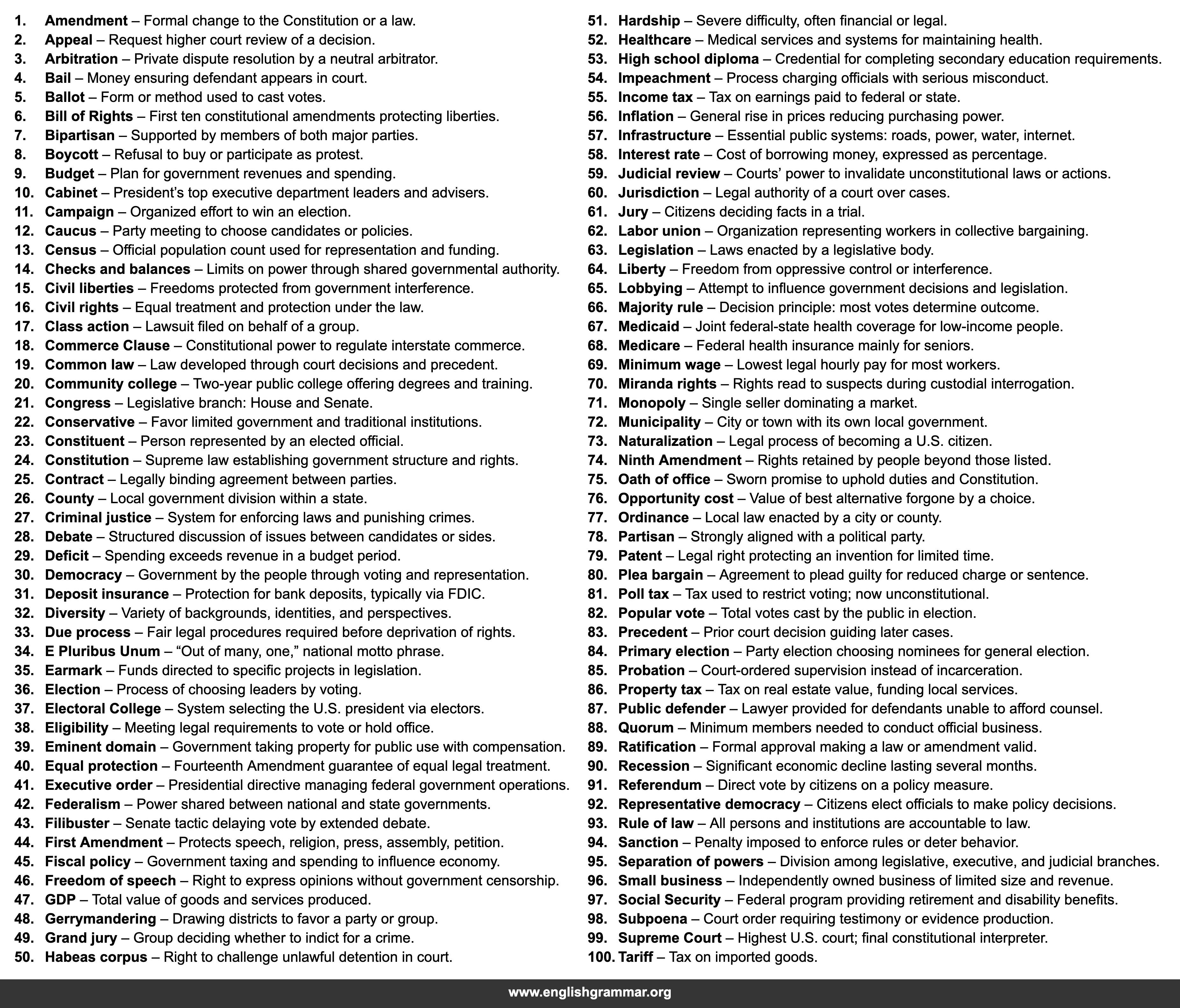
| No. | Term | Definition |
|---|---|---|
| 1. | Amendment | Formal change to the Constitution or a law. |
| 2. | Appeal | Request higher court review of a decision. |
| 3. | Arbitration | Private dispute resolution by a neutral arbitrator. |
| 4. | Bail | Money ensuring defendant appears in court. |
| 5. | Ballot | Form or method used to cast votes. |
| 6. | Bill of Rights | First ten constitutional amendments protecting liberties. |
| 7. | Bipartisan | Supported by members of both major parties. |
| 8. | Boycott | Refusal to buy or participate as protest. |
| 9. | Budget | Plan for government revenues and spending. |
| 10. | Cabinet | President’s top executive department leaders and advisers. |
| 11. | Campaign | Organized effort to win an election. |
| 12. | Caucus | Party meeting to choose candidates or policies. |
| 13. | Census | Official population count used for representation and funding. |
| 14. | Checks and balances | Limits on power through shared governmental authority. |
| 15. | Civil liberties | Freedoms protected from government interference. |
| 16. | Civil rights | Equal treatment and protection under the law. |
| 17. | Class action | Lawsuit filed on behalf of a group. |
| 18. | Commerce Clause | Constitutional power to regulate interstate commerce. |
| 19. | Common law | Law developed through court decisions and precedent. |
| 20. | Community college | Two-year public college offering degrees and training. |
| 21. | Congress | Legislative branch: House and Senate. |
| 22. | Conservative | Favor limited government and traditional institutions. |
| 23. | Constituent | Person represented by an elected official. |
| 24. | Constitution | Supreme law establishing government structure and rights. |
| 25. | Contract | Legally binding agreement between parties. |
| 26. | County | Local government division within a state. |
| 27. | Criminal justice | System for enforcing laws and punishing crimes. |
| 28. | Debate | Structured discussion of issues between candidates or sides. |
| 29. | Deficit | Spending exceeds revenue in a budget period. |
| 30. | Democracy | Government by the people through voting and representation. |
| 31. | Deposit insurance | Protection for bank deposits, typically via FDIC. |
| 32. | Diversity | Variety of backgrounds, identities, and perspectives. |
| 33. | Due process | Fair legal procedures required before deprivation of rights. |
| 34. | E Pluribus Unum | “Out of many, one,” national motto phrase. |
| 35. | Earmark | Funds directed to specific projects in legislation. |
| 36. | Election | Process of choosing leaders by voting. |
| 37. | Electoral College | System selecting the U.S. president via electors. |
| 38. | Eligibility | Meeting legal requirements to vote or hold office. |
| 39. | Eminent domain | Government taking property for public use with compensation. |
| 40. | Equal protection | Fourteenth Amendment guarantee of equal legal treatment. |
| 41. | Executive order | Presidential directive managing federal government operations. |
| 42. | Federalism | Power shared between national and state governments. |
| 43. | Filibuster | Senate tactic delaying vote by extended debate. |
| 44. | First Amendment | Protects speech, religion, press, assembly, petition. |
| 45. | Fiscal policy | Government taxing and spending to influence economy. |
| 46. | Freedom of speech | Right to express opinions without government censorship. |
| 47. | GDP | Total value of goods and services produced. |
| 48. | Gerrymandering | Drawing districts to favor a party or group. |
| 49. | Grand jury | Group deciding whether to indict for a crime. |
| 50. | Habeas corpus | Right to challenge unlawful detention in court. |
| 51. | Hardship | Severe difficulty, often financial or legal. |
| 52. | Healthcare | Medical services and systems for maintaining health. |
| 53. | High school diploma | Credential for completing secondary education requirements. |
| 54. | Impeachment | Process charging officials with serious misconduct. |
| 55. | Income tax | Tax on earnings paid to federal or state. |
| 56. | Inflation | General rise in prices reducing purchasing power. |
| 57. | Infrastructure | Essential public systems: roads, power, water, internet. |
| 58. | Interest rate | Cost of borrowing money, expressed as percentage. |
| 59. | Judicial review | Courts’ power to invalidate unconstitutional laws or actions. |
| 60. | Jurisdiction | Legal authority of a court over cases. |
| 61. | Jury | Citizens deciding facts in a trial. |
| 62. | Labor union | Organization representing workers in collective bargaining. |
| 63. | Legislation | Laws enacted by a legislative body. |
| 64. | Liberty | Freedom from oppressive control or interference. |
| 65. | Lobbying | Attempt to influence government decisions and legislation. |
| 66. | Majority rule | Decision principle: most votes determine outcome. |
| 67. | Medicaid | Joint federal-state health coverage for low-income people. |
| 68. | Medicare | Federal health insurance mainly for seniors. |
| 69. | Minimum wage | Lowest legal hourly pay for most workers. |
| 70. | Miranda rights | Rights read to suspects during custodial interrogation. |
| 71. | Monopoly | Single seller dominating a market. |
| 72. | Municipality | City or town with its own local government. |
| 73. | Naturalization | Legal process of becoming a U.S. citizen. |
| 74. | Ninth Amendment | Rights retained by people beyond those listed. |
| 75. | Oath of office | Sworn promise to uphold duties and Constitution. |
| 76. | Opportunity cost | Value of best alternative forgone by a choice. |
| 77. | Ordinance | Local law enacted by a city or county. |
| 78. | Partisan | Strongly aligned with a political party. |
| 79. | Patent | Legal right protecting an invention for limited time. |
| 80. | Plea bargain | Agreement to plead guilty for reduced charge or sentence. |
| 81. | Poll tax | Tax used to restrict voting; now unconstitutional. |
| 82. | Popular vote | Total votes cast by the public in election. |
| 83. | Precedent | Prior court decision guiding later cases. |
| 84. | Primary election | Party election choosing nominees for general election. |
| 85. | Probation | Court-ordered supervision instead of incarceration. |
| 86. | Property tax | Tax on real estate value, funding local services. |
| 87. | Public defender | Lawyer provided for defendants unable to afford counsel. |
| 88. | Quorum | Minimum members needed to conduct official business. |
| 89. | Ratification | Formal approval making a law or amendment valid. |
| 90. | Recession | Significant economic decline lasting several months. |
| 91. | Referendum | Direct vote by citizens on a policy measure. |
| 92. | Representative democracy | Citizens elect officials to make policy decisions. |
| 93. | Rule of law | All persons and institutions are accountable to law. |
| 94. | Sanction | Penalty imposed to enforce rules or deter behavior. |
| 95. | Separation of powers | Division among legislative, executive, and judicial branches. |
| 96. | Small business | Independently owned business of limited size and revenue. |
| 97. | Social Security | Federal program providing retirement and disability benefits. |
| 98. | Subpoena | Court order requiring testimony or evidence production. |
| 99. | Supreme Court | Highest U.S. court; final constitutional interpreter. |
| 100. | Tariff | Tax on imported goods. |
