
• Skip to primary navigation
  • Skip to main content
  • Skip to primary sidebar
Home of English Grammar
  • Home
  • Course
  • Exercises
  • Grammar Rules
  • Matches
  • Posts
  • Tools
    • Grammar Checker
    • Very Replacer
    • Word Counter
  • Vocabulary Lists
  • Archives
    • Social Media Posts
    • Writing Guides
  • Sign in
  • Join free

Ample vs. plentiful vs. abundant vs. bountiful vs. copious vs. profuse

November 2, 2026

Ample vs. Plentiful vs. Abundant vs. Bountiful vs. Copious vs. Profuse

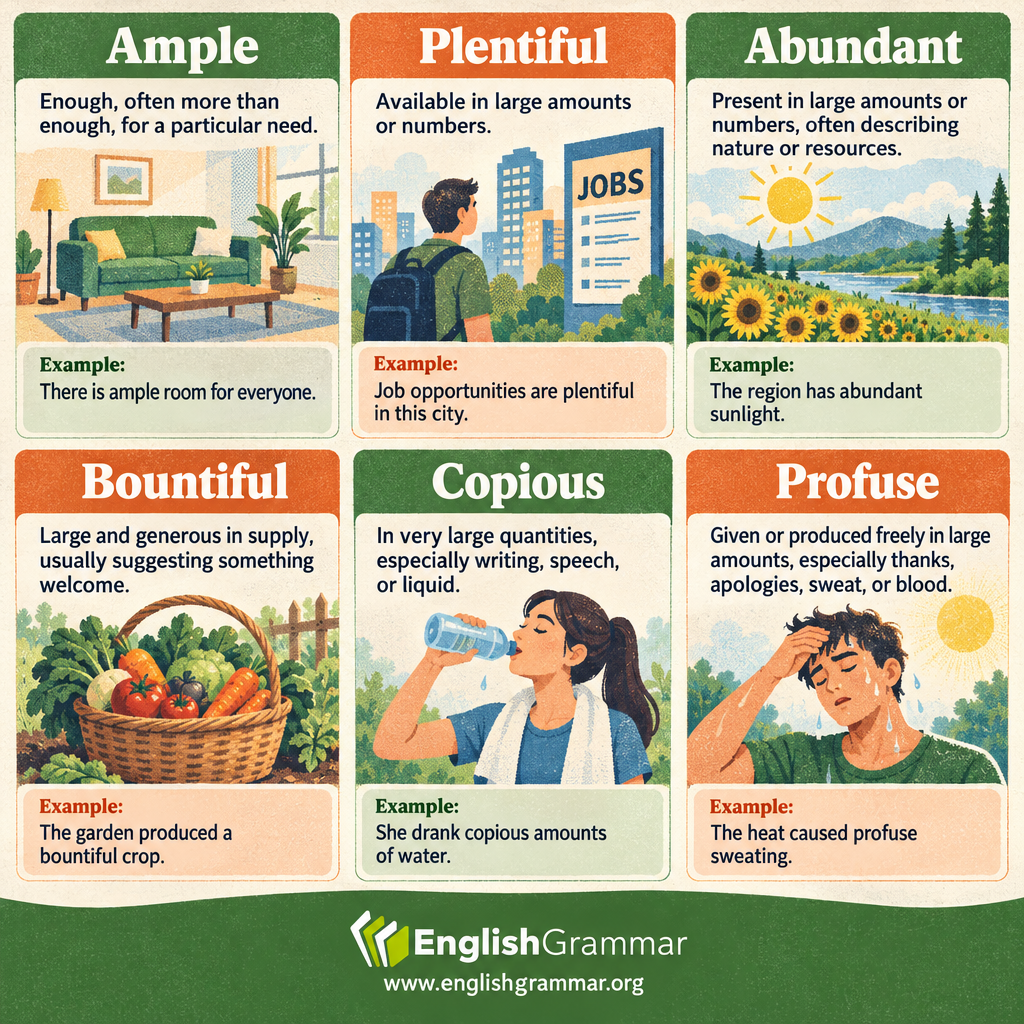
These six adjectives all describe a generous amount, but they are not always interchangeable. The best choice depends on whether you mean enough for a purpose, plenty available, or something produced in great quantities.

  • Ample means enough, often more than enough, for a particular need. We allowed ample time for questions. The focus is on having sufficient time, not simply a large amount.
  • Plentiful means available in large amounts or numbers. Fresh vegetables are plentiful in summer. It is a natural choice when something is easy to find or obtain.
  • Abundant also means present in large amounts or numbers. The island has abundant wildlife. It emphasizes quantity and is common in descriptions of nature and resources.
  • Bountiful suggests a large, generous supply, usually with a positive feeling. The farmers celebrated a bountiful harvest. It often describes food, crops, or gifts and can sound more literary.
  • Copious emphasizes a very large quantity, especially of writing, speech, or liquid. She took copious notes during the lecture. It sounds more formal than everyday alternatives such as lots of.
  • Profuse describes something given or produced freely in large amounts. He offered profuse apologies for the delay. Common partners include thanks, apologies, sweating, and bleeding.

These are tendencies, not strict boundaries. Both plentiful food and abundant food are natural; ample food focuses more on whether there is enough for everyone.

Improve your English grammar, vocabulary and writing

We take you step by step from beginner to advanced, even if you struggled with English at school or have always had trouble remembering the rules.

  • 10 modules, 112 lessons and 730 questions
  • Just log in and learn anytime and anywhere
  • Your progress is saved in your account
  • Download the 2027 Grammar Guide (PDF)
Join free

Already have an account? Sign in

See what’s in the course

Primary Sidebar

2.4M760.9K165.9K

Free 2027 Grammar Guide

  • Download Grammar Guide (PDF)
  • Online grammar course, A1 to C2
  • Weekly exercises and vocabulary
  • Join over 3 million English learners

We respect your privacy. Unsubscribe anytime.

Already have an account? Sign in

Grammar Checker - Try Now

Latest Posts

  • Ample vs. plentiful vs. abundant vs. bountiful vs. copious vs. profuse November 2, 2026
  • 100 Best Synonyms for “Respectfully” November 2, 2026
  • The origin of “out of left field” November 2, 2026
  • Creepy, spooky, eerie, sinister, macabre, and bloodcurdling: What’s the difference? November 2, 2026
  • 100 Best Synonyms for “Improvement” November 2, 2026
  • 100 Best Synonyms for “Understood” November 2, 2026
  • Perspicacious vs. perspicuous: understanding the difference November 2, 2026
  • 100 Best Synonyms for “Resent” November 2, 2026
  • 100 Best Synonyms for “Heavenly” November 2, 2026
  • 100 Best Synonyms for “Underpinned” November 2, 2026
Home of English Grammar

Free English grammar exercises, rules and vocabulary lists, with new exercises every week. Join the leading English grammar site with over 3 million followers.

Join free

Learn

  • Exercises
  • Matches
  • Grammar rules
  • Vocabulary lists
  • Writing guides
  • Online tools

More

  • Top social media posts
  • Various posts
  • Contact

Account

  • Join free
  • Grammar Course
  • Free grammar guide (PDF)

Copyright © 2026 EnglishGrammar.org

  • Disclaimer
  • Privacy policy
  • Terms
  • Sitemap