
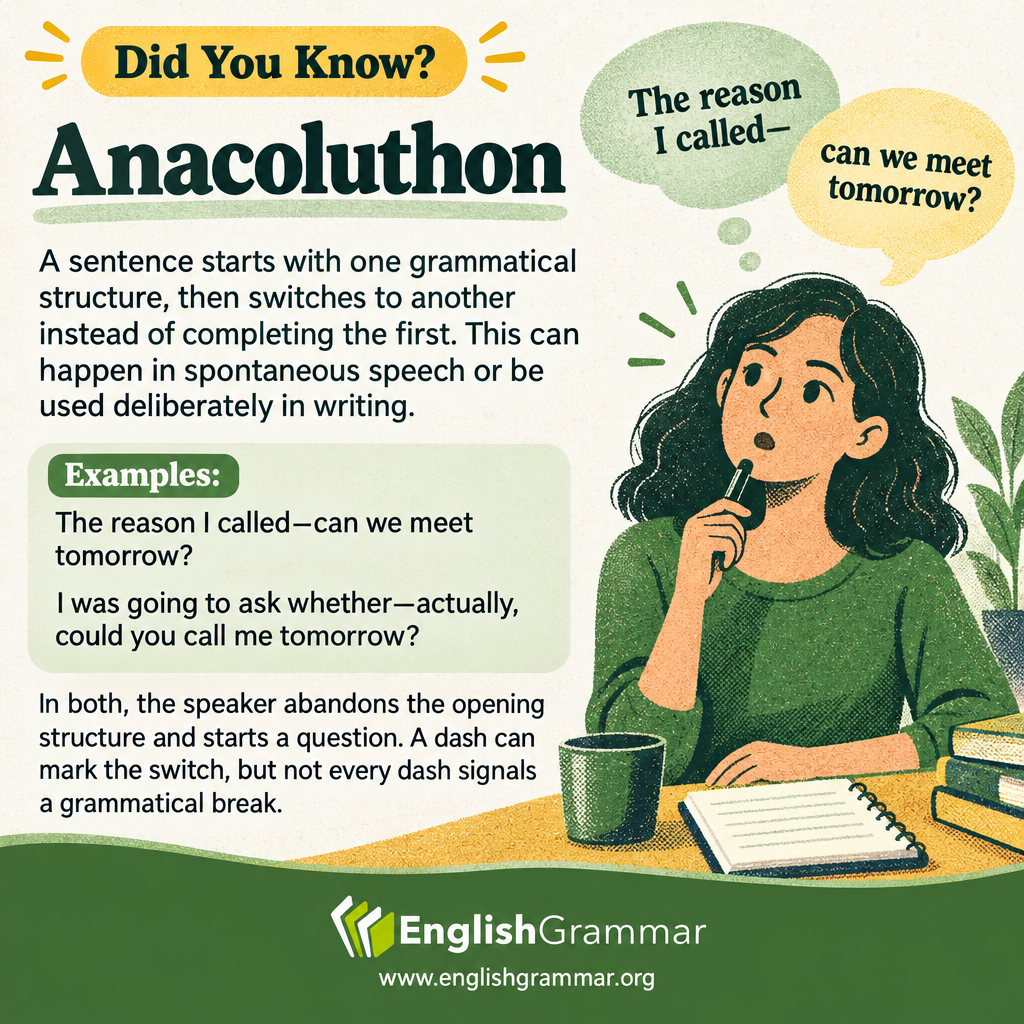
A sentence sometimes begins with one grammatical plan and finishes with another. This break in structure is called anacoluthon. The speaker does not complete the opening construction as expected but switches to a different one.
You may hear this in spontaneous conversation, when someone changes their mind, gets distracted, or becomes emotional. Writers can also use it deliberately to make dialogue sound natural or show a character’s unsettled thoughts.
- I was wondering whether—could we move the meeting to Friday?The opening leads us to expect a clause after whether. Instead, the speaker restarts with a direct question.
- The thing I wanted to explain—let me start again.The opening noun phrase is left without a grammatical role in the new command.
A dash alone does not make this effect. In I wanted—really wanted—to go, the interruption adds emphasis, but the underlying sentence still works: I wanted to go. What matters is the change in grammatical structure, not the punctuation.
In dialogue or creative writing, a broken structure can be expressive rather than careless. In a report, application, or formal explanation, however, it may distract readers. Unless the interruption serves a purpose, revise the sentence so its opening and ending fit together.
For example, the first sentence above could become the straightforward question Could we move the meeting to Friday? The information stays, but the sense of a speaker changing direction disappears.