
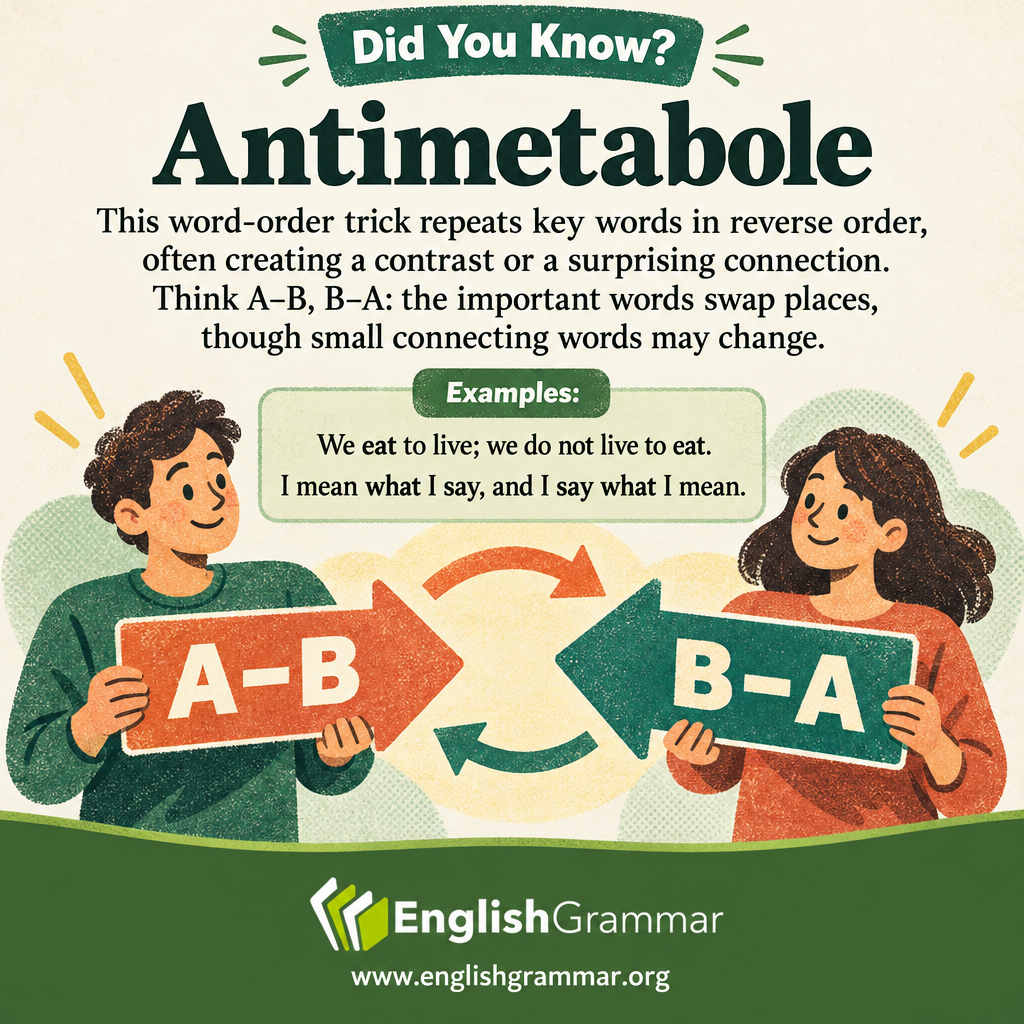
Antimetabole repeats key words in reverse order. The second part turns the first part around, creating a contrast, a change in emphasis, or a surprising connection.
You can often spot the pattern as A–B, B–A. The letters stand for the important words or groups of words, not every word in the sentence. Small connecting words may change.
- Work to live; don’t live to work. The words work and live switch places. The first part treats work as a way to support your life; the second warns against making work your whole purpose.
- We shape our habits; then our habits shape us. First, people influence habits. Then the direction reverses: habits influence people. The repeated words make that two-way relationship easy to follow.
This pattern appears in speeches, advertising, arguments, and everyday advice. Reusing familiar words gives the listener something to recognize, while reversing them creates a fresh point. That combination can make a sentence easier to remember.
Simply changing word order is not enough: the key feature is repetition in reverse order. When writing your own example, check that both halves make sense and that the reversal adds something useful.
A neat reversal can sound convincing, but its structure does not prove its message. Enjoy the wording, then consider whether the claim is actually fair or true.