
• Skip to primary navigation
  • Skip to main content
  • Skip to primary sidebar
Home of English Grammar
  • Home
  • Course
  • Exercises
  • Grammar Rules
  • Matches
  • Posts
  • Tools
    • Grammar Checker
    • Very Replacer
    • Word Counter
  • Vocabulary Lists
    • My Word Lists
  • For Teachers
  • Archives
    • Social Media Posts
    • Writing Guides
  • Sign in
  • Join free

Aposiopesis: when a sentence breaks off on purpose

November 21, 2026

Aposiopesis: when a sentence breaks off on purpose

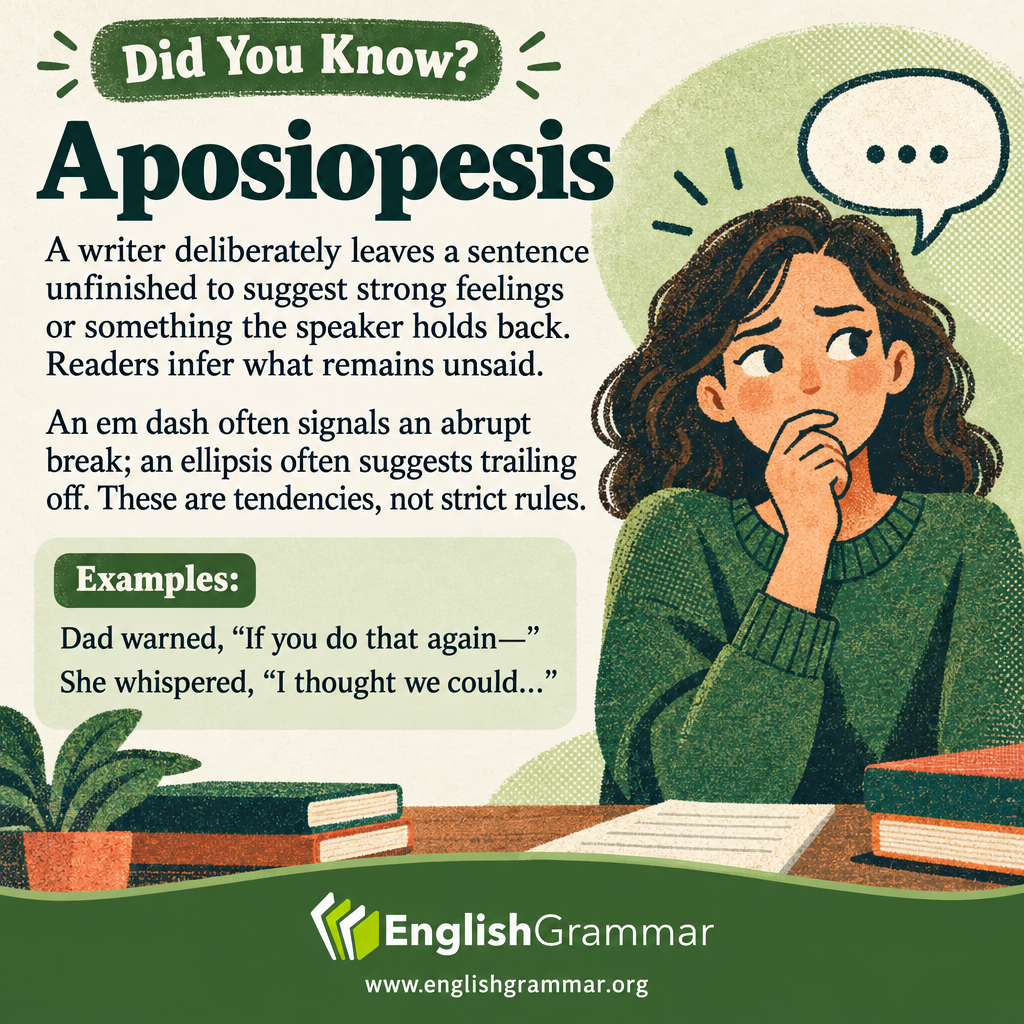
A speaker does not always finish a thought. Sometimes anger, shock, hesitation, or a wish to avoid saying something makes the speaker stop. When a writer deliberately uses this unfinished speech for effect, the technique is called aposiopesis. Readers are invited to imagine what remains unsaid.

The missing words matter. An unfinished warning can sound threatening without naming a punishment. A broken sentence can also suggest that someone is too upset to continue or unwilling to admit something.

  • A warning: “If you tell anyone my secret—” The speaker leaves the consequence unstated, allowing the listener to imagine it.
  • Shock: “But you promised you would never—” The speaker breaks off before finishing the accusation.
  • Reluctance: “I wanted to tell her the truth, but…” The speaker trails off instead of explaining what stopped them.

An em dash often marks a sudden break, while an ellipsis often suggests a voice fading into silence or hesitation. These are useful tendencies, not strict rules. Context tells readers why the thought stops.

Not every unfinished sentence is this technique. A speaker may simply be interrupted by another person, and dots may mark words omitted from a quotation. The key here is the deliberate effect of leaving a thought unfinished. In your own writing, use it where the silence gives readers something meaningful to infer, rather than merely making the sentence harder to understand.

Improve your English grammar, vocabulary and writing

We take you step by step from beginner to advanced, even if you struggled with English at school or have always had trouble remembering the rules.

  • 11 modules, 124 lessons and 819 questions
  • Just log in and learn anytime and anywhere
  • Your progress is saved in your account
  • Download the 2027 Grammar Guide (PDF)
Join free

Already have an account? Sign in

See what’s in the course

Primary sidebar

2.4M760.9K165.9K

Free 2027 Grammar Guide

  • Download Grammar Guide (PDF)
  • Online grammar course, A1 to C2
  • Weekly exercises and vocabulary
  • Join over 3 million English learners

We respect your privacy. Unsubscribe anytime.

Already have an account? Sign in

Grammar Checker - Try Now

Rankings

Home of English Grammar

Free exercises, a step-by-step grammar course, rules and vocabulary lists, with new exercises every week. Join the leading English grammar site with over 3 million followers.

Join free

Learn

  • Exercises
  • Grammar course
  • Level test
  • Matches
  • Grammar rules
  • Vocabulary lists
  • Writing guides
  • Online tools

More

  • Top social media posts
  • Various posts
  • For teachers
  • Contact

Account

  • Join free
  • My word lists
  • Free grammar guide (PDF)

Copyright © 2026 EnglishGrammar.org

  • Disclaimer
  • Privacy policy
  • Terms
  • Sitemap