
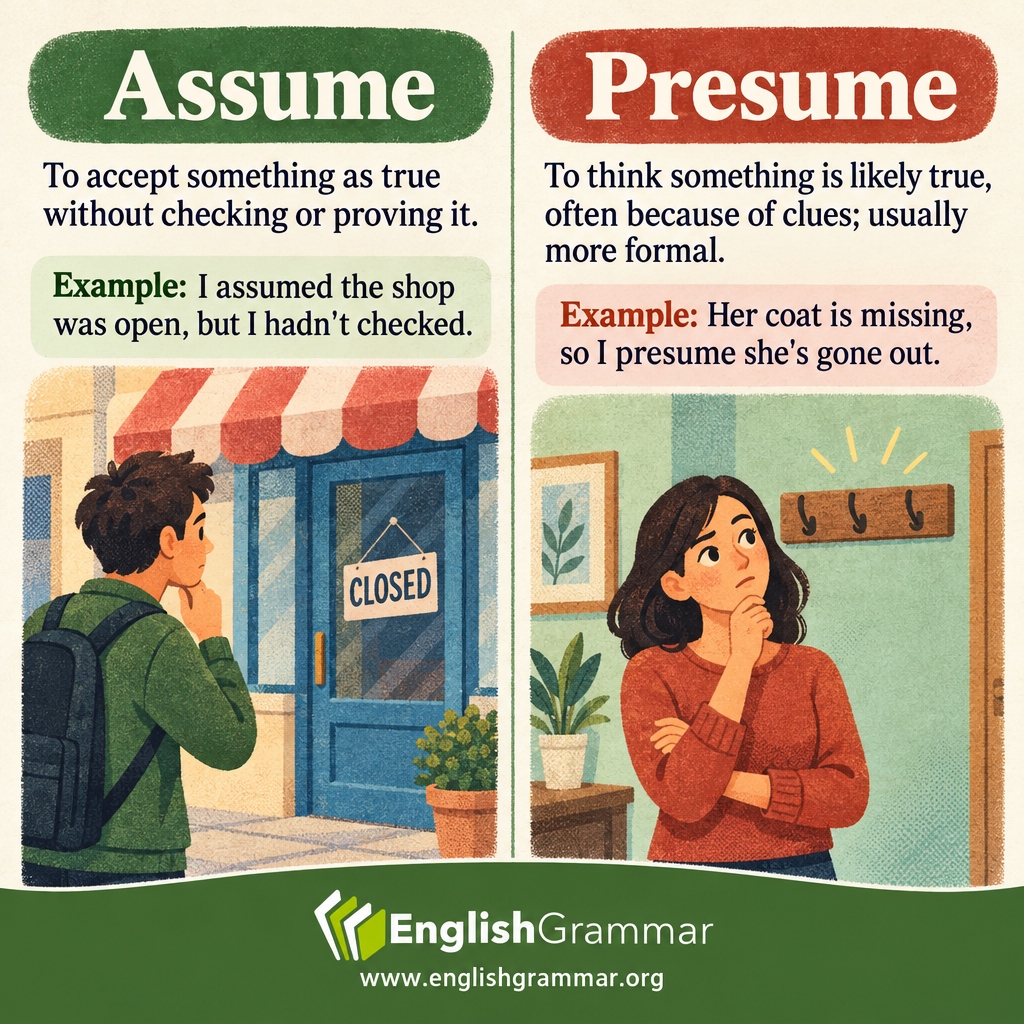
Assume and presume both describe accepting something as true without knowing for certain. Their meanings overlap, so the difference is usually a matter of emphasis, not a strict rule.
Assume is common in everyday English. It often suggests accepting an idea without checking it or having proof. For example, I assumed you wanted coffee, so I made you a cup. The speaker treated a guess as fact without asking.
Presume often suggests that something seems likely because of available clues or what normally happens. It also usually sounds more formal. For example, The meeting room is empty, so I presume everyone has left. The empty room gives the speaker a reason for that belief.
Compare these two situations:
- We assumed the tickets were free and arrived without any money. This highlights an unchecked belief.
- The tickets have no price printed on them, so we presume admission is free. This highlights a reason for the belief, although it could still be wrong.
Do not treat the evidence distinction as absolute. People also use assume when they have reasons, and presume does not guarantee strong evidence. In many everyday sentences, either word works. Choose based on the emphasis and tone you want, rather than treating one as automatically correct.