
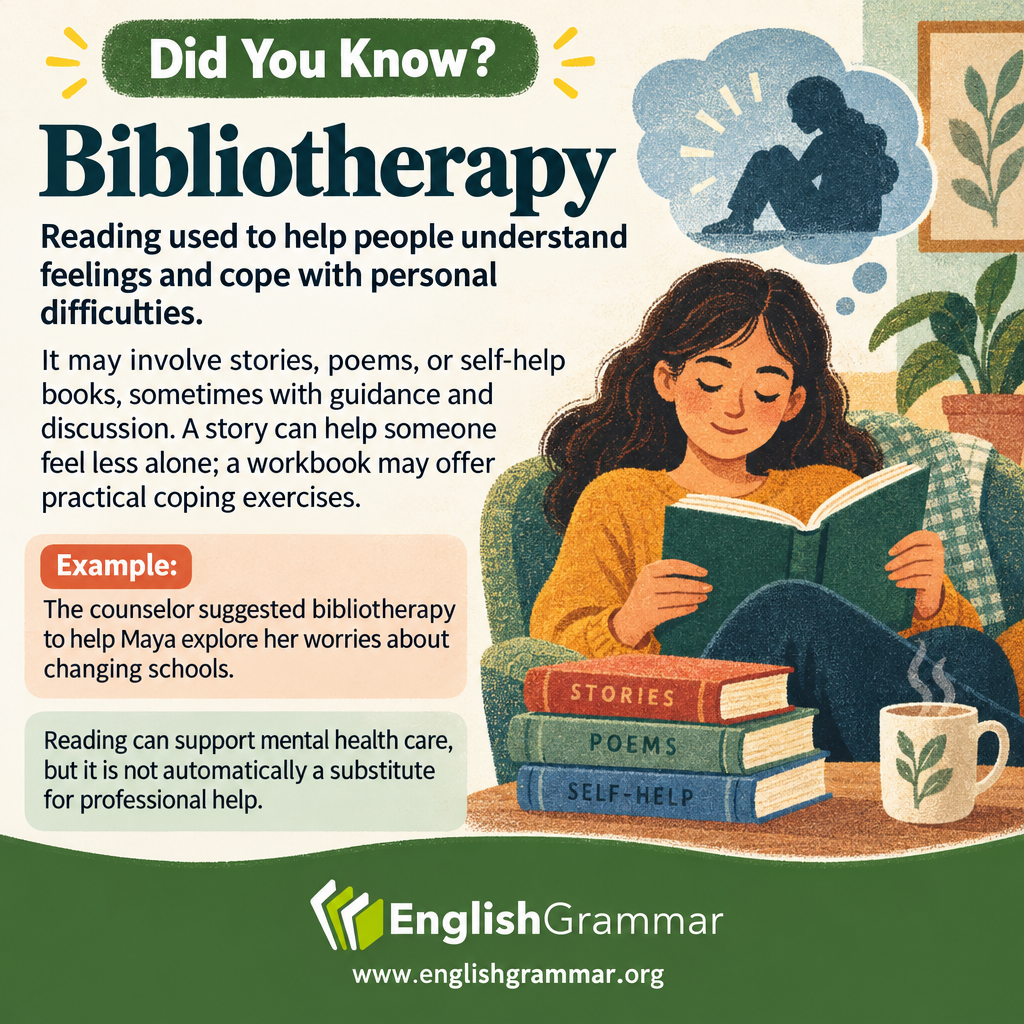
Bibliotherapy means using reading to help people understand their feelings and deal with personal difficulties. The reading has a purpose: it is chosen to support a particular need, rather than simply to entertain or provide information.
The material might be a novel, a poem, a personal story, or a self-help book. Different kinds of writing can offer different kinds of support:
- Stories and poems may help readers recognize feelings, see a situation from another person’s viewpoint, or feel less alone.
- Self-help books may explain a problem and offer practical exercises for managing it. Some approaches use structured reading based on established psychological methods.
For example, a child adjusting to a new school might read a story about a character who feels left out. Talking about the character’s experiences can make it easier for the child to discuss their own worries. An adult dealing with anxiety might use a recommended workbook alongside sessions with a therapist.
In everyday English, you could say, “The counselor used bibliotherapy to help students talk about friendship problems.” Here, the word names the planned use of reading as support.
Bibliotherapy can involve guidance from a therapist or another trained professional, often with discussion or exercises. Some reading-based support is self-directed. However, not every comforting book counts as a treatment, and reading is not automatically a substitute for professional mental health care. Its usefulness depends on the person, the material, and the difficulty being addressed.