
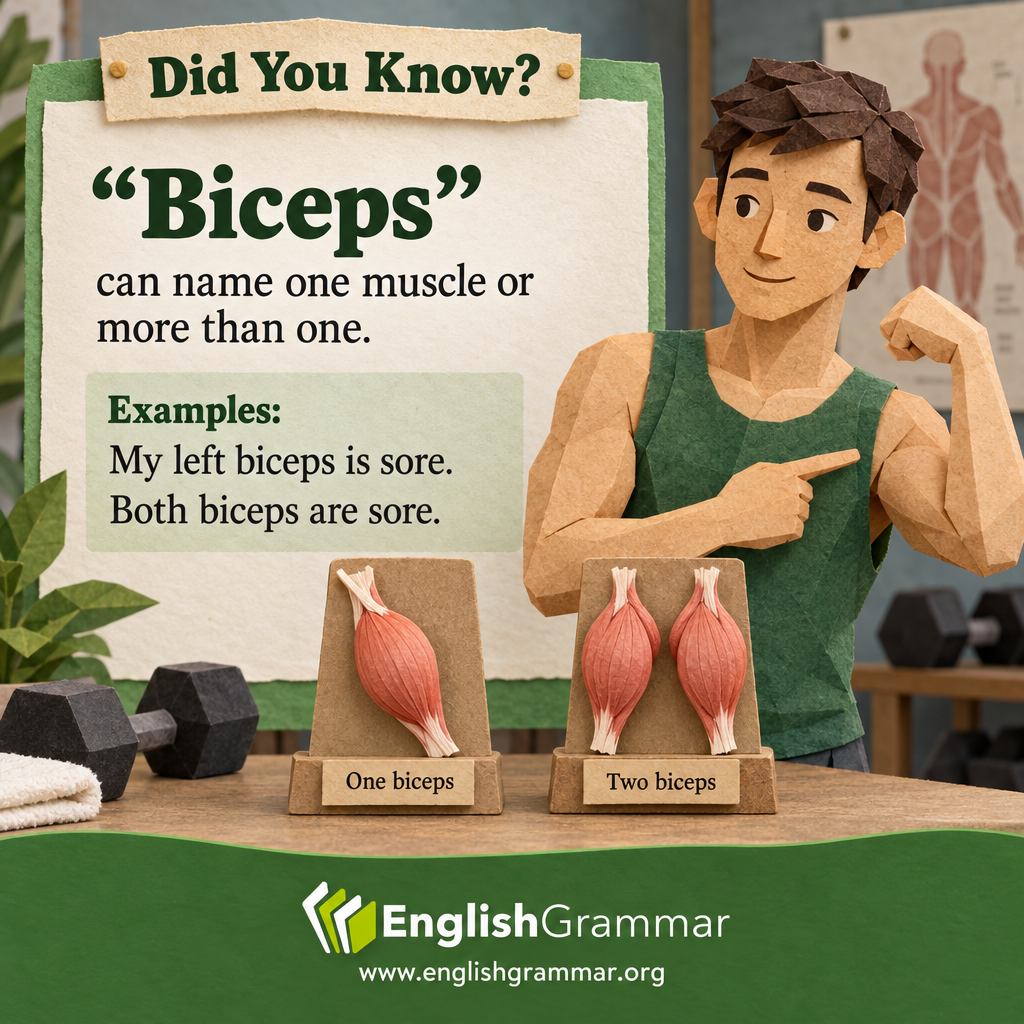
Biceps can be singular or plural, even though it ends in s. You can use the same spelling when talking about one muscle or more than one. The final letter is part of the word, not simply a plural ending added in English.
This can seem surprising because many familiar nouns form their plurals by adding s: one arm, two arms; one muscle, two muscles. But an ending alone does not always tell you whether a noun is singular or plural.
With biceps, look at the surrounding words. Numbers, words such as both, and verbs such as is or are help make the meaning clear.
- One muscle: My right biceps is sore after yesterday’s workout.
- Two muscles: Both of my biceps are sore after yesterday’s workout.
In the first example, right identifies one muscle, so the verb is singular: is. In the second, both identifies two muscles, so the verb is plural: are.
You may also encounter bicepses, which is an accepted plural form. However, you do not need to add es to show that you mean more than one.
When choosing a verb, focus on how many muscles you mean rather than the final letter of the noun. For example, “Her biceps is injured” refers to one muscle; “Her biceps are strong” refers to more than one.