
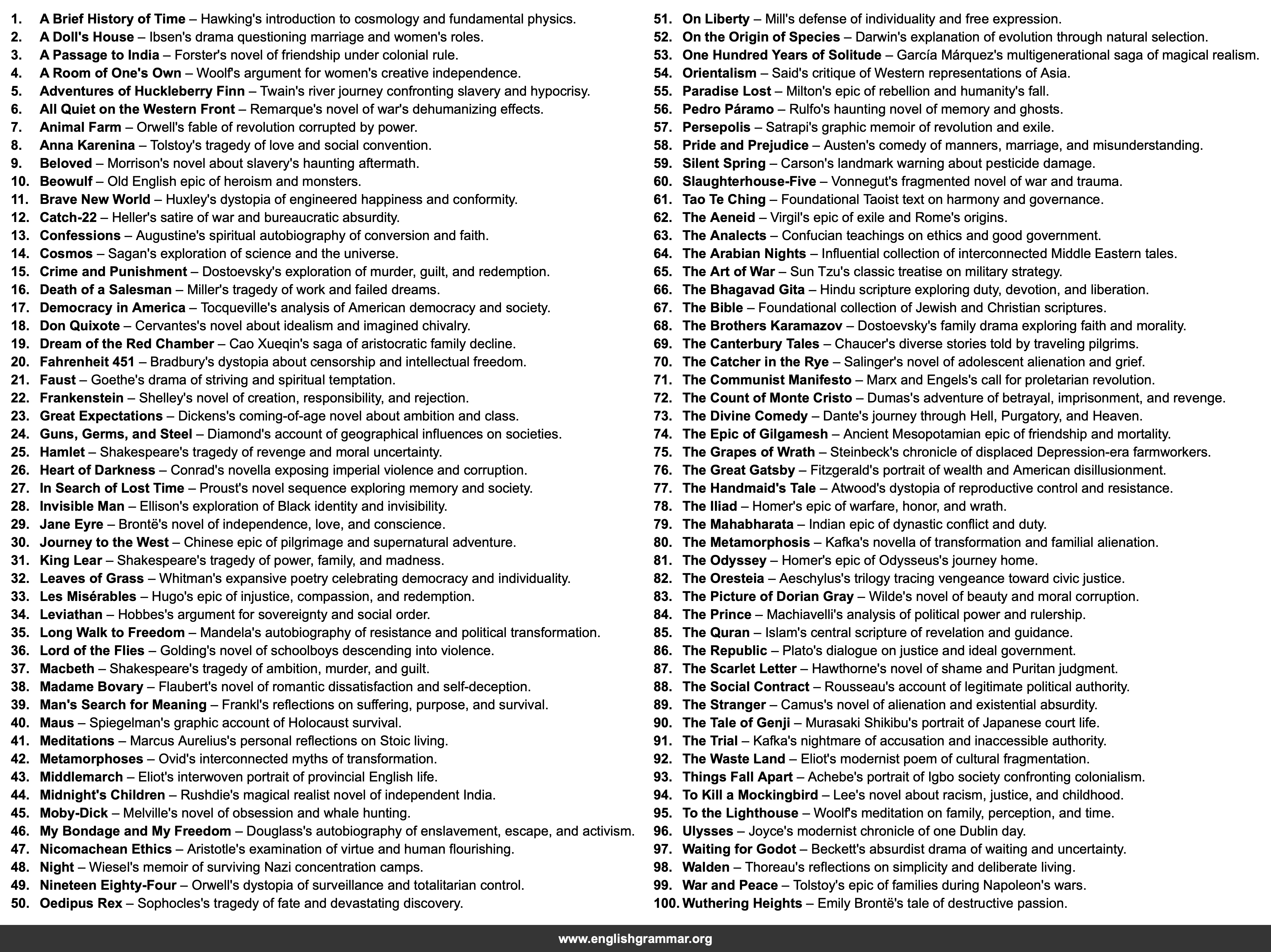
| No. | Item | Definition |
|---|---|---|
| 1. | A Brief History of Time | Hawking’s introduction to cosmology and fundamental physics. |
| 2. | A Doll’s House | Ibsen’s drama questioning marriage and women’s roles. |
| 3. | A Passage to India | Forster’s novel of friendship under colonial rule. |
| 4. | A Room of One’s Own | Woolf’s argument for women’s creative independence. |
| 5. | Adventures of Huckleberry Finn | Twain’s river journey confronting slavery and hypocrisy. |
| 6. | All Quiet on the Western Front | Remarque’s novel of war’s dehumanizing effects. |
| 7. | Animal Farm | Orwell’s fable of revolution corrupted by power. |
| 8. | Anna Karenina | Tolstoy’s tragedy of love and social convention. |
| 9. | Beloved | Morrison’s novel about slavery’s haunting aftermath. |
| 10. | Beowulf | Old English epic of heroism and monsters. |
| 11. | Brave New World | Huxley’s dystopia of engineered happiness and conformity. |
| 12. | Catch-22 | Heller’s satire of war and bureaucratic absurdity. |
| 13. | Confessions | Augustine’s spiritual autobiography of conversion and faith. |
| 14. | Cosmos | Sagan’s exploration of science and the universe. |
| 15. | Crime and Punishment | Dostoevsky’s exploration of murder, guilt, and redemption. |
| 16. | Death of a Salesman | Miller’s tragedy of work and failed dreams. |
| 17. | Democracy in America | Tocqueville’s analysis of American democracy and society. |
| 18. | Don Quixote | Cervantes’s novel about idealism and imagined chivalry. |
| 19. | Dream of the Red Chamber | Cao Xueqin’s saga of aristocratic family decline. |
| 20. | Fahrenheit 451 | Bradbury’s dystopia about censorship and intellectual freedom. |
| 21. | Faust | Goethe’s drama of striving and spiritual temptation. |
| 22. | Frankenstein | Shelley’s novel of creation, responsibility, and rejection. |
| 23. | Great Expectations | Dickens’s coming-of-age novel about ambition and class. |
| 24. | Guns, Germs, and Steel | Diamond’s account of geographical influences on societies. |
| 25. | Hamlet | Shakespeare’s tragedy of revenge and moral uncertainty. |
| 26. | Heart of Darkness | Conrad’s novella exposing imperial violence and corruption. |
| 27. | In Search of Lost Time | Proust’s novel sequence exploring memory and society. |
| 28. | Invisible Man | Ellison’s exploration of Black identity and invisibility. |
| 29. | Jane Eyre | Brontë’s novel of independence, love, and conscience. |
| 30. | Journey to the West | Chinese epic of pilgrimage and supernatural adventure. |
| 31. | King Lear | Shakespeare’s tragedy of power, family, and madness. |
| 32. | Leaves of Grass | Whitman’s expansive poetry celebrating democracy and individuality. |
| 33. | Les Misérables | Hugo’s epic of injustice, compassion, and redemption. |
| 34. | Leviathan | Hobbes’s argument for sovereignty and social order. |
| 35. | Long Walk to Freedom | Mandela’s autobiography of resistance and political transformation. |
| 36. | Lord of the Flies | Golding’s novel of schoolboys descending into violence. |
| 37. | Macbeth | Shakespeare’s tragedy of ambition, murder, and guilt. |
| 38. | Madame Bovary | Flaubert’s novel of romantic dissatisfaction and self-deception. |
| 39. | Man’s Search for Meaning | Frankl’s reflections on suffering, purpose, and survival. |
| 40. | Maus | Spiegelman’s graphic account of Holocaust survival. |
| 41. | Meditations | Marcus Aurelius’s personal reflections on Stoic living. |
| 42. | Metamorphoses | Ovid’s interconnected myths of transformation. |
| 43. | Middlemarch | Eliot’s interwoven portrait of provincial English life. |
| 44. | Midnight’s Children | Rushdie’s magical realist novel of independent India. |
| 45. | Moby-Dick | Melville’s novel of obsession and whale hunting. |
| 46. | My Bondage and My Freedom | Douglass’s autobiography of enslavement, escape, and activism. |
| 47. | Nicomachean Ethics | Aristotle’s examination of virtue and human flourishing. |
| 48. | Night | Wiesel’s memoir of surviving Nazi concentration camps. |
| 49. | Nineteen Eighty-Four | Orwell’s dystopia of surveillance and totalitarian control. |
| 50. | Oedipus Rex | Sophocles’s tragedy of fate and devastating discovery. |
| 51. | On Liberty | Mill’s defense of individuality and free expression. |
| 52. | On the Origin of Species | Darwin’s explanation of evolution through natural selection. |
| 53. | One Hundred Years of Solitude | García Márquez’s multigenerational saga of magical realism. |
| 54. | Orientalism | Said’s critique of Western representations of Asia. |
| 55. | Paradise Lost | Milton’s epic of rebellion and humanity’s fall. |
| 56. | Pedro Páramo | Rulfo’s haunting novel of memory and ghosts. |
| 57. | Persepolis | Satrapi’s graphic memoir of revolution and exile. |
| 58. | Pride and Prejudice | Austen’s comedy of manners, marriage, and misunderstanding. |
| 59. | Silent Spring | Carson’s landmark warning about pesticide damage. |
| 60. | Slaughterhouse-Five | Vonnegut’s fragmented novel of war and trauma. |
| 61. | Tao Te Ching | Foundational Taoist text on harmony and governance. |
| 62. | The Aeneid | Virgil’s epic of exile and Rome’s origins. |
| 63. | The Analects | Confucian teachings on ethics and good government. |
| 64. | The Arabian Nights | Influential collection of interconnected Middle Eastern tales. |
| 65. | The Art of War | Sun Tzu’s classic treatise on military strategy. |
| 66. | The Bhagavad Gita | Hindu scripture exploring duty, devotion, and liberation. |
| 67. | The Bible | Foundational collection of Jewish and Christian scriptures. |
| 68. | The Brothers Karamazov | Dostoevsky’s family drama exploring faith and morality. |
| 69. | The Canterbury Tales | Chaucer’s diverse stories told by traveling pilgrims. |
| 70. | The Catcher in the Rye | Salinger’s novel of adolescent alienation and grief. |
| 71. | The Communist Manifesto | Marx and Engels’s call for proletarian revolution. |
| 72. | The Count of Monte Cristo | Dumas’s adventure of betrayal, imprisonment, and revenge. |
| 73. | The Divine Comedy | Dante’s journey through Hell, Purgatory, and Heaven. |
| 74. | The Epic of Gilgamesh | Ancient Mesopotamian epic of friendship and mortality. |
| 75. | The Grapes of Wrath | Steinbeck’s chronicle of displaced Depression-era farmworkers. |
| 76. | The Great Gatsby | Fitzgerald’s portrait of wealth and American disillusionment. |
| 77. | The Handmaid’s Tale | Atwood’s dystopia of reproductive control and resistance. |
| 78. | The Iliad | Homer’s epic of warfare, honor, and wrath. |
| 79. | The Mahabharata | Indian epic of dynastic conflict and duty. |
| 80. | The Metamorphosis | Kafka’s novella of transformation and familial alienation. |
| 81. | The Odyssey | Homer’s epic of Odysseus’s journey home. |
| 82. | The Oresteia | Aeschylus’s trilogy tracing vengeance toward civic justice. |
| 83. | The Picture of Dorian Gray | Wilde’s novel of beauty and moral corruption. |
| 84. | The Prince | Machiavelli’s analysis of political power and rulership. |
| 85. | The Quran | Islam’s central scripture of revelation and guidance. |
| 86. | The Republic | Plato’s dialogue on justice and ideal government. |
| 87. | The Scarlet Letter | Hawthorne’s novel of shame and Puritan judgment. |
| 88. | The Social Contract | Rousseau’s account of legitimate political authority. |
| 89. | The Stranger | Camus’s novel of alienation and existential absurdity. |
| 90. | The Tale of Genji | Murasaki Shikibu’s portrait of Japanese court life. |
| 91. | The Trial | Kafka’s nightmare of accusation and inaccessible authority. |
| 92. | The Waste Land | Eliot’s modernist poem of cultural fragmentation. |
| 93. | Things Fall Apart | Achebe’s portrait of Igbo society confronting colonialism. |
| 94. | To Kill a Mockingbird | Lee’s novel about racism, justice, and childhood. |
| 95. | To the Lighthouse | Woolf’s meditation on family, perception, and time. |
| 96. | Ulysses | Joyce’s modernist chronicle of one Dublin day. |
| 97. | Waiting for Godot | Beckett’s absurdist drama of waiting and uncertainty. |
| 98. | Walden | Thoreau’s reflections on simplicity and deliberate living. |
| 99. | War and Peace | Tolstoy’s epic of families during Napoleon’s wars. |
| 100. | Wuthering Heights | Emily Brontë’s tale of destructive passion. |