
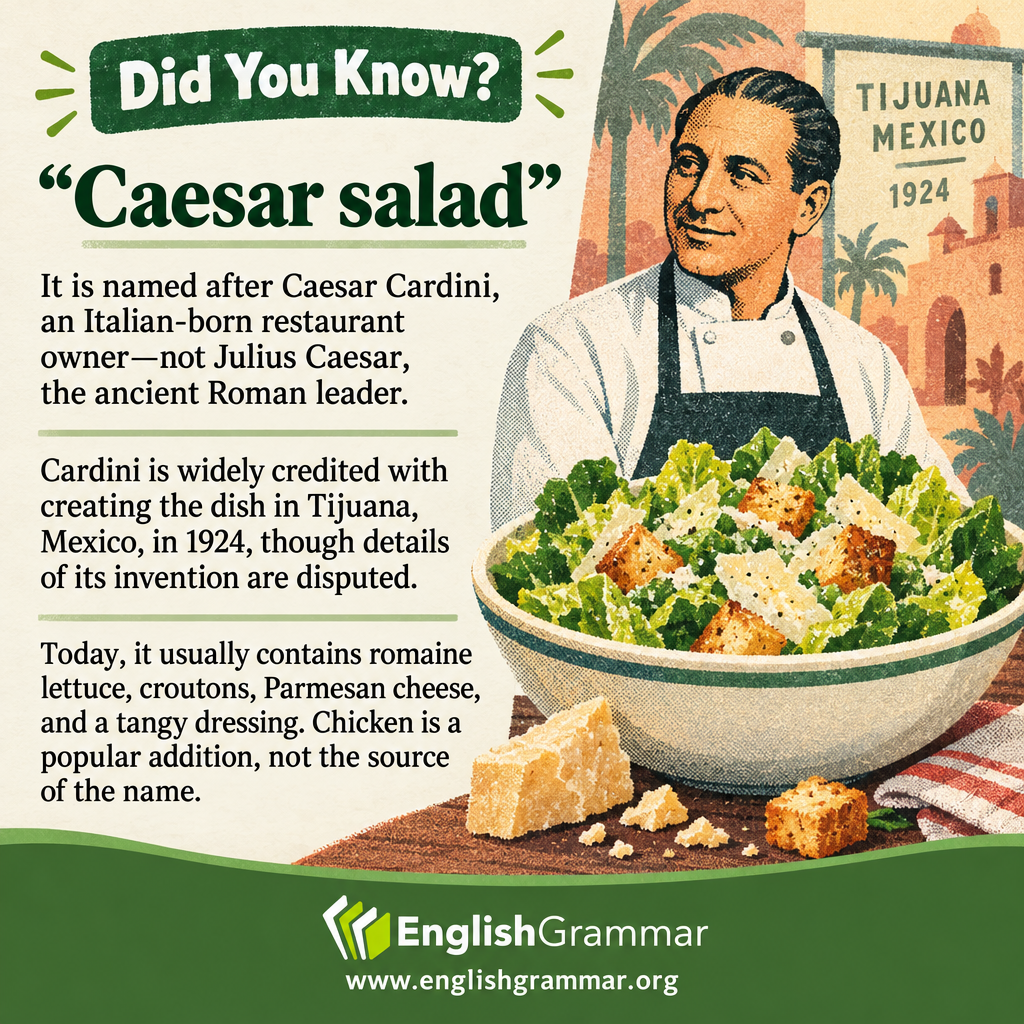
Caesar salad is not named after Julius Caesar, the ancient Roman leader. Its name comes from Caesar Cardini, an Italian-born restaurateur who worked in Tijuana, Mexico.
Cardini is widely credited with creating the dish there in 1924. The familiar story says that, during a busy holiday weekend, his restaurant was running short of supplies. He put together a salad using ingredients he still had and prepared it at the table. Some details of the invention are disputed, so it is better to describe this as the traditional account rather than a fully settled story.
Today, the name usually refers to a salad made with romaine lettuce, croutons, Parmesan cheese, and a rich, tangy dressing. Restaurants often add chicken, shrimp, or other ingredients, but those additions are not what gave the dish its name.
These examples show how the name appears in everyday English:
- I ordered a Caesar salad with grilled chicken for lunch.
- Does the Caesar dressing contain anchovies?
In the second example, Caesar dressing means the dressing associated with the salad. Many modern recipes include anchovies, though recipes vary.
The spelling can make the name look connected to ancient Rome. Here, however, Caesar is a person’s first name. Food names sometimes preserve the name of a cook, restaurant owner, or place rather than describe the ingredients.