
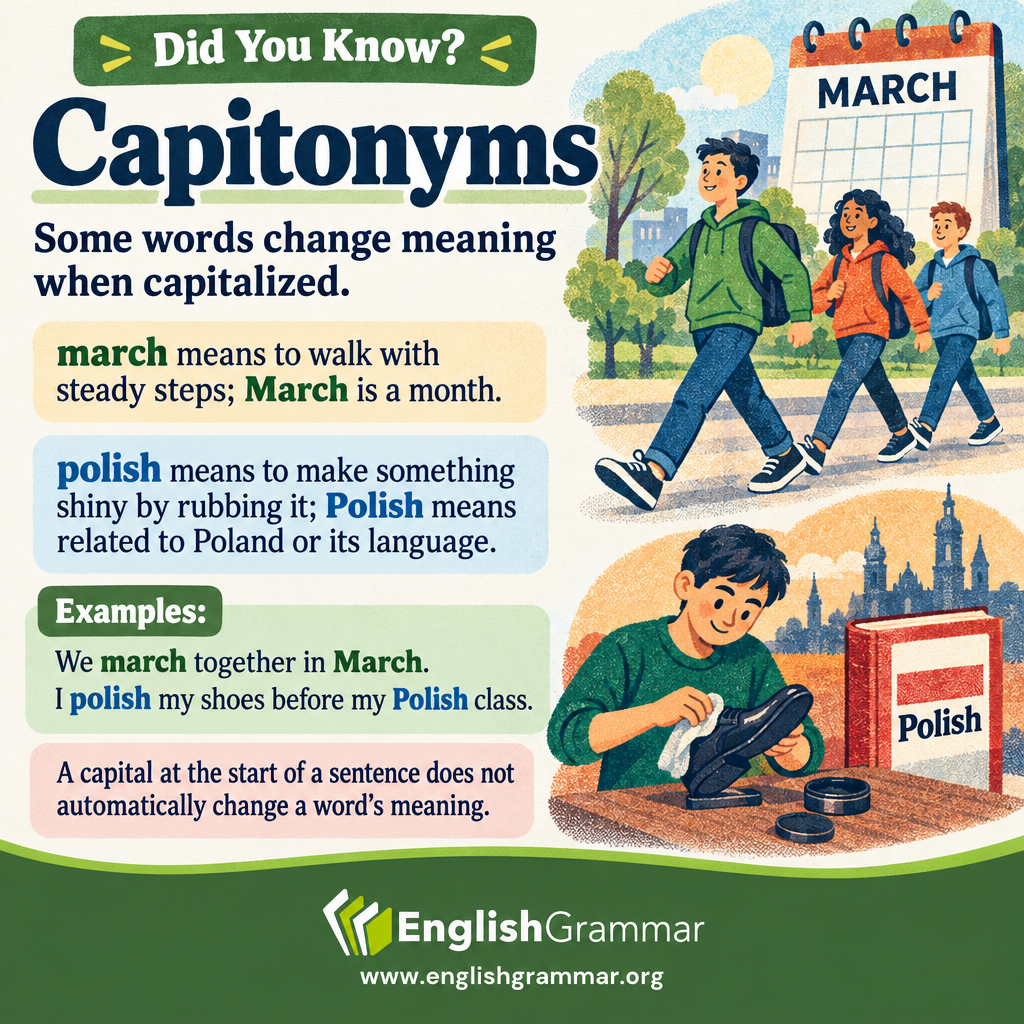
Some words have different meanings depending on whether they begin with a capital letter. These words are called capitonyms. Learning a few common pairs can help you understand what you read and choose the right form when you write.
Here are two useful pairs:
- march / March: To march means to walk with regular, steady steps, often as part of a group. March is the third month of the year. For example: “The soldiers march past our school.” “Our next holiday is in March.”
- polish / Polish: To polish means to make something smooth or shiny by rubbing it. Polish means related to Poland, its people, or its language. For example: “Please polish the silver spoon.” “My neighbour speaks Polish.” These two forms also have different pronunciations.
Sometimes both forms fit naturally into one sentence: “We march together in March.” The lowercase word describes an action; the capitalized word names a month.
However, capitalization alone is not always enough to identify the meaning. English also requires a capital letter at the beginning of a sentence. In “March slowly across the room,” the first word is an instruction to walk, not the name of a month.
When reading, check what the whole sentence means. When writing, keep the capital for names such as months, countries, and languages, and remember that an ordinary word may still need a capital because of its position.