
• Skip to primary navigation
  • Skip to main content
  • Skip to primary sidebar
Home of English Grammar
  • Home
  • Course
  • Exercises
  • Grammar Rules
  • Matches
  • Posts
  • Tools
    • Grammar Checker
    • Very Replacer
    • Word Counter
  • Vocabulary Lists
    • My Word Lists
  • For Teachers
  • Archives
    • Social Media Posts
    • Writing Guides
  • Sign in
  • Join free

How common, proper, concrete, abstract, countable, collective and possessive nouns differ

November 12, 2026

Common and Proper Nouns vs. Concrete and Abstract Nouns vs. Countable and Uncountable Nouns vs. Collective Nouns vs. Possessive Nouns

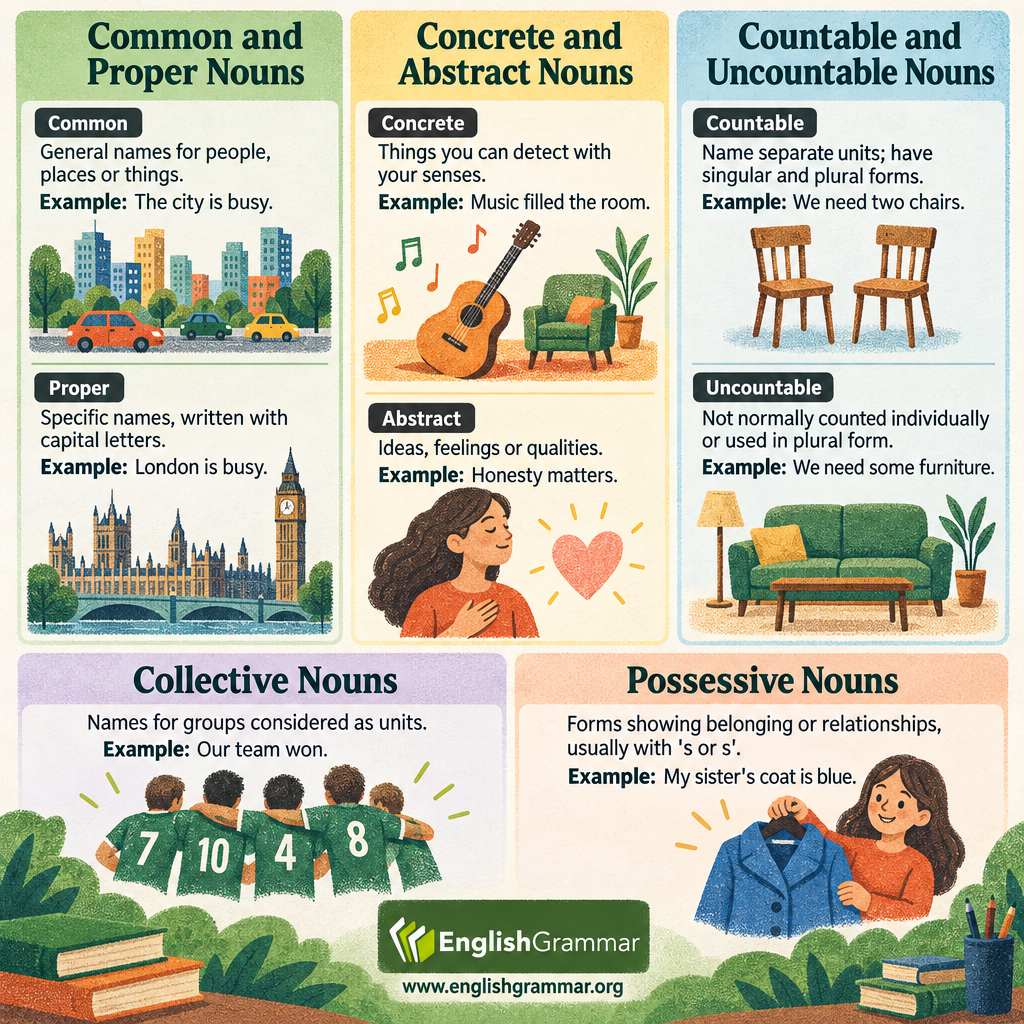
These noun categories answer different questions. They are not competing labels: one noun can belong to several categories at once.

  • Common and proper nouns: A common noun gives a general name, such as teacher or country. A proper noun names someone or something specifically and uses capital letters: Ms Patel or Japan. Compare: “We visited a country” and “We visited Japan.”
  • Concrete and abstract nouns: A concrete noun names something you can detect with your senses, including a sound or smell. “The bell rang.” An abstract noun names an idea, feeling or quality. “Her kindness helped us.” Something does not need to be touchable to be concrete.
  • Countable and uncountable nouns: Countable nouns have singular and plural forms: “I bought three apples.” Uncountable nouns are not normally counted individually: “We need some rice.” Use a unit to count an amount: two bags of rice. Usage can change with meaning: chicken can mean an animal or meat.
  • Collective nouns: These name groups as units. “A flock flew overhead.” Although flock refers to multiple birds, its form here is singular.
  • Possessive nouns: These forms show belonging or relationships. “The doctor’s office is upstairs.” Usually, add ‘s to a singular noun and an apostrophe after a regular plural ending in s: the doctors’ offices.

For example, book is common, concrete and countable. In the book’s cover, it also has a possessive form.

Improve your English grammar, vocabulary and writing

We take you step by step from beginner to advanced, even if you struggled with English at school or have always had trouble remembering the rules.

  • 11 modules, 124 lessons and 819 questions
  • Just log in and learn anytime and anywhere
  • Your progress is saved in your account
  • Download the 2027 Grammar Guide (PDF)

Related lesson in the course Possessive ’s: who owns what Module 02: Nouns and reference · Lesson 8

Join free

Already have an account? Sign in

See what’s in the course

Primary sidebar

2.4M760.9K165.9K

Free 2027 Grammar Guide

  • Download Grammar Guide (PDF)
  • Online grammar course, A1 to C2
  • Weekly exercises and vocabulary
  • Join over 3 million English learners

We respect your privacy. Unsubscribe anytime.

Already have an account? Sign in

Grammar Checker - Try Now

Rankings

Home of English Grammar

Free exercises, a step-by-step grammar course, rules and vocabulary lists, with new exercises every week. Join the leading English grammar site with over 3 million followers.

Join free

Learn

  • Exercises
  • Grammar course
  • Level test
  • Matches
  • Grammar rules
  • Vocabulary lists
  • Writing guides
  • Online tools

More

  • Top social media posts
  • Various posts
  • For teachers
  • Contact

Account

  • Join free
  • My word lists
  • Free grammar guide (PDF)

Copyright © 2026 EnglishGrammar.org

  • Disclaimer
  • Privacy policy
  • Terms
  • Sitemap