
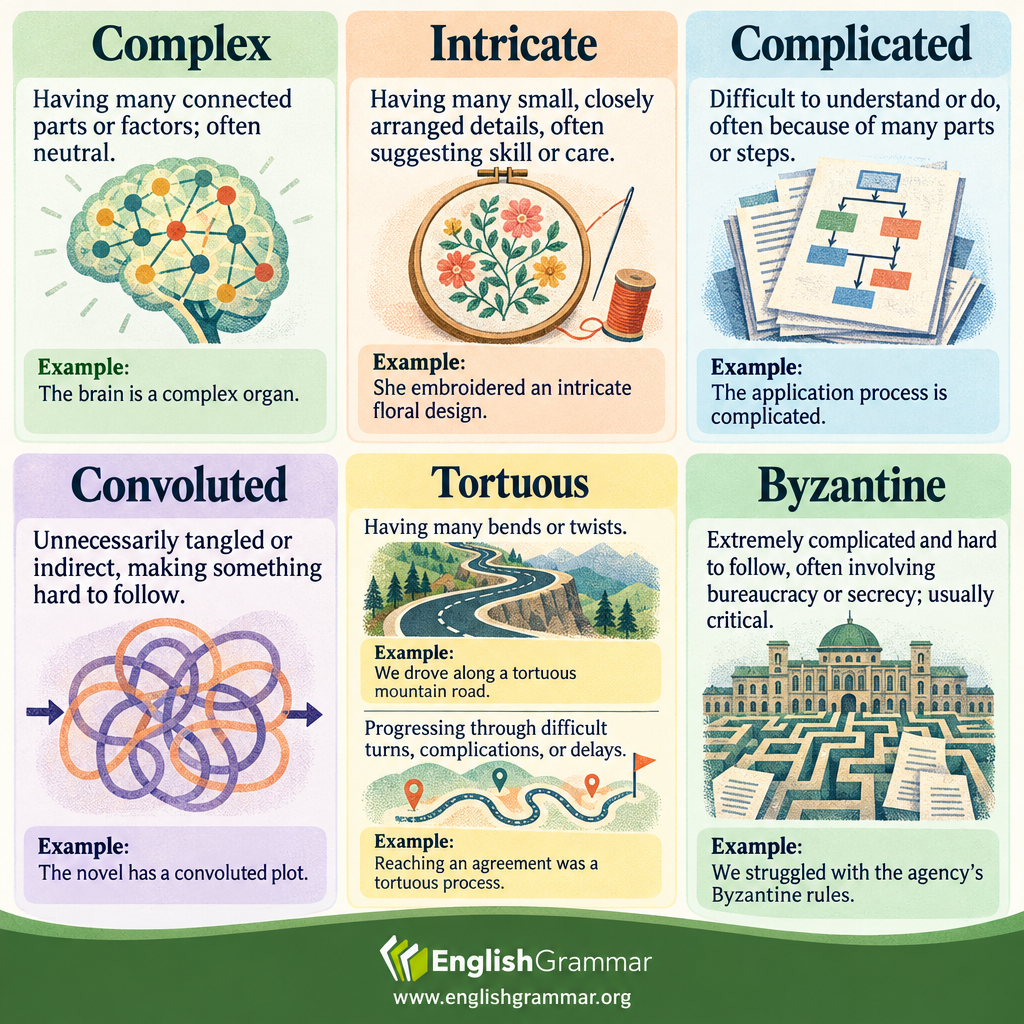
These six adjectives overlap, but they draw attention to different features. Choose according to what makes something detailed, difficult, or confusing.
- Complex emphasizes many connected parts or factors. It is often neutral: something can be difficult to understand without being badly designed. The causes of the housing shortage are complex.
- Intricate emphasizes many small, closely arranged details. It often suggests care or skill, especially in patterns and designs. The bracelet has an intricate silver pattern.
- Complicated emphasizes difficulty in understanding or doing something, often because of its parts, steps, or conditions. Changing my booking was more complicated than I expected.
- Convoluted usually criticizes something for being unnecessarily tangled or indirect. It commonly describes explanations, arguments, and plots. Her convoluted explanation left everyone confused.
- Tortuous describes a route with many bends or, figuratively, a process with difficult turns and delays. A tortuous path climbed the hillside. The negotiations followed a tortuous course.
- Byzantine describes extremely complicated systems, rules, or dealings that are hard to follow, often involving bureaucracy or secrecy. It usually expresses criticism. The company had a Byzantine network of approval procedures.
The same thing can fit more than one word. Calling a tax system complex highlights its interacting parts; calling it complicated highlights the difficulty users face. Calling it Byzantine adds stronger criticism of its tangled rules. These are differences in emphasis, not strict boundaries.