
• Skip to primary navigation
  • Skip to main content
  • Skip to primary sidebar
Home of English Grammar
  • Home
  • Course
  • Exercises
  • Grammar Rules
  • Matches
  • Posts
  • Tools
    • Grammar Checker
    • Very Replacer
    • Word Counter
  • Vocabulary Lists
  • Archives
    • Social Media Posts
    • Writing Guides
  • Join free

Comprise, consist of, include, compose, constitute, and make up: How to choose

October 22, 2026

Comprise vs. Consist of vs. Include vs. Compose vs. Constitute vs. Make up

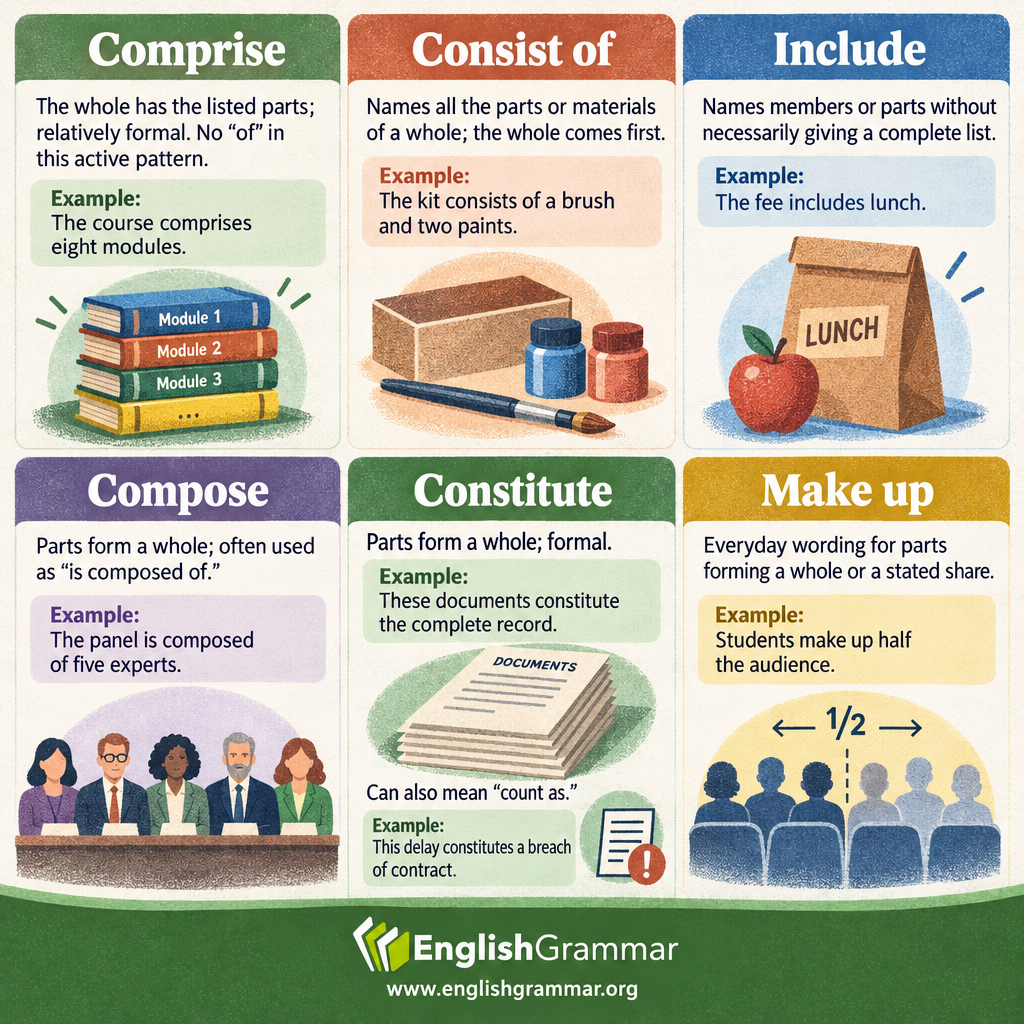
These expressions often connect a whole with its parts. The main questions are which comes first and whether you are naming everything.

  • Comprise: The whole comes first, followed by its parts: The apartment comprises three rooms. This is a relatively formal choice. Do not add of in this active pattern.
  • Consist of: The whole also comes first. Use it to say what something is made of or to give its complete set of parts: The breakfast consists of eggs, toast, and coffee.
  • Include: Use this when naming things that belong to a larger group, without necessarily listing everything: The price includes breakfast. Other things may be covered too, although the word does not guarantee that there are more.
  • Compose: The parts come first in the active form: Six musicians compose the ensemble. The passive form is common: The ensemble is composed of six musicians.
  • Constitute: This formal word can mean that parts form a whole: These twelve districts constitute the region. It can also mean “count as”: Sharing that password could constitute a security risk.
  • Make up: This everyday expression puts the parts first: Volunteers make up most of the staff. It works for both a whole and a stated share.

You will also encounter is comprised of. It is widely used, but some editors object to it. For less disputed wording, choose comprises, consists of, or is composed of, adjusting the sentence structure as needed.

Improve your English grammar, vocabulary and writing

We take you step by step from beginner to advanced, even if you struggled with English at school or have always had trouble remembering the rules.

  • 10 modules, 105 lessons and 688 questions
  • Just log in and learn anytime and anywhere
  • Your progress is saved in your account
  • Download the 2027 Grammar Guide (PDF)
Join free

Already have an account? Sign in

See what’s in the course

Primary Sidebar

2.4M761.4K165.8K

Free 2027 Grammar Guide

  • Download Grammar Guide (PDF)
  • Online grammar course, A1 to C2
  • Weekly exercises and vocabulary
  • Join over 3 million English learners

We respect your privacy. Unsubscribe anytime.

Already have an account? Sign in

Grammar Checker - Try Now

Latest Posts

  • 100 Best Synonyms for “Spirit” October 22, 2026
  • 100 Best Synonyms for “Distinct” October 22, 2026
  • Comprise, consist of, include, compose, constitute, and make up: How to choose October 22, 2026
  • Describing People Vocabulary Exercise October 22, 2026
  • 100 Best Synonyms for “Properties” October 22, 2026
  • 100 Best Synonyms for “Changeable” October 22, 2026
  • 100 Best Synonyms for “Specialized” October 22, 2026
  • 100 Best Synonyms for “Disparities” October 22, 2026
  • Relevant vs. relative: how to choose the right word October 22, 2026
  • 100 Words Every Chocolate Maker Should Know October 22, 2026
Home of English Grammar

Free English grammar exercises, rules and vocabulary lists, with new exercises every week. Join the leading English grammar site with over 3 million followers.

Join free

Learn

  • Exercises
  • Matches
  • Grammar rules
  • Vocabulary lists
  • Writing guides
  • Online tools

More

  • Top social media posts
  • Various posts
  • Contact

Account

  • Join free
  • Grammar Course
  • Free grammar guide (PDF)

Copyright © 2026 EnglishGrammar.org

  • Disclaimer
  • Privacy policy
  • Terms
  • Sitemap