
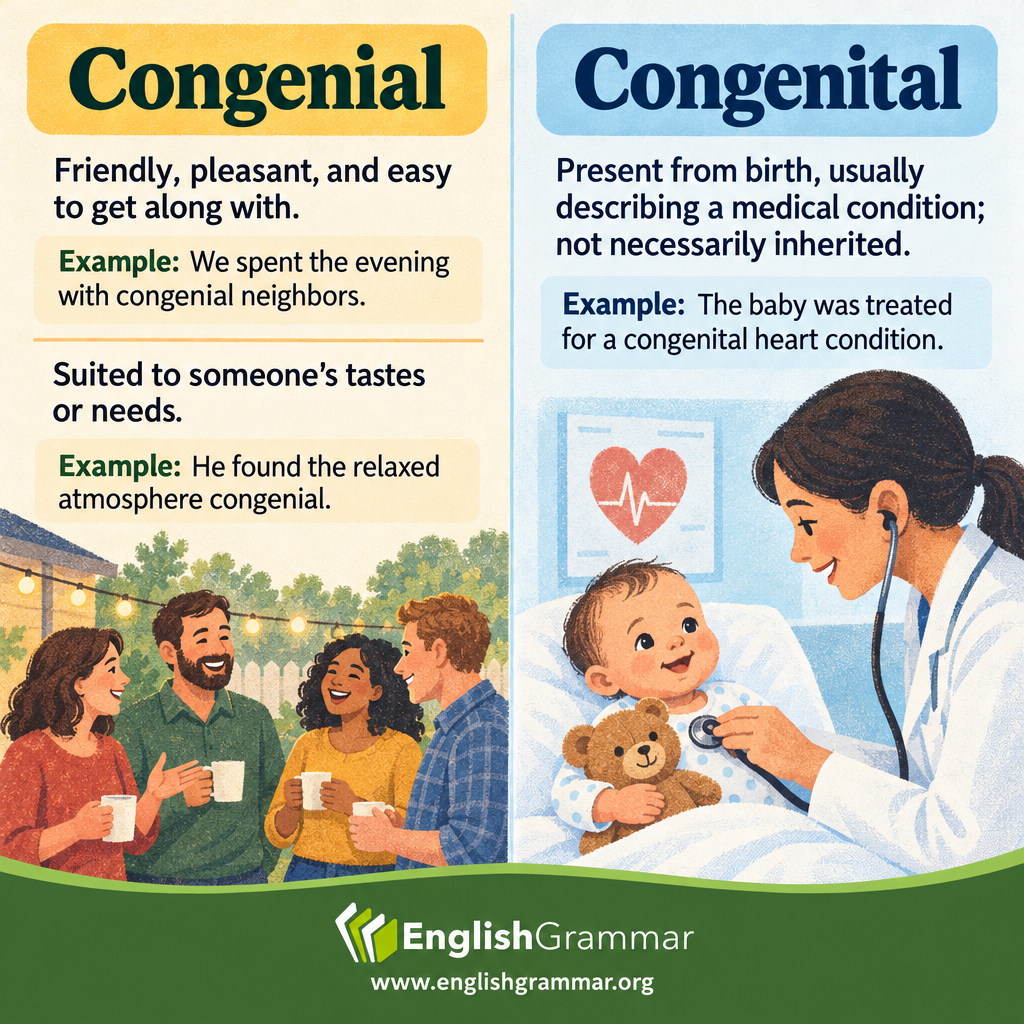
Congenial and congenital look very similar, but they describe different things. Both are adjectives: words that describe people, places, conditions, or other nouns. Choosing between them depends on your meaning, not on the sentence structure.
Congenial can describe someone who is friendly, pleasant, and easy to get along with. For example, Our host was congenial and made everyone feel welcome. It is a positive description of someone’s company or manner.
It can also describe surroundings, activities, or conditions that suit someone’s tastes or needs. For example, She found the quiet library congenial to her work. Here, the library is not being friendly; its atmosphere suits her. This use is somewhat formal.
Congenital usually appears in medical contexts. It describes a condition that is present from birth, even if it is discovered later. For example, The scan revealed a congenital heart defect.
Importantly, congenital does not automatically mean inherited. Some congenital conditions have genetic causes, while others have different causes. The word itself tells you when the condition was present, not exactly what caused it.
- Talking about pleasant company? A congenial colleague is someone you enjoy being around.
- Talking about suitable surroundings? A congenial workplace fits your preferences or needs.
- Talking about a condition present at birth? Congenital is the usual medical choice.